10 hours
1-1 UCAT tutoring
Reviewed by Dr Shaneil Tanna
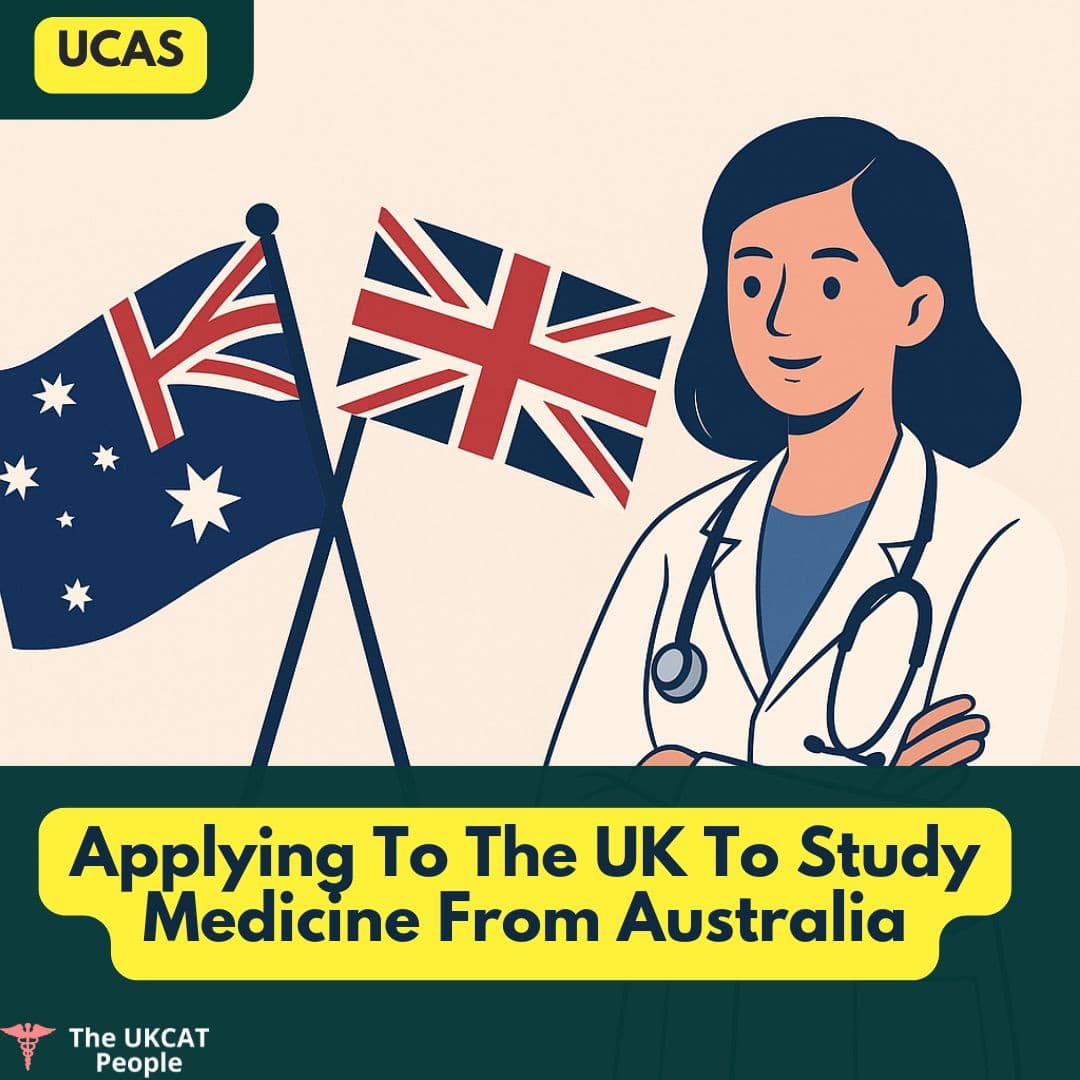
Each year, a growing number of students from Australia and New Zealand consider the UK as a destination for medical school.
With highly competitive domestic entry routes, earlier UCAT ANZ testing, and limited places available across Australian universities, the UK offers a direct and globally recognised alternative.
This comprehensive guide covers every stage of the process for Australian and New Zealand students applying to UK medical schools. We cover key differences between UCAT ANZ and UCAT UK, how ATAR and IB scores are assessed, interview formats, timelines, tuition costs and how to prepare effectively from overseas.
✅ Our Ultimate Package is designed specifically for international students. It includes one-to-one UCAT tutoring, personal statement editing, interview coaching and expert guidance from UK doctors. The Gold Ultimate Package is the most popular choice for Australian students.
Medicine is one of the most competitive university courses in Australia.
Undergraduate entry is restricted to a small number of institutions, and these offer only a limited number of places each year.
As a result, students are often required to achieve UCAT ANZ scores in the top decile, often above the 95th or even 98th percentile, alongside exceptional academic records. Since 2025 the UCAT has had four subtests (Verbal Reasoning, Decision Making, Quantitative Reasoning and Situational Judgement); Abstract Reasoning was removed and the three cognitive subtests are now scored out of a combined 2700.
Even with a strong ATAR and solid interview performance, many well-qualified applicants are turned away due to the sheer volume of competition.
This intense pressure has led many students and families to explore international alternatives, with the UK offering a significantly broader range of medical schools, each with their own entry thresholds and assessment methods.
UK medical schools assess candidates using a combination of the UCAT UK, academic performance (such as ATAR or IB), and interviews. Importantly, not all UK universities place the same weight on UCAT scores.
This provides greater flexibility for students who may not have reached the extremely high cut-offs required by Australian medical schools.
In addition, the UK system places emphasis on a more holistic evaluation, considering qualities such as communication skills, motivation for medicine, ethical reasoning and reflective ability.
For students who may not perform as well on test day, this broader approach can open new doors.
👉🏼 Read more: Compared: UK Medical School Fees For International Students
Tuition for overseas students sits well above home-fee levels, so it is worth budgeting early. Our guide to UK medical school fees for international students breaks down 2026 costs school by school, and our international students' guide to studying medicine in the UK walks through visas, English requirements and the wider process.
The University Clinical Aptitude Test (UCAT ANZ) is used by a consortium of universities in Australia and New Zealand for their medical, dental and clinical science degree programmes.
The UCAT ANZ is identical in format and content to the UCAT.
Candidates intending to apply to Australian/New Zealand consortium universities and UK/Partner Consortium Universities (for 2027 entry) should sit the UCAT ANZ for the following reasons:
Candidates should check the entry requirements for each course with the relevant university before booking a test. Alternative entry requirements apply to certain applicants to UCAT ANZ Universities.
Candidates are not permitted to sit both the UCAT and UCAT ANZ in the same year under any circumstances. This is considered candidate misconduct, and all results may be withdrawn.
👉🏼 Read more: IELTS Exam English Language Requirements For Medicine In The UK
UK universities have varying requirements for students from Australia and New Zealand:
For a full breakdown of UK academic thresholds, see our UK medical school entry requirements guide and our IB requirements for medicine guide, which list requirements for every medical school.
Be mentored 1-1 by a doctor
Every question answered from abroad, from fee status to interview day, in your time zone.
You can register for:
Remember you cannot take both exams in the same year.
There are many UCAT test centres in Australia and New Zealand, making it convenient for students to sit either the UCAT ANZ or UCAT UK exams.
Common UCAT testing locations include:
When booking your test, ensure that you register early to secure your preferred UCAT testing centre in your city.
All UCAT ANZ test centres are run by Pearson VUE and operate under strict timing and ID rules, so it is important to be well prepared ahead of your test day.
For structured revision, work through our UCAT Guides hub for subtest tips, scoring and study plans, and build speed and accuracy with the UCAT online question bank and trainer. If you are weighing up which sitting suits you, our UCAT ANZ guide explains the differences in detail.
UK medical schools typically conduct interviews between November and March every year.
The majority of universities use the Multiple Mini Interview (MMI) format, which involves rotating through a series of short stations, each designed to assess different skills relevant to medicine. These may include:
Some universities may still use panel interviews, particularly for graduate entry or small cohorts, although this is less common than MMIs.
For applicants based in Australia or New Zealand, interviews are usually conducted virtually. UK medical schools understand the geographical distance and almost all now offer a remote interview option via platforms like Zoom or Microsoft Teams.
This means students can complete the entire application process from Australia or New Zealand, including the UCAT, personal statement, and interviews. Time zone differences are taken into account when scheduling.
Interview formats remain the same, even when conducted online. Students may still be asked to complete multiple MMI-style stations in sequence, or face a traditional interview panel.
While there is some overlap in skills assessed, UK interviews tend to place greater emphasis on:
Australian interviews often focus more on general aptitude and may be slightly shorter. For this reason, students applying to the UK should prepare specifically for NHS-style MMI scenarios and ethical frameworks.
Boost your UCAT with 1-1 tutoring
Rated 5.0 from 640+ reviews. 1-1 sessions with top-scoring tutors, weekly or more often, built around your weakest subtests.
10 hours
1-1 UCAT tutoring
20 hours
1-1 UCAT tutoring
30 hours
1-1 UCAT tutoring
Here is a rough guide to a timeline you can use to help apply to the UK from Australia.
We guide students through each stage of the UK application process, including managing time zones, documentation, and pre-departure steps.
✅ Book a free strategy consultation or explore the Ultimate Package to get started.
Our Ultimate Package is ideal for students applying from Australia or New Zealand.
What it includes:
🎓 Used by hundreds of successful applicants across Australia and New Zealand
Best of luck with your application! If you are looking for more help, then check out the other parts of our UCAS guide or our other guides to components of the application such as the UCAT tutoring and personal statement.
You can also contact our expert team of tutors for assistance with studying for the UCAT, writing your medicine personal statement, or medicine interview coaching.
Choose your Ultimate Package, mentored from abroad
Rated 5.0 from 640+ reviews. 1-1 mentoring from doctors across UCAT or UCAT ANZ, personal statement, fee-status shortlisting and online interviews, scheduled in your time zone.
Bronze
20 hours
Silver
35 hours
Gold
50 hours
Platinum
75 hours
Yes. Australian and New Zealand students can apply directly to UK medical schools through UCAS, usually straight from Year 12. You sit the UCAT, meet academic requirements such as a competitive ATAR or IB score, submit a personal statement and attend an interview. The UK offers far more medical school places than Australia, which makes it a popular alternative.
UK medical schools accept the ATAR directly rather than converting it. Most competitive courses look for an ATAR around 96 to 98 or higher, with strong results in Chemistry and Biology, though thresholds vary by school. Some universities place more weight on the UCAT than on academic scores, which can help applicants who narrowly miss the very top ATARs.
No. If you are applying only to UK medical schools you can use a single UCAT result. You are not permitted to sit both the UCAT and UCAT ANZ in the same year, as this is treated as candidate misconduct. If you are applying to both Australian and UK schools, plan carefully and check each university's accepted test before booking.
Pearson VUE runs test centres in major cities including Sydney, Melbourne, Brisbane, Perth, Adelaide, Auckland and Wellington. The UK UCAT cycle runs from July to late September, while the UCAT ANZ window falls between July and early August. Book early to secure your preferred centre and date.
Since 2025 the UCAT has four subtests: Verbal Reasoning, Decision Making, Quantitative Reasoning and Situational Judgement. Abstract Reasoning was removed. The three cognitive subtests are scored out of a combined 2700, and the Situational Judgement Test is reported separately in bands. There is no BMAT, which was discontinued after 2024.
No. The GAMSAT is not required for undergraduate medicine in the UK. School leavers from Australia and New Zealand apply straight from Year 12 using the UCAT, their ATAR or IB results, a personal statement and an interview. The GAMSAT is only relevant for some graduate-entry medicine courses, which are a separate route.
The UCAS deadline for medicine is 15 October at 18:00 UK time for entry the following year. This applies equally to Australian and New Zealand applicants. You must sit your UCAT before the testing window closes in late September, so plan your registration, revision and test date well ahead of the October deadline.
International tuition for UK medicine is significantly higher than home-student fees and varies widely by university, with full degree costs often running into several hundred thousand pounds. You should also budget for living costs and a student visa. Our guide to UK medical school fees for international students breaks down 2026 figures school by school.
Yes. Almost all UK medical schools offer remote interviews for applicants based in Australia and New Zealand, so you can complete the entire process without travelling. Interviews usually run from November to March, most use the Multiple Mini Interview (MMI) format, and universities account for time-zone differences when scheduling.
UK medical schools almost always require Chemistry and Biology at the highest level (ATAR, IB Higher Level or equivalent). Many schools want strong results in both, and some specify minimum grades. Check each university's requirements before finalising your subjects, as a small number ask for one science plus another approved subject.
Yes. UK primary medical qualifications are recognised by the Australian Medical Council, and graduates can return to Australia or New Zealand for postgraduate training and registration, subject to current regulatory requirements. Always confirm the latest registration pathway with the AMC or the Medical Council of New Zealand, as recognition processes can change.
UK medicine offers many more places across a far wider range of schools, with varied UCAT thresholds, so strong students who miss out locally can still secure a place. The UK also allows direct entry from Year 12 without a prior degree, and uses a holistic assessment of UCAT, academics, personal statement and interview.
Ideally begin in Year 11 or early Year 12. Start UCAT preparation several months before your test, gain work experience (including virtual options such as Observe GP), draft your personal statement over the winter, and shortlist universities by early September. This gives you time to sit the UCAT and submit through UCAS before the 15 October deadline.
There is no single best school, as universities weight the UCAT, academics and interviews differently. Applicants from Australia and New Zealand should shortlist schools whose UCAT thresholds and academic requirements match their profile, and check which offer remote interviews. Our UK medical schools ranking hub helps you compare courses and entry data to build a balanced list.

Want expert help with your application?
From 1-1 tutoring and personal statement editing to interview coaching and our all-in-one Ultimate Package, we support every stage. Tell us what you are aiming for and we will recommend the right option.
Ultimate Package students from our 2025/26 cycle, with their UCAT scores and offers, who trained with us for the UCAT, personal statements and interviews.
“Harry got my UCAT up to 2,590, working through the sections I kept dropping marks on week by week. Gemma then ran my interview practice so the MMI stations didn't catch me out, and Dr Akash mentored me the whole way through. I'm off to King's for Medicine.”
“The interview prep was the part that actually moved the needle. Proper mock MMIs, not just lists of questions, and feedback that was honest about what I was getting wrong. I ended up with four offers and firmed UCL.”
“The Ultimate Package kept me organised from UCAT through to interviews. They knew what dental schools actually ask and tightened up my personal statement. Four offers in the end, and I'm going to Birmingham.”
“Vet applications come down to the written SAQs as much as the interview. Dr Rebecca went through my SAQs line by line, sharpened my answers and prepped me for the panels. I came away with four offers and chose the RVC.”
Book your FREE consultation today
Click to book your free consultation