10 hours
1-1 UCAT tutoring
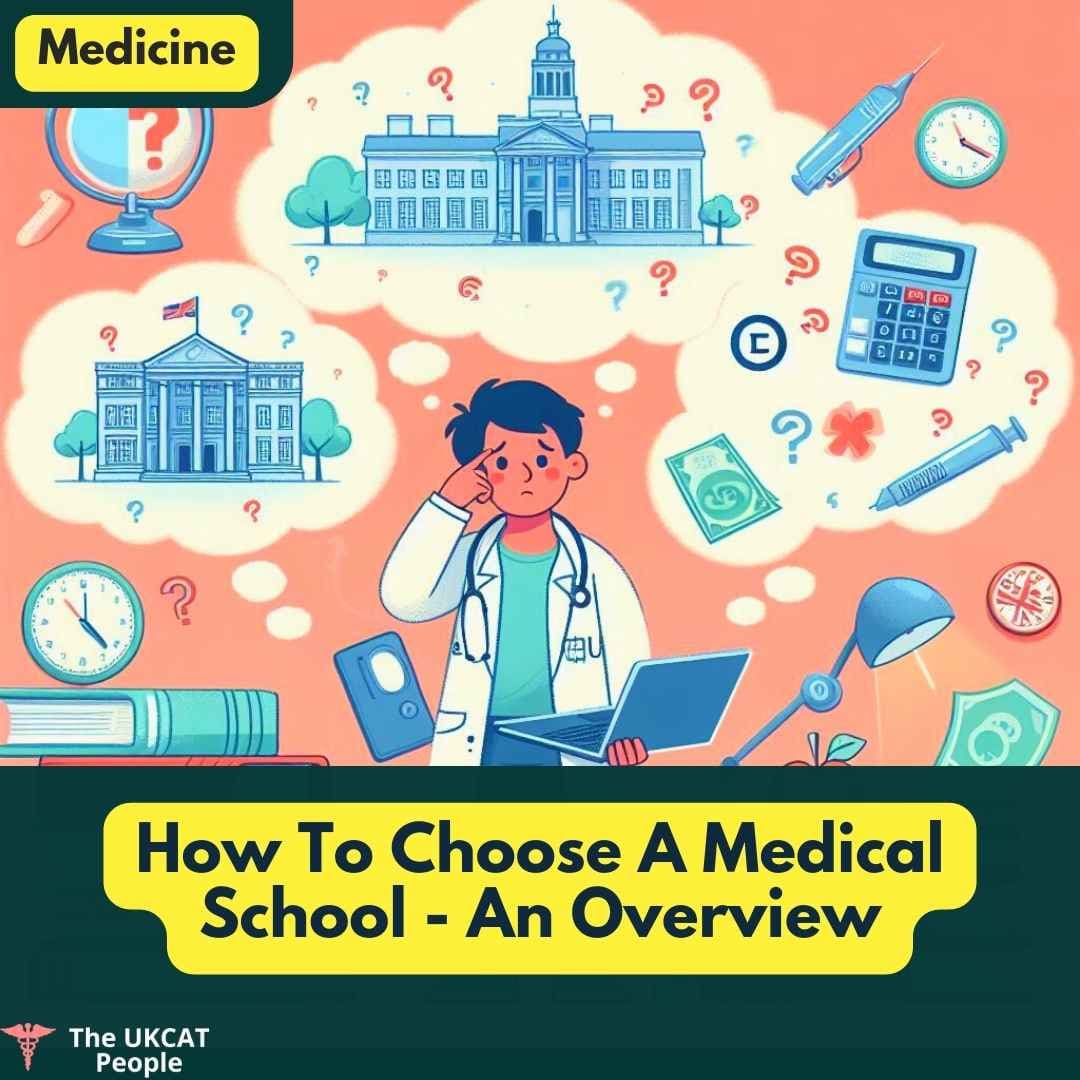
With dozens of medical schools in the UK, many of which are world-class, it can be very difficult to decide which ones to apply to. What medical suits my academic style best? What city do I most want to live in? Which medical schools do I have the best chances of getting into?
In this guide to selecting a medical school, we walk you through some of the key factors that you ought to weigh up in your decision. UK medical school admissions statistics can be bleak, with only around 30% of candidates being made an offer.
However, by following this guide you can not only maximise your chances of being in that group but also make sure that you’re going to the medical school that’s best for you. It’s a very personal decision, and different people will suit different schools, so it’s important to ensure that the decision is yours and yours alone.
How many medical school places are there in the UK? For 2026 entry there are roughly 8,500 medicine places across the UK (about 8,126 funded places in England, plus Scotland, Wales and Northern Ireland). That may sound like a lot, but with 25,770 applicants for 2026 entry (a 10.4% rise on the previous year, UCAS) competition is intense and most applicants are not made an offer.
How many medical schools are there in the UK?
There are now around 50 UK universities offering a medicine degree leading to GMC registration, including a wave of newer medical schools alongside the long-established ones. That gives you plenty to compare and choose from when selecting the schools that best suit you.
How many UK medical schools can I apply to?
You can apply to a maximum of 4 medicine courses in the UK and must do so through UCAS (the Universities and Colleges Admissions Service). Your fifth UCAS choice can be a non-medicine back-up course, which does not count against your four medical schools.
How many UK medical schools should I apply to?
As many as you can! Generally, this means applying to four medical schools in the UK and it may also be appropriate to apply to some abroad, for instance in Ireland, if you have lower grades. This will maximise your chances in the competitive world of medical school admissions.
How long is UK medical school?
UK medical school generally takes 5 years. However, some universities will also give you the opportunity to undertake an intercalated degree, which will extend your time in university by one year in exchange for the receipt of a second degree (often a Bachelor of Medical Sciences).
It’s true that most medical school applicants will try to secure a spot by applying through UCAS in their final year of high school.
However, with the increasingly competitive nature of this process, more and more candidates are considering alternative pathways to a medical career.
Some of these that you may wish to consider include:
Ireland is a popular option for UK and international applicants, partly because Irish schools use the HPAT rather than the UCAT. See our guide to studying medicine in Ireland and the Irish medical schools hub for entry routes and deadlines.
👉🏼 Read more: Compared: UK Medical School Fees For International Students (2027 entry update)
For how each type of course is structured and how long it takes, see our guide to MBBS in the UK.
Be mentored 1-1 by a doctor
Every question answered, from choosing schools to interview day.
One of the key factors to consider when applying to medical school is what teaching style suits you best. Generally, medical schools follow one of these two methodologies:
These labels hide a lot of variety: most modern courses sit somewhere on a spectrum and use a mix of problem-based learning (PBL), case-based learning (CBL), lectures and early patient contact. For a full breakdown of PBL, CBL, spiral, integrated and traditional courses (and how to work out which suits you), read our guide to medical school teaching styles.
Boost your UCAT with 1-1 tutoring
Rated 5.0 from 660+ reviews. 1-1 sessions with top-scoring tutors, weekly or more often, built around your weakest subtests.
10 hours
1-1 UCAT tutoring
20 hours
1-1 UCAT tutoring
30 hours
1-1 UCAT tutoring
Your UCAT score matters here. The UCAT is now scored out of 2700 across four subtests (Verbal Reasoning, Decision Making, Quantitative Reasoning and Situational Judgement; Abstract Reasoning was removed from 2025), and there is no BMAT. Some schools weight the UCAT heavily, others barely look at it, so check each school's policy and use the UCAT guides hub to choose UCAT-heavy or UCAT-light schools. You can also practise on the UCAT online trainer.
It’s worth checking out universities’ own websites for information or looking at sites such as the Medical Schools Council with information on many of them.
Additionally, consider attending medicine university open days for a taste of what life at each one is like.
You should also check out the other pages in this guide:
Choose your Ultimate Package
Rated 5.0 from 660+ reviews. 1-1 mentoring from doctors across UCAT, personal statement and interviews.
Bronze
20 hours
Silver
35 hours
Gold
50 hours
Platinum
75 hours
There are now around 50 UK universities offering a medicine degree that leads to registration with the General Medical Council (GMC). This includes roughly 44 long-established medical schools plus a wave of newer schools opened in recent years. That gives applicants plenty of options to compare on teaching style, location, entry requirements and admissions policy.
For 2026 entry there are around 8,500 medicine places across the UK. England has roughly 8,126 funded places (capped by the Office for Students), with further places in Scotland, Wales and Northern Ireland. The figure has stayed broadly flat in recent years, so competition remains high as applicant numbers rise.
For 2026 entry, 25,770 students applied to study medicine by the 15 October 2025 UCAS deadline, a 10.4% rise on the previous cycle. With only around 8,500 places UK-wide, that works out at roughly three applicants per place, and only about 30% of candidates are made an offer.
You can apply to a maximum of four medicine courses in a single UCAS application. Your fifth choice can be a non-medicine back-up course, which does not count as a fifth medical school. Because you only get four medicine slots, it is vital to choose schools where your grades and UCAT score make you genuinely competitive.
Start with where you are competitive: match your predicted grades and UCAT score to each school's admissions policy, since some weight the UCAT heavily and others barely use it. Then weigh teaching style (traditional vs integrated, PBL or CBL), location and cost. Applying strategically to four well-matched schools beats applying to four big-name schools where you may be screened out.
Spread your four choices across schools with different UCAT policies. If your score is high, target UCAT-heavy schools where it gives you an edge. If it is lower, choose schools that weight the UCAT lightly or focus on academics, contextual data or the interview. Check each school's exact policy every year, as cut-offs and weightings change. Our UCAT guides hub can help you match scores to schools.
Standard UK undergraduate medicine usually takes five years. Some courses run for six years, either because they include a compulsory intercalated degree or because they are extended or foundation (gateway) programmes. Graduate-entry medicine is typically four years. After graduating you complete a two-year Foundation Programme before specialty training.
The BMAT was discontinued after the 2023 sitting, so no UK medical school uses it for 2026 entry. The main admissions test is now the UCAT, scored out of 2700 across four subtests: Verbal Reasoning, Decision Making, Quantitative Reasoning and Situational Judgement. Abstract Reasoning was removed from 2025. A small number of routes use the UCAT differently, so always check each school's requirements.
Most courses sit on a spectrum between traditional and integrated. Traditional courses front-load lectures and lab work before clinical placements; integrated courses put you on the wards early and blend science with practice, often using problem-based learning (PBL) or case-based learning (CBL). Few schools are purely one or the other, so read the curriculum detail rather than relying on the label alone.
London has the most, with several medical schools including those at UCL, Imperial, King's College London, Queen Mary (Barts) and St George's. Other cities such as Manchester, Glasgow and Edinburgh also host major medical schools. If you want city life and a wide choice, London is the obvious hub, but factor in higher living costs.
Compare schools on entry requirements, UCAT or contextual policy, teaching style, course length, location and cost. Use university websites and the Medical Schools Council for official data, attend open days where possible, and use a side-by-side ranking hub. Our UK medical schools ranking hub brings the key facts together so you can shortlist quickly.
It is a personal choice. You will live in your university city for five to six years, so proximity to home, support networks, lifestyle and travel cost all matter. Some students thrive far from home; others prefer to stay close. International applicants often weigh proximity to a major airport. There is no academic advantage either way, so choose what supports your wellbeing and studies.
Tuition fees are broadly the same for most home students across England, Wales and Northern Ireland. The main difference is for Scottish students studying in Scotland, who typically have tuition funded by SAAS. Living costs vary a lot by city (London is the most expensive), and a compulsory intercalated year can add an extra year of fees and maintenance to factor in.
You still have options. Target schools that weight your strongest area most heavily, consider contextual or widening-participation routes, and look at foundation (gateway) medicine courses or graduate entry. Studying abroad, for example in Ireland or Europe, is another route. Resitting or reapplying with a stronger profile is also common; just check each school's policy on resits before you commit.
Yes. Many UK applicants study medicine in Ireland, Europe or further afield, often using different admissions tests (Ireland uses the HPAT, not the UCAT). Check that the degree is recognised by the GMC if you plan to practise in the UK, and research fees, language of teaching and how you would return to the UK Foundation Programme afterwards.

Want expert help with your application?
From 1-1 tutoring and personal statement editing to interview coaching and our all-in-one Ultimate Package, we support every stage. Tell us what you are aiming for and we will recommend the right option.
Ultimate Package students from our 2025/26 cycle, with their UCAT scores and offers, who trained with us for the UCAT, personal statements and interviews.
“Harry got my UCAT up to 2,590, working through the sections I kept dropping marks on week by week. Gemma then ran my interview practice so the MMI stations didn't catch me out, and Dr Akash mentored me the whole way through. I'm off to King's for Medicine.”
“The interview prep was the part that actually moved the needle. Proper mock MMIs, not just lists of questions, and feedback that was honest about what I was getting wrong. I ended up with four offers and firmed UCL.”
“The Ultimate Package kept me organised from UCAT through to interviews. They knew what dental schools actually ask and tightened up my personal statement. Four offers in the end, and I'm going to Birmingham.”
“Vet applications come down to the written SAQs as much as the interview. Dr Rebecca went through my SAQs line by line, sharpened my answers and prepped me for the panels. I came away with four offers and chose the RVC.”
Book your FREE consultation today
Click to book your free consultation