10 hours
1-1 UCAT tutoring
Important update: the BMAT has been discontinued. Its final sitting took place in October 2023, and no BMAT exam has run since. Cambridge Assessment Admissions Testing withdrew the test, so there is nothing to register for or revise. If you are applying to medicine, dentistry or veterinary medicine now, you do not sit the BMAT at all.
Every university that previously required the BMAT, including Oxford, Cambridge, Imperial College London, UCL, Leeds, Lancaster and Brighton & Sussex, now uses the UCAT as their admissions test. In practice this means UK applicants now sit a single admissions test (the UCAT) wherever they apply.
The guidance below is kept for historical reference only, to explain how BMAT scoring used to work for the cohorts who sat it up to October 2023. The BMAT is no longer used by any UK medical, dental or veterinary school, so current applicants should not spend time on the BMAT scale. What matters now is understanding how the UCAT is scored and what counts as a competitive UCAT score.
For current entry, the test that replaced the BMAT is the UCAT. The UCAT changed substantially for 2025 entry onwards: Abstract Reasoning was removed, leaving four subtests scored out of a maximum of 2700, plus a separate Situational Judgement Test reported as a band (Band 1 to Band 4). If you came here for scoring help, see our UCAT scores and scoring guide and our explainer on what counts as a good UCAT score.
There is nothing to register for: BMAT registration closed permanently after the October 2023 sitting. Current applicants register for the UCAT instead, which typically opens in the summer and is sat in the autumn before the UCAS deadline.
When the BMAT was still running, candidates received three separate scores, one for each of its three sections. That is no longer relevant for live applications. Today your admissions-test score comes from the UCAT: four subtests combined into a total out of 2700, reported alongside a separate SJT band.
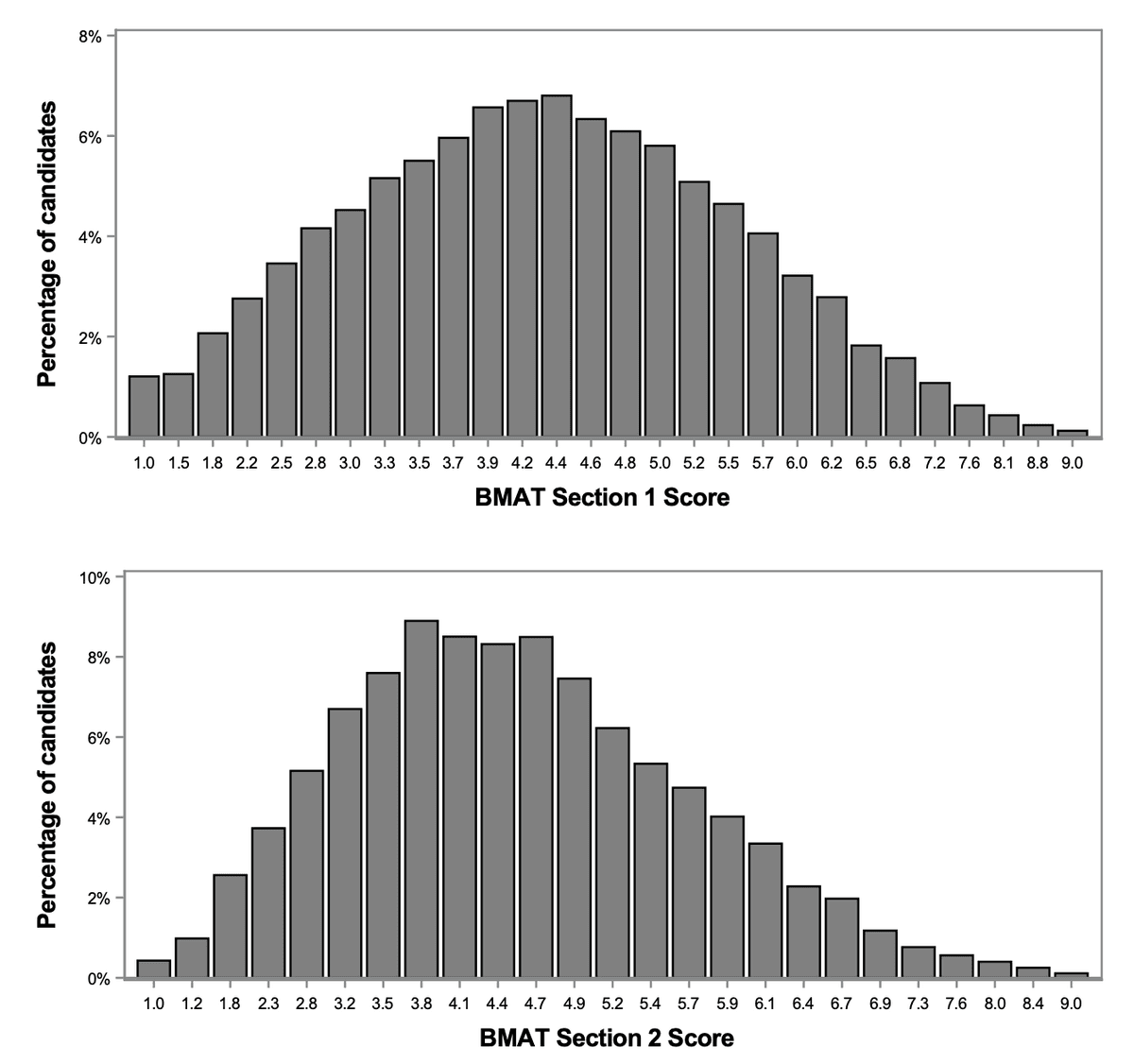
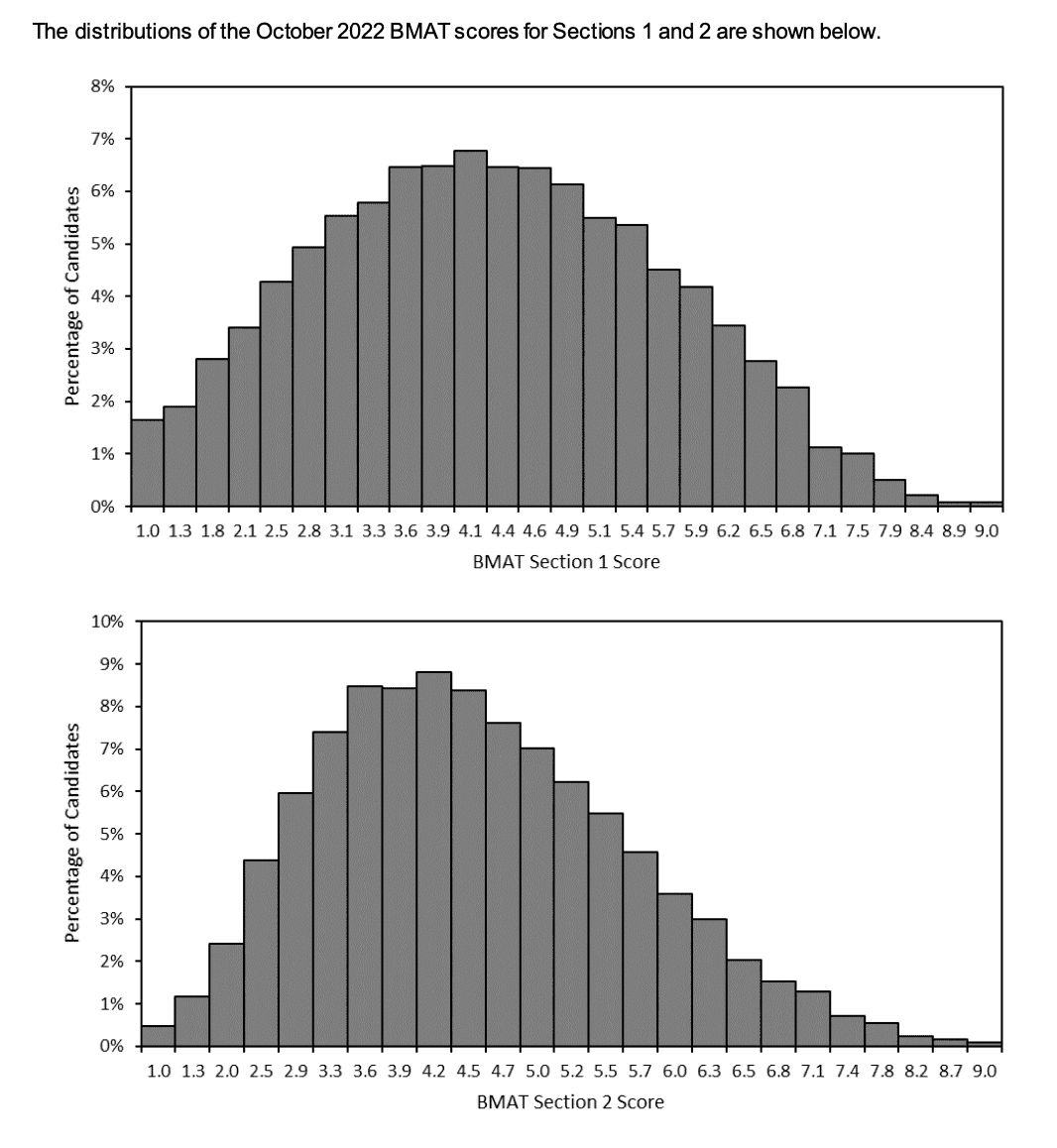
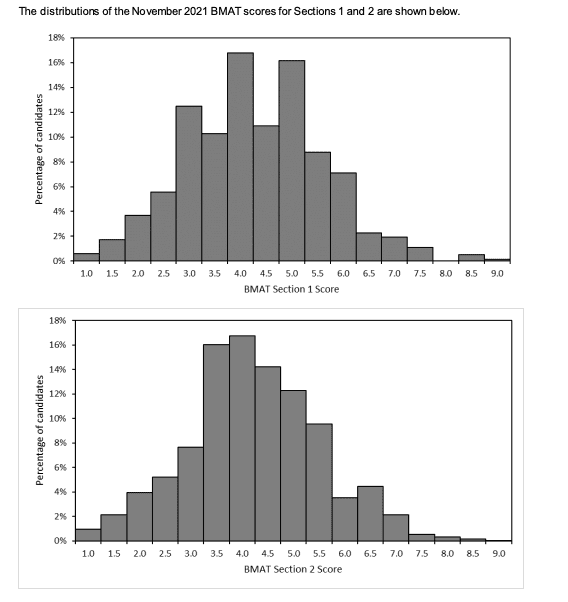
Questions in BMAT sections 1 & 2 are worth 1 mark each where the total raw marks for each section are converted via the BMAT Scale, which runs from 1.0 (lowest) to 9.0 (highest).
The average score of most BMAT candidates is around 5.0, which is roughly equivalent to roughly half of the marks available in the test.
Historical note only: this BMAT scale (1.0 to 9.0) is no longer used by any university. The modern equivalent question, what is a good UCAT score, is answered against the UCAT total out of 2700 and the SJT bands, not the old BMAT scale.
The best candidates are expected to score in the region of 6.0 - 7.0. You can get a maximum of 32 raw marks in section 1 and a maximum of 27 raw marks in section 2.
Each BMAT university will have its cut-off point; for example, Imperial and UCL tend to have a cut-off of around 4.7-4.9 in recent years, whilst Oxford and Cambridge admissions tend to cut-off candidates at 6.0.
These former BMAT cut-offs are now obsolete. Oxford, Cambridge, Imperial and UCL all switched to the UCAT, so each sets its own UCAT threshold and weighting instead. To understand how universities apply UCAT cut-offs and deciles today, read our UCAT scores and scoring guide and the full breakdown of the 2025 UCAT changes.
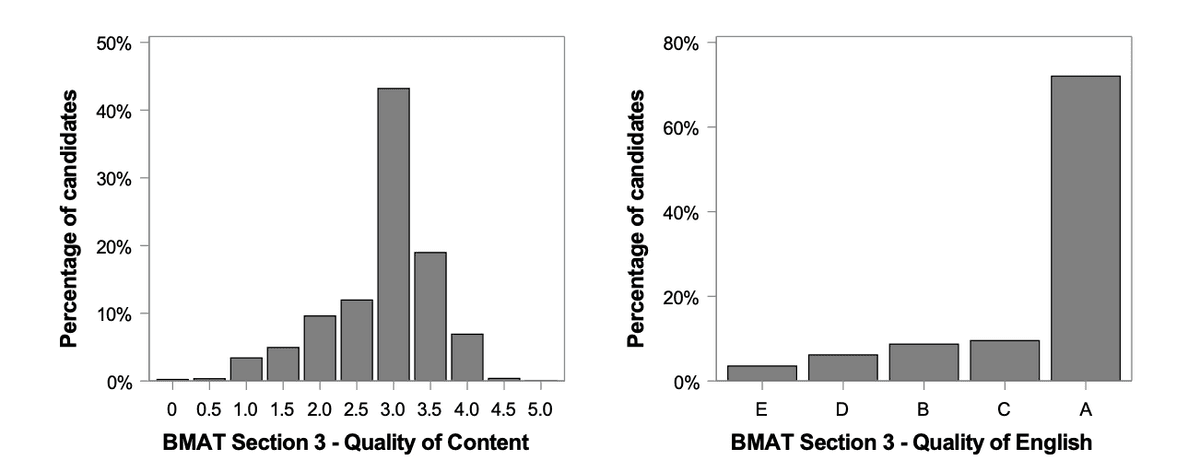
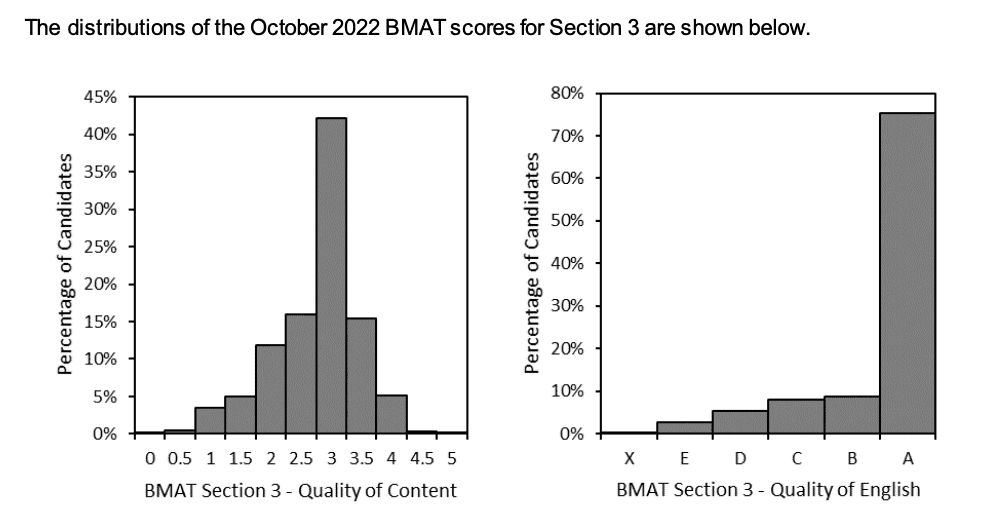
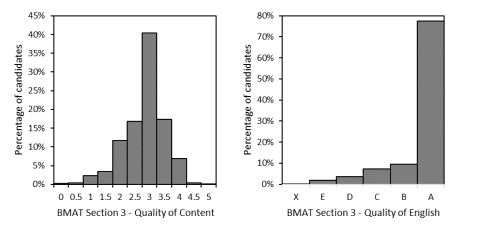
The writing tasks in Section 3 are marked by two examiners. Each examiner gives two scores; one for quality of the content (on a scale of 0-5) and one for the quality of English (Scaled A, C or E). If the two marks for content are the same or no more than one mark apart, the candidate gets the averageof the two marks.
If the two marks for written English are the same or no more than one mark apart, the scores are combined as follows: AA = A, AC = B, CE = D, EE = E.
When are BMAT results released in 2023?
BMAT Results were released on Friday 24th November 2023 at 9am.
In 2022 you will receive your BMAT score on 25th November 2022. Unfortunately, this means that your BMAT 2022 result comes after your UCAS application is due. BMAT results are checked by logging into the Metritests system. Use the login details from the Confidential Results Information sheet, which is provided on the day of the test.
This means that applying to a university that requires the BMAT, comes with its own risk. As such, we do not recommend applying to more than 2 BMAT universities.
BMAT Section 1 Results 2023 & BMAT Section 2 Results 2023
BMAT Section 3 Results 2023
Section 1 - Aptitude and Skills
Section 2 - Scientific Knowledge and Applications
Section 3 - Writing Task
Overall, comparing 2022 and 2023 - Our analysis
Master the UCAT, 1-1
A bespoke plan across VR, DM, QR and SJT.
BMAT Section 1 Results 2022 & BMAT Section 2 Results 2022
BMAT Section 3 Results 2022
BMAT Section 1 Results 2021 & BMAT Section 2 Results 2021
BMAT Section 3 Results 2021
Choose your 1-1 UCAT package
Rated 5.0 from 640+ reviews. 1-1 sessions with top-scoring tutors, weekly or more often, built around your weakest subtests.
10 hours
1-1 UCAT tutoring
20 hours
1-1 UCAT tutoring
30 hours
1-1 UCAT tutoring
BMAT 2020 Scores & BMAT Results
Section 1 BMAT 2020 Scores
Section 2 BMAT 2020 Scores
Section 3 BMAT 2020 Scores
BMAT 2019 Scores & BMAT Results
Section 1 BMAT 2019 Scores
Section 2 BMAT 2019 Scores
Section 3 BMAT 2019 Scores
Most universities will use the BMAT in conjunction with the other key factors of your application. Some universities place a greater emphasis on the BMAT than others.
Overall - you must try to gain the highest marks possible in the BMAT to boost your overall application as much as possible.
BMAT Score Conversion 2023
It is extremely difficult to create a conversion from raw marks to a BMAT score as the exam changes each year. This bmat score calculator will help you work out your rough BMAT score in your practice.
However, given that the BMAT team used to publish a detailed score conversion between raw marks and BMAT score, we can use the past data to construct a rough idea of the BMAT score conversion that one could expect when practising for 2024 BMAT entry.
Working out your score and working on your weaknesses will help you work out how to improve your bmat score.
BMAT Score → Raw Marks
1 - <3
2 - 6
3 - 8
4 - 12
5 - 17
6 - 21
7 - 25
8 - 29
9 - >30
BMAT Score → Raw Marks
1 - <2
2 - 3
3 - 5
4 - 8
5 - 11
6 - 14
7 - 18
8 - 21
9 - >23
Choose your Ultimate Package
Rated 5.0 from 640+ reviews. 1-1 mentoring from doctors across UCAT, personal statement and interviews.
Bronze
20 hours
Silver
35 hours
Gold
50 hours
Platinum
75 hours
There is no BMAT Section 3 Score Conversion Table. Instead, you must aim to answer all of the bullet points, which guarantees a score of 3 or more, which you can do to aim to score higher.
Remember that your essay will be the average of two examiner's scores.
We would recommend considering writing in simple English, utilising short sentences to help make your point. An introduction and conclusion are key in helping to introduce and conclude the points that you are trying to convey.
No. The BMAT has been discontinued. Its final sitting was in October 2023, and Cambridge Assessment Admissions Testing has not run the exam since. No UK medical, dental or veterinary school uses the BMAT for current entry, so there is nothing to register for or revise.
The UCAT replaced the BMAT. Every university that previously required the BMAT now uses the UCAT as its admissions test, so UK applicants sit a single test wherever they apply. The UCAT is scored out of 2700 across four subtests, plus a separate Situational Judgement Test reported as a band from Band 1 to Band 4.
Former BMAT universities included Oxford, Cambridge, Imperial College London, UCL, Leeds, Lancaster and Brighton & Sussex Medical School, among others. All of them switched to the UCAT from 2024 to 2025 entry onwards. If you are applying to any of these now, you sit the UCAT rather than the BMAT.
No. Oxford and Cambridge both dropped the BMAT and now require the UCAT for medicine. Oxford moved to the UCAT for 2025 entry, and Cambridge did the same. There is no longer an Oxford or Cambridge BMAT cut-off; instead each sets its own approach to UCAT scores within a holistic review.
The last BMAT sitting took place in October 2023, with results released on 24 November 2023. Candidates who sat that exam were assessed normally for 2024 entry. After that cohort, the BMAT was withdrawn and has not been offered since.
BMAT Sections 1 and 2 were each scored on a scale from 1.0 (lowest) to 9.0 (highest), with the average candidate scoring around 5.0 and strong candidates around 6.0 to 7.0. Section 3, the writing task, was marked for content (0 to 5) and quality of English (A, C or E). This is historical only, as the BMAT is no longer used.
Historically a good BMAT score in Sections 1 and 2 was roughly 6.0 and above, since the average was around 5.0 and the top decile sat near 6.2. A Section 3 essay scoring 3.5 or higher with an A for English was competitive. These benchmarks no longer apply to live applications, where the UCAT is used instead.
Because the UCAT replaced the BMAT, that is the score that matters today. A competitive UCAT total is generally above the average of the cohort, with stronger applicants in the upper deciles, plus ideally SJT Band 1 or Band 2. Exact thresholds vary by university, so check our UCAT scores guide and good-score explainer for current figures.
The UCAT has four scored subtests: Verbal Reasoning, Decision Making, Quantitative Reasoning and Abstract Reasoning was removed for 2025 entry. The remaining subtests are each scaled from 300 to 900 and added together for a total out of 2700. The Situational Judgement Test is reported separately as a band rather than a number.
No. BMAT registration closed permanently after the October 2023 sitting, so there is nothing to sign up for. Current applicants register for the UCAT instead, which usually opens for booking in the summer and is sat in the autumn before the UCAS deadline.
A BMAT score calculator is no longer useful because the exam has been withdrawn and no new papers exist. If you want to estimate and convert your admissions-test score, use our UCAT score calculator, which converts raw marks into scaled scores out of 2700 for the current test.
No, they are very different. The BMAT used a 1.0 to 9.0 scale per section plus a separate essay grade. The UCAT uses scaled subtest scores from 300 to 900 that combine into a total out of 2700, with a separate SJT band. Old BMAT benchmarks cannot be translated into UCAT terms.
Switch your preparation to the UCAT, since that is now the only admissions test for UK medicine, dentistry and veterinary medicine. Start with the UCAT scores guide and the 2025 UCAT changes article, practise on the UCAT question bank, and consider UCAT tutoring if you want structured support.
There is no indication the BMAT will return. Cambridge Assessment Admissions Testing withdrew it permanently, and the universities that used it have fully transitioned to the UCAT. Plan your application around the UCAT and the rest of your profile rather than waiting for the BMAT to return.

Want expert help with your application?
From 1-1 tutoring and personal statement editing to interview coaching and our all-in-one Ultimate Package, we support every stage. Tell us what you are aiming for and we will recommend the right option.
Ultimate Package students from our 2025/26 cycle, with their UCAT scores and offers, who trained with us for the UCAT, personal statements and interviews.
“Harry got my UCAT up to 2,590, working through the sections I kept dropping marks on week by week. Gemma then ran my interview practice so the MMI stations didn't catch me out, and Dr Akash mentored me the whole way through. I'm off to King's for Medicine.”
“The interview prep was the part that actually moved the needle. Proper mock MMIs, not just lists of questions, and feedback that was honest about what I was getting wrong. I ended up with four offers and firmed UCL.”
“The Ultimate Package kept me organised from UCAT through to interviews. They knew what dental schools actually ask and tightened up my personal statement. Four offers in the end, and I'm going to Birmingham.”
“Vet applications come down to the written SAQs as much as the interview. Dr Rebecca went through my SAQs line by line, sharpened my answers and prepped me for the panels. I came away with four offers and chose the RVC.”
Book your FREE consultation today
Click to book your free consultation