10 hours
1-1 UCAT tutoring
Important: Abstract Reasoning (AR) was removed from the UCAT from the 2025 test (2026 entry) and is no longer part of the exam. The UCAT now has three scored cognitive subtests, Verbal Reasoning, Decision Making and Quantitative Reasoning, marked out of 2700 in total (300 to 900 each), plus the Situational Judgement Test (SJT), which is reported in bands 1 to 4. This page keeps a short history of what Abstract Reasoning used to involve, then points you to the subtests you actually need to revise today.
If you are revising for the UCAT now, you do not need to practise Abstract Reasoning. Skip to the current subtests instead: Verbal Reasoning, Decision Making, Quantitative Reasoning and the SJT. The rest of this page explains what AR used to test, why it was scrapped and where to focus your preparation.
Written by qualified doctors. Find out about the question types, timing, example questions and tips & tricks from the best in the business!
Here you can work out and learn about different ucat abstract reasoning patterns that are fundamental for your own knowledge.
👉🏻 Read more:The Ultimate UCAT Guide
Abstract Reasoning was removed from the UCAT from the 2025 test (2026 entry), so it no longer appears in the exam or counts towards your score. Historically, the AR subtest assessed your ability to identify patterns among abstract shapes, often with irrelevant or distracting material designed to mislead you into the wrong conclusion.
UCAT Abstract Reasoning Questions assesses your ability to identify patterns amongst abstract shapes where irrelevant and distracting material may lead to incorrect conclusions.
The test, therefore, measures your ability to change track, critically evaluate and generate hypotheses and requires you to query judgements as you go along.
Because AR no longer exists, your revision time is better spent on the three scored subtests. Read our deep-dive guides on Verbal Reasoning, Decision Making and Quantitative Reasoning, and see the full overview in our What is the UCAT? guide.
👉🏻 Read more: UCAT Preparation - The Ultimate Guide
Quite often patients will present with a myriad of symptoms that a clinician must interpret. The clinician must take into account several different factors, some of which might be misleading, before deciphering which ones are pertinent.
Making such judgements are akin to those in Abstract Reasoning. Research within medicine and dentistry also involves identifying patterns in results to generate further hypotheses.
The skills AR once tested (spotting patterns and ignoring distractors) are now assessed within Decision Making and, to an extent, Quantitative Reasoning. For the full timeline of what changed and why, read our explainer on the UCAT 2025 changes: Abstract Reasoning removed and new scoring out of 2700.
👉🏻 Read more: Top Tips For UCAT Abstract Reasoning
Historically, Abstract Reasoning gave you 13 minutes (plus one minute of instruction time) to answer 55 questions across four question types. These timings are no longer relevant because AR was removed in 2025. The current UCAT runs to four subtests: Verbal Reasoning (22 minutes, 44 questions), Decision Making (32 minutes, 29 questions), Quantitative Reasoning (25 minutes, 36 questions) and the Situational Judgement Test (27 minutes, 69 questions).
👉🏻 Read more: UCAT Preparation 2026 - The Ultimate Guide
👉🏻 Read more: UCAT Reflective Revision - the most important UCAT Tip
👉🏻 Read more: UCAT Burnout - How To Avoid It
👉🏻 Read more: UCAT Revision Timetable - how to create one
Master the UCAT, 1-1
A bespoke plan across VR, DM, QR and SJT.
Historically, Abstract Reasoning was scored from 300 to 900, the same scaled range as the other cognitive subtests. That score no longer exists because AR was removed in 2025. The UCAT total is now out of 2700, made up of three scored subtests (Verbal Reasoning, Decision Making and Quantitative Reasoning), each scaled 300 to 900, plus the SJT reported in bands 1 to 4.
Minimum UCAT Abstract Reasoning Score: 300
Remember to contact our UCAT Tutors to find out more about how we can boost your chances of finding the correct answer in test questions and improve your abstract reasoning ability.
👉🏻 Read more: UCAT Scores - The Ultimate Guide
👉🏻 Read more: UCAT Deciles - Everything You Need To Know
👉🏻 Read more: UCAT Score Converter - For When You Are Practicing UCAT Questions
👉🏻 Read more: Where To Apply With A Low UCAT Score
When Abstract Reasoning still ran, the average AR score was roughly 600 to 650, but this figure is now historical only because AR was removed in 2025. To gauge where you stand today, look at the average and decile data for the three current subtests instead.
This is why you must master your UCAT preparation to have the best chance of doing well in your abstract reasoning questions in the UCAT.
Choose your 1-1 UCAT package
Rated 5.0 from 640+ reviews. 1-1 sessions with top-scoring tutors, weekly or more often, built around your weakest subtests.
10 hours
1-1 UCAT tutoring
20 hours
1-1 UCAT tutoring
30 hours
1-1 UCAT tutoring
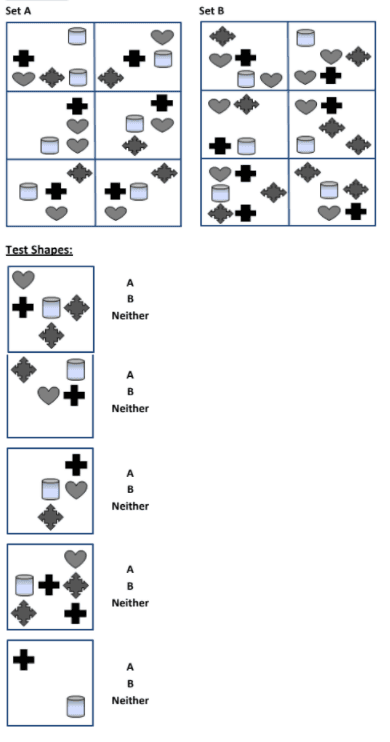
Abstract Reasoning UCAT Type 1 Example Question
Answers:
B, N, A, A, B
In set A, the top left is always empty, and the top right space is always occupied.
In set B, the top right is always empty, and the top left is always occupied.
You can find more ucat abstract reasoning questions for free across the internet by googling this term, we like the free bank at Passmedicine for abstract reasoning questions.
👉🏻 Read more:UKCAT Key Dates
👉🏻 Read more:UCAT Registration - The Ultimate Guide
There are four types of questions that appear in the UCAT (UKCAT) Abstract Reasoning subtest.
Note: the four AR question types below are kept for historical reference only. None of them appear in the current UCAT. To practise the live subtests under realistic timed conditions, use the UCAT trainer and question bank, and browse free strategy guides in our UCAT Guides hub.
👉🏻 UCAT Coursesto boost your score!
There are many mnemonics available for you to help decipher the ucat abstract reasoning patterns. The most popular mnemonic is SCANS which stands for:
Join one of our 1-1 UCAT Tutoring sessions or our UCAT Courses where we teach a uniquely developed mnemonic to boost your chances of finding the most common abstract reasoning patterns.
👉🏼 Read more: UCAT Revision Timetable for Summer 2026
👉🏻 Read more: UKCAT Key Dates in 2026
👉🏻 Read more: UCAT Registration 2026 - The Ultimate Guide
Choose your Ultimate Package
Rated 5.0 from 640+ reviews. 1-1 mentoring from doctors across UCAT, personal statement and interviews.
Bronze
20 hours
Silver
35 hours
Gold
50 hours
Platinum
75 hours
Here is a list of the most useful ukcat abstract reasoning tips as written by our qualified doctors, these are also taught on our UCAT courses and during our 1-1 UCAT Tutoring:
👉🏻 Read more: Top Tips For UCAT Abstract Reasoning
👉🏻 Read more: Top Tips For UCAT Quantitative Reasoning
👉🏻 Read more: Top Tips For UCAT Verbal Reasoning
No. Abstract Reasoning was removed from the UCAT from the 2025 test (2026 entry) and is no longer assessed. The UCAT now has three scored cognitive subtests, Verbal Reasoning, Decision Making and Quantitative Reasoning, marked out of 2700, plus the Situational Judgement Test reported in bands. You do not need to revise Abstract Reasoning.
The UCAT Consortium removed Abstract Reasoning to shorten the exam and focus on the skills universities valued most for medicine and dentistry. AR was the subtest least correlated with the others, and dropping it streamlined the test to three scored cognitive subtests plus the SJT, reducing fatigue while keeping the test's predictive value for selection.
Nothing was added in its place. Abstract Reasoning was simply removed, leaving Verbal Reasoning, Decision Making and Quantitative Reasoning as the three scored cognitive subtests, plus the Situational Judgement Test. The pattern-recognition and hypothesis-testing skills AR once measured are now reflected mainly within Decision Making.
Abstract Reasoning was removed from the 2025 UCAT test cycle, which applies to 2026 entry, and it remains absent in 2026 (2027 entry). If you sat or studied for the UCAT before 2025, you will have seen AR, but it no longer appears in the live exam.
The UCAT has four subtests: Verbal Reasoning, Decision Making and Quantitative Reasoning (the three scored cognitive subtests, marked 300 to 900 each for a total out of 2700), plus the Situational Judgement Test, which is reported in bands 1 to 4 rather than added to your numerical score.
Out of 2700. With Abstract Reasoning removed, the UCAT cognitive total is the sum of three subtests (Verbal Reasoning, Decision Making and Quantitative Reasoning), each scaled 300 to 900, giving a maximum of 2700. The old maximum of 3600 applied when AR was still included before 2025.
Abstract Reasoning was a UCAT subtest that tested your ability to spot patterns among abstract shapes, often amid distracting or irrelevant detail. It used four question types and was scored 300 to 900. It assessed flexible thinking and hypothesis generation, but it was removed from the test in 2025 and is now historical only.
No. Because AR was removed in 2025, practising it is a waste of revision time. Focus instead on Verbal Reasoning, Decision Making, Quantitative Reasoning and the Situational Judgement Test, and practise these under timed conditions using a current UCAT question bank or trainer.
Historically, AR used four types: Type 1 (deciding whether a test shape fit Set A, Set B or neither), Type 2 (choosing the next shape in a series), Type 3 (selecting the shape completing a statement) and Type 4 (choosing which option belonged to a given set). These no longer feature in the UCAT.
SCANS was a popular memory aid for spotting AR patterns: Size, Colour, Angle, Number of shapes, and Sides and Symmetry. It helped candidates systematically check common pattern categories. Since Abstract Reasoning was removed in 2025, SCANS is now only of historical interest and is not needed for the current UCAT.
For the UCAT, yes, AR-specific material is no longer relevant because the subtest was removed in 2025. However, the underlying logical-thinking skills can still loosely support Decision Making. The most efficient approach is to switch to up-to-date resources covering Verbal Reasoning, Decision Making, Quantitative Reasoning and the SJT.
Not necessarily. The exam is shorter, but each remaining subtest still demands speed and accuracy under tight time limits, and with fewer subtests every section carries more weight in your total out of 2700. Competition for medicine and dentistry remains high, so a strong score in the three scored subtests still matters.
As a rough guide for 2026, around 2500 and above is competitive, roughly 2700 cognitive total places you near the top decile, and the average sits near the middle of the 900 to 2700 range. Targets vary by university, so always check each medical or dental school's UCAT policy and our scores guide.
Use a question bank and trainer that reflects the post-2025 format, covering Verbal Reasoning, Decision Making, Quantitative Reasoning and the SJT under timed conditions. Our UCAT Guides hub has free subtest strategy guides, and our online UCAT trainer lets you drill questions and review your performance to target weak areas.

Want expert help with your application?
From 1-1 tutoring and personal statement editing to interview coaching and our all-in-one Ultimate Package, we support every stage. Tell us what you are aiming for and we will recommend the right option.
Ultimate Package students from our 2025/26 cycle, with their UCAT scores and offers, who trained with us for the UCAT, personal statements and interviews.
“Harry got my UCAT up to 2,590, working through the sections I kept dropping marks on week by week. Gemma then ran my interview practice so the MMI stations didn't catch me out, and Dr Akash mentored me the whole way through. I'm off to King's for Medicine.”
“The interview prep was the part that actually moved the needle. Proper mock MMIs, not just lists of questions, and feedback that was honest about what I was getting wrong. I ended up with four offers and firmed UCL.”
“The Ultimate Package kept me organised from UCAT through to interviews. They knew what dental schools actually ask and tightened up my personal statement. Four offers in the end, and I'm going to Birmingham.”
“Vet applications come down to the written SAQs as much as the interview. Dr Rebecca went through my SAQs line by line, sharpened my answers and prepped me for the panels. I came away with four offers and chose the RVC.”
Book your FREE consultation today
Click to book your free consultation