10 hours
1-1 UCAT tutoring
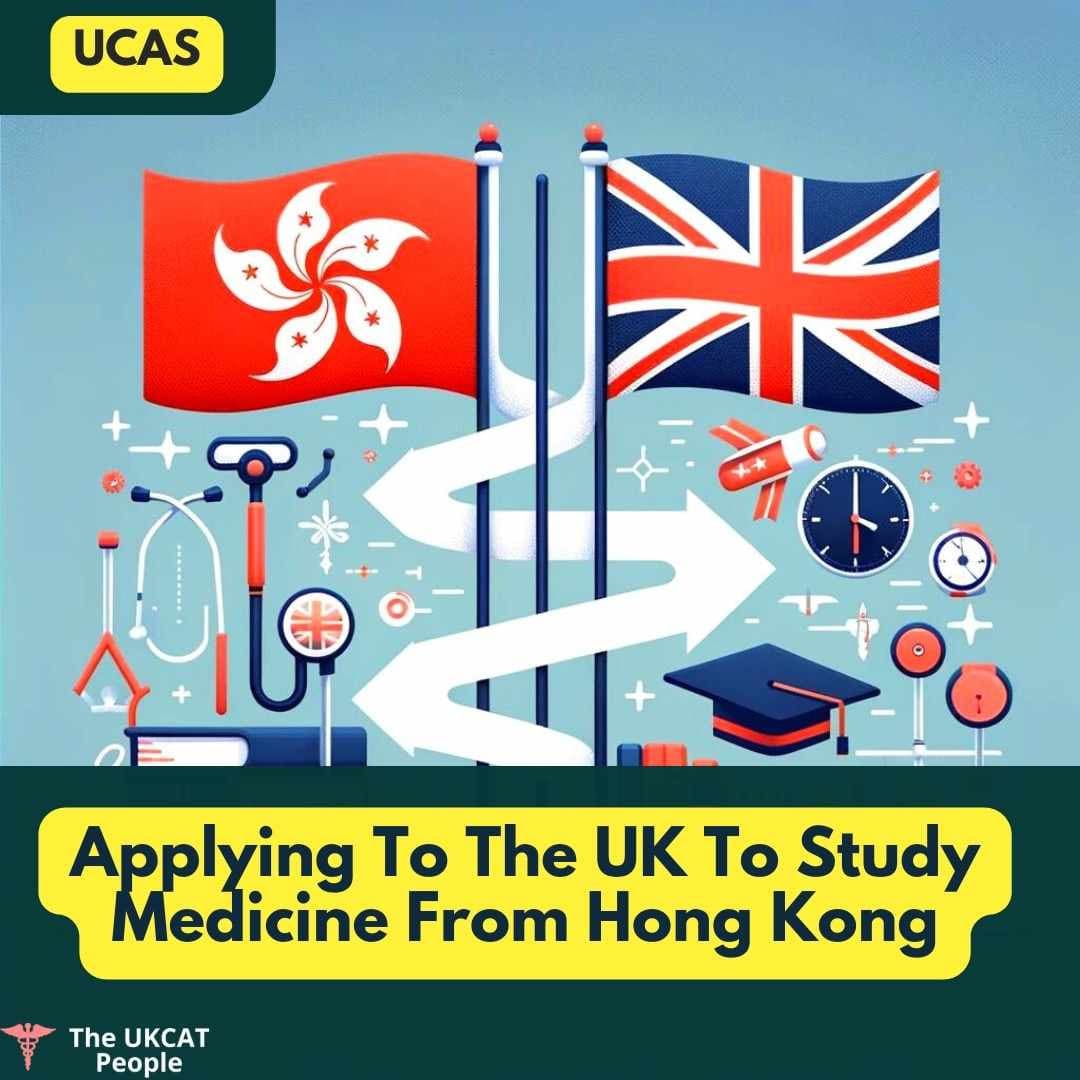
Hong Kong families approach UK medicine from two directions at once. Some are HKDSE or IB students at an international school in Hong Kong, applying to HKU and CUHK as well as to the UK. Others are Hong Kong students already boarding at a UK school, or BN(O) families who have moved to England and want to know whether their child now counts as a home student. The questions overlap: which UK schools keep the option of practising in Hong Kong open under the Medical Council of Hong Kong’s special registration route, how to use one UCAT sitting for both HKU and UCAS, what it costs in Hong Kong dollars, and how the fee rules treat a BN(O) visa.
This guide answers each of those for 2027 and 2028 entry: the MCHK list with a link to every UK school on it and the five-year public-service condition behind it, the UCAT in Hong Kong, HKDSE and IB offers school by school, the HKU and CUHK calendar alongside the UCAS one, fees in HK$ and the BN(O) home-fee rule, and how to run both applications in the same year without doing everything twice.
At TheUKCATPeople we have supported international applicants to UK medical schools since 2012, including students from King George V School, Christian Alliance International School and Harrow Hong Kong, and Hong Kong families whose children board in the UK. Our Ultimate Package for international students combines one-to-one mentoring with a UK doctor, UCAT tutoring, personal statement editing and interview coaching, all online and scheduled in Hong Kong time. The Hong Kong Medical Society of the United Kingdom is also worth joining early: it is run by Hong Kong medical students and doctors in the UK.
UK medical schools publish Hong Kong-specific offers, and the three qualifications are treated differently:
Published HKDSE requirements for medicine at seventeen UK medical schools, read from each school’s own pages on 14 October 2026. Seven of the seventeen publish a medicine-specific HKDSE offer; the rest publish only a university-wide equivalence table and tell medicine applicants to write to admissions, so treat those rows as a guide and get the offer in writing. No school states that the HKDSE is not accepted.
Medical school | HKDSE requirement for medicine (published position, 14 October 2026) |
|---|---|
Imperial | 5* and 5 in Biology and Chemistry in either order, plus 5 in a third elective |
UCL | Level 5 in English Language and Mathematics, 5* in one elective and 5 in two further electives (the A Level line asks for Biology and Chemistry with one at A*) |
King’s College London | 5*, 5, 5 in three electives plus 5 and 4 in two core subjects excluding Citizenship and Social Development; A Level grade A maps to a 5, so Biology and Chemistry at 5 |
Queen Mary (Barts) | 5*, 5, 5 in three subjects including Chemistry or Biology plus one further science (Chemistry, Biology, Physics or Mathematics), excluding Citizenship and Social Development |
Edinburgh | 5*, 5*, 5* in three electives including Chemistry and one of Biology, Physics or Mathematics, with the four core subjects at Level 3 or above (page dated November 2024) |
Glasgow | Minimum 5, 5, 5, 3, 3 with Chemistry, Biology and one of Mathematics or Physics at grade 5; Mathematics extended parts M1 or M2 if Mathematics is offered |
Birmingham | 5 in Chemistry and in Biology or Physics, 5 in Mathematics and English, minimum 4 in all other subjects except Chinese, overall 5, 5, 5 (2027 entry page) |
Liverpool | 5, 5, 5 in three electives, or 5, 5 in two electives plus one core subject, including Chemistry and one of Biology, Physics or Mathematics, with a minimum 4 in core Mathematics and 4 in English (E2027 guidelines) |
Newcastle | University block on the A100 page: 5, 4, 4 in three senior secondary subjects excluding Liberal Studies and Chinese as the AAA equivalent, Level 3 or above elsewhere; the medicine policy adds Biology or Chemistry plus a second science |
Oxford | 5*, 5, 5 in three Category A electives including the subjects the course requires, with 5 in core Mathematics and core English; medicine asks for Chemistry and one of Biology, Physics or Mathematics |
Cambridge | 5 in all core subjects, 5* in two or more relevant subjects, and for an A*A*A course such as medicine at least 5*, 5*, 5 in the electives, with Citizenship and Social Development attained (updated March 2026) |
Manchester | Not published for medicine. The university table maps AAA to 5, 5, 5 in three electives, and the MBChB page says country requirements may differ: email the medicine admissions team |
Bristol | Not published for medicine. The university Hong Kong page gives 4, 4, 4 to 5*, 5, 5 across courses; the medicine admissions statement refers international applicants to that page |
Leeds | Not published for medicine. The university table maps AAA to 5, 5, 5 to 5, 5, 4 and A*AA to 5*, 5, 5 to 5, 5, 5, excluding Liberal Studies and Citizenship and Social Development; medicine asks for Chemistry and Biology |
Sheffield | Not published for medicine. The university table gives 5, 5, 5 in three subjects; the medicine page asks international applicants to write to the Medical Admissions Office with certificates |
Nottingham | Not published for medicine. The university page gives 4, 4, 4 to 5*, 5, 5 and excludes Citizenship and Social Development and English Language from the offer; the medicine policy says international qualifications are considered individually |
Cardiff | Nothing published: the course page asks you to email the medicine admissions office for your country’s requirements |
Our UK medical school entry requirements guide lists the standard offer at every school, the IB requirements for medicine guide covers every IB offer, and the UK foundation medicine courses guide explains the few foundation routes open to international students.
Since the Medical Registration (Amendment) Ordinance 2021, a non-locally trained doctor can register in Hong Kong without the Licensing Examination through special registration, but only with a qualification on the list drawn up by the Special Registration Committee, and only on conditions. You must be a "specified person", which for a new graduate means a Hong Kong permanent resident (a non-permanent resident qualifies only with a Hong Kong Academy of Medicine fellowship or equivalent). You must be selected for a full-time post with the Hospital Authority, the Department of Health, HKU or CUHK. And full registration comes only after five years of that employment following a specialist qualification from the Academy, so for a fresh graduate the route is specialist training first, then five more years: roughly eleven years after graduation before you can leave the public sector as a fully registered doctor.
One condition matters more than any other for a UK applicant. Special registration is for doctors who have completed an internship. Foundation Year 1 in the UK, the natural first step after graduation, satisfies it: a graduate who completes F1 and holds General Medical Council registration enters special registration directly. A graduate without a foundation year must pass the Licensing Examination and complete the one-year period of assessment in Hong Kong before special registration opens to them, even with a listed qualification. The usual UK path, F1 straight after finals, is therefore also the one that keeps the Hong Kong route open.
The list is extended in batches and names programmes, not just universities: a university can be listed for its five-year MBBS and not for its four-year graduate-entry course, or for one campus and not another. The seventh batch, gazetted on 18 June 2026, took it to 166 qualifications worldwide. If practising in Hong Kong is a possibility, check the current list on the Medical Council of Hong Kong website before you finalise your four UCAS choices, and match the programme length and campus against the entry.
Each name above links to our profile of that school: entry requirements, how it uses the UCAT, interview format and application tips. Not on the list, and worth knowing because several are popular with Hong Kong applicants: Aberdeen, Dundee, St Andrews, Cardiff, Queen’s Belfast, Exeter, Plymouth, Keele, Lancaster, Norwich, Hull York, Brighton and Sussex, City St George’s, Sunderland, Kent and Medway, Lincoln, Aston, Edge Hill, Chester, Worcester, Surrey and Pears Cumbria. A degree from any of those means the Licensing Examination route. Use the UK medical schools ranking hub to compare the listed schools, and note that several Irish medical schools are also on the MCHK list: see our guide to studying medicine in Ireland and the Irish medical school profiles.
One trap to know about. Brunel, Buckingham, the University of Lancashire (formerly UCLan) and Queen Mary’s Malta campus accept direct international applications outside the four UCAS medicine choices, which makes them tempting insurance options. None of them is on the MCHK list, so a graduate of those courses could only register in Hong Kong through the Licensing Examination.
The UCAT is the admissions test for nearly every standard-entry medicine course in the UK, and from 2028 entry it is also required by HKU, so one sitting in Hong Kong can serve both applications. Hong Kong candidates sit the UCAT (UK), not the UCAT ANZ, and you cannot sit both in the same year.
The BMAT no longer exists: it was discontinued after 2023, and Oxford, Cambridge, Imperial and UCL all moved to the UCAT. If you are searching for BMAT courses in Hong Kong or "BMAT 香港", that time belongs to the UCAT now. Our posts on the BMAT cancellation and the move to the UCAT, the old BMAT registration process and the 2025 UCAT changes explain the background.
The UCAT is delivered at Pearson VUE test centres, booked through your UCAT account. When we searched the UCAT test centre locator on 14 October 2026 it listed one centre in Hong Kong: the Pearson Professional Centre on the 18th floor of the China Overseas Building, 139 Hennessy Road, Wan Chai. The Mongkok centre that older guides mention was not on the live list, and the next nearest centres are in Macau and Guangzhou. One centre for every Hong Kong candidate means July and August dates go within days, so register the day registration opens in May and book the day booking opens in June. Check the locator inside your UCAT account once you have registered, because the list can change for 2027.
Milestone | Date |
|---|---|
Account registration opened | 20 May 2026 |
Booking opened | 23 June 2026 |
Testing window | 13 July to 24 September 2026 |
Booking deadline | 16 September 2026 (15:00 UK time, 22:00 Hong Kong time) |
Results sent to universities | early November 2026 |
Fee for tests taken outside the UK | £115 (about HK$1,200; UK centres £70) |
Reading this after September 2026? The 2026 testing window has closed, so if you have not sat the UCAT you are applying for 2028 entry. UCAT publishes the 2027 dates in March 2027 and the cycle is expected to follow the same shape: registration in May, booking in June, testing from July to late September 2027, UCAS deadline in mid-October 2027. HKU requires the UCAT from every non-JUPAS MBBS applicant for 2028 entry, so a UCAT 2027 sitting serves both.
Since 2025 the UCAT has three scored cognitive subtests, Verbal Reasoning, Decision Making and Quantitative Reasoning, each scaled from 300 to 900 for a total out of 2700, plus a Situational Judgement Test reported as Band 1 (highest) to Band 4. Abstract Reasoning was withdrawn in 2025, so ignore any Hong Kong tutoring-centre advice built on the old 3600 scale. Start with the free UCAT Guides hub, build timed stamina on the UCAT online trainer, read our honest take on how hard the UCAT really is, and see the UCAT registration guide for the booking process. For every university outside the UK that uses the UCAT, from HKU and CUHK to NUS, NTU and Malta, see our list of universities that accept the UCAT outside the UK.
The 2026 mean total score was 1918 (Verbal Reasoning 602, Decision Making 640, Quantitative Reasoning 675), and the top 10 percent of candidates scored 2250 or above. The Situational Judgement Test bands were distributed 15 percent Band 1, 40 percent Band 2, 34 percent Band 3 and 11 percent Band 4.
International places at each UK medical school are a small fixed quota, so international applicants compete mainly against each other and a strong UCAT matters more, not less. As a rule of thumb, 2300 to 2500 makes you competitive at most schools that take international students, and above 2500 is competitive everywhere. Several schools use the SJT as a filter, so a Band 4 can rule you out regardless of your total. Hong Kong students usually score well on Quantitative Reasoning; Verbal Reasoning under time pressure, especially for students whose schooling has been mainly in Cantonese, is the subtest to start earliest.
Use the UCAT cut-off scores guide to see how each university uses the test, the UCAT score calculator to convert practice scores, and the UCAT scores and scoring guide for deciles and percentiles. All our UCAT tutors are UK doctors or top-decile medical students, and lessons are in the Hong Kong afternoon and evening. Explore 1-1 UCAT tutoring or our UCAT courses.
Be mentored 1-1 by a doctor
Every question answered from abroad, from fee status to interview day, in your time zone.
Most strong Hong Kong applicants at international schools apply to both: four UK schools through UCAS in October, and HKU and CUHK as non-JUPAS applicants on the local calendar. The two applications share more than families expect, and the UCAT is now the hinge: HKU makes it optional for non-JUPAS applicants entering in 2027-28, with no disadvantage for those without it, and requires it from 2028-29 entry, from a sitting "attempted in any year". CUHK sets no test but says applicants increasingly add a UCAT or MCAT result as supporting evidence. HKU is not a UCAT Consortium university, so you download your result and upload it to the HKU application yourself.
UK (UCAS) | HKU MBBS (non-JUPAS, 2027-28) | CUHK MBChB (non-JUPAS, 2027) | |
|---|---|---|---|
Application window | Opened 12 May 2026; deadline 15 October 2026 at 18:00 UK time | Opened 23 September 2026; first-round deadline 25 November 2026 at noon, then rolling | Opened 2 October 2026; deadline 7 January 2027 at 23:59. The advance-offer round does not apply to medicine |
Admissions test | UCAT, required by nearly every school | UCAT optional for 2027-28, required for 2028-29, attempted in any year | None required; UCAT or MCAT accepted as supporting evidence |
Typical offer | A*AA or AAA including Chemistry and Biology; IB 36 to 42; HKDSE 5, 5, 5 in electives | Expected minimum IB 43 or four A* at A Level; Biology or Chemistry; a good working knowledge of Chinese for all students | IB 42 with 6, 7, 7 at Higher Level including Chemistry or Biology, or four A* at A Level |
Written submission | Personal statement: three structured UCAS questions, 4,000 characters in total | Online application with supporting documents | Online application with a separate 250-word personal statement |
Interview | Online MMI or panel, November to March, scheduled in UK time | Individual interview in English and Chinese plus a group interview in English, in person only: 15 and 16 December 2026, 31 March, 12 July and 20 August 2027 | Individual panel interview of about 15 minutes with two interviewers, in English, in person: 18 and 19 December 2026, 1 April, 11 June and 27 July 2027 |
Fees for a non-local student | About £30,000 to £70,000 a year | HK$590,000 a year | See CUHK’s non-local fee schedule |
Two practical consequences. First, the December HKU and CUHK interview dates sit inside the UK interview season, and both are in person in Hong Kong while UK interviews are online in UK time, so December needs planning. Second, HKU interviews partly in Chinese and asks every student for a working knowledge of Chinese, which an international-school applicant who dropped Chinese early should think about before counting HKU as a safe choice.
What transfers is the thinking, not the text: the work experience you reflect on, the reasons you give for medicine, the ethical scenarios you have practised and the knowledge of both health systems behind them. The UK statement is written first because its deadline comes first; the CUHK 250-word statement and the HKU documents are adapted from it. Interview preparation works the same way: the MMI stations UK schools run in the autumn test the same skills the HKU and CUHK panels test, with Hong Kong-specific content (the Hospital Authority, the public and private split, the manpower shortage, the new special registration route) layered on top of the NHS material.
This is how our Ultimate Package runs for Hong Kong students: one doctor mentor across both applications, a UCAT tutor through the summer, personal statement editing for the UCAS deadline and then the CUHK and HKU forms, and interview coaching that starts with the UK MMIs and covers the Hong Kong panels in December.
Since 2021 a large number of Hong Kong families have moved to the UK on the British National (Overseas) visa, and for them the fee question is different, because home fee status turns a £300,000 international degree into a £9,535-a-year one with a tuition fee loan. The rule is not the same across the UK, and the common belief that three years’ residence is enough is only true in Scotland.
Where you would study | Home fee status for a BN(O) family (position on 14 October 2026) |
|---|---|
England | Only once the student, or the parent they depend on, has settled status, plus three years’ ordinary residence in the UK and Islands before the first day of the first academic year. BN(O) settlement comes after five years, so the first qualifying families are those who arrived in early 2021 and settled in 2026. Student Finance England applies the same settled-plus-three-years test |
Scotland | Three years’ ordinary residence in the UK, with leave to enter or remain, and residence in Scotland on the relevant date. The Scottish Government has confirmed that the BN(O) visa counts as that leave, from the 2023-24 academic year |
Wales | No BN(O) category in the fee regulations; the settled route applies |
Northern Ireland | No BN(O) category in the fee regulations; the settled route applies |
Fee status is assessed by each university against the regulations for your year of entry, not by UCAS, and the residence period is counted to the first day of the academic year, not to the application date. A family that arrived in England in 2022 will not have settled status for a September 2027 start and will pay international fees unless something changes. Ask the university’s fee assessment team in writing before you rely on home fees, and if you miss by months, a one-year deferral can be worth £150,000 or more. Also note that of the Scottish medical schools, only Edinburgh and Glasgow are on the MCHK list.
Home fee status also changes the competition you face. Home applicants are not limited by the small international quota, but they compete in the much larger home pool, where the UCAT threshold at many schools is higher. For a BN(O) student with a strong UCAT that is good news; for one with an average score, it changes which four schools make sense. This is a conversation to have early, with your UCAT score in hand.
For international-fee students, a UK medical degree is a five or six-year investment, and the fee is fixed in pounds while the family budget is in Hong Kong dollars. The conversions below use £1 = about HK$10.40 (the European Central Bank reference rates on 13 October 2026) and are rounded; check the live rate when you plan and budget with a buffer.
Published international tuition fees for the 2026/27 academic year at a sample of MCHK-listed schools (2027/28 fees are published through the autumn and spring and are usually a few percent higher):
Medical school | International fee per year | Approximate HK$ |
|---|---|---|
University of Manchester | £39,900 in years 1 and 2, £60,900 in the clinical years | HK$415,000, then HK$633,000 |
University of Liverpool | £50,000 | HK$520,000 |
Imperial College London | £58,600 | HK$609,000 |
University of Cambridge | £70,554 plus a college fee | HK$734,000 plus the college fee |
Across all UK medical schools the 2026/27 range runs from about £30,150 a year (HK$314,000) in the pre-clinical years at the cheapest schools to £70,554 (HK$734,000) at Cambridge, with most clinical years between £45,000 and £60,000 (HK$468,000 to HK$624,000). For comparison, HKU’s non-local MBBS fee for 2027-28 is HK$590,000 a year. See our school-by-school breakdown of UK medical school fees for international students to compare total course cost, not just the first year.
Other money you must plan for on the Student visa:
The Hong Kong Scholarship for Excellence Scheme (HKSES), run by the Education Bureau, is the one government award that funds undergraduate study overseas, and medicine is not excluded: there is no limit on discipline, although STEM fields are prioritised. For the 2027/28 cohort the deadline is 31 December 2026 at 18:00, the award is up to HK$300,000 a year towards tuition plus a means-tested bursary of up to HK$200,000, the institution must normally be in the top 100 of the major rankings, you need an unconditional offer before the scholarship interview, and you must return to work in Hong Kong for two years or the length of the scholarship, whichever is longer. The unconditional-offer condition is the catch for a school leaver, because UK medicine offers are conditional until results day, so read the notes for applicants carefully. On the UK side, Chevening and Commonwealth Scholarships are for postgraduate study, Imperial’s medicine scholarships are for home students, and the few international awards medical schools advertise are typically a few thousand pounds off the first year. Treat any scholarship as a bonus, never as the plan.
Hong Kong is not on the UK Home Office list of majority English-speaking countries, so the Student visa’s English requirement (CEFR B2) is not met by nationality alone. A university that is a licensed Higher Education Provider assesses your English itself, and whether HKDSE English Language counts in place of IELTS varies school by school. On 14 October 2026: Edinburgh accepts HKDSE English at Level 5 overall with 5 in each component for medicine, with no further English test; Imperial lists HKDSE English Level 3 as meeting even its higher requirement; Birmingham asks for 5 overall with three bands at 5 and one at 4 for the MBChB; Bristol lists 5*; Newcastle lists 5 with a minimum of 4 in each element; Queen Mary lists Level 5 for its top band. Liverpool asks for HKDSE English grade 4 and IELTS 7.0 in every component and accepts nothing else; Nottingham accepts only IELTS 7.5, PTE, Cambridge or IB English; UCL and King’s do not list the HKDSE among the school qualifications they accept for English, so plan on IELTS there (UCL’s medicine level is IELTS 7.5 with 7.0 in each component, King’s is 7.0 with 6.5 in each skill); Manchester accepts DSE English at grade 4 or higher for most courses but its MBChB page lists only IGCSE, IELTS 7.0, PTE, Cambridge and IB and asks you to check before applying. IELTS Academic is widely available in Hong Kong, so if two of your four choices need it, book it early.
Quote the school, never a single "medicine IELTS": our IELTS requirements for UK medical schools guide lists every school. Hong Kong is on the list of places whose residents need a tuberculosis test from a Home Office approved clinic before applying for a UK visa of more than six months, so book it in the summer before you travel. ATAS clearance is not required for an undergraduate MBBS.
Boost your UCAT with 1-1 tutoring
Rated 5.0 from 700+ reviews. 1-1 sessions with top-scoring tutors, weekly or more often, built around your weakest subtests.
10 hours
1-1 UCAT tutoring
20 hours
1-1 UCAT tutoring
30 hours
1-1 UCAT tutoring
All applications to UK medical schools go through UCAS, exactly as they do for UK students. The key facts for 2027 entry:
For the personal statement, read our ultimate medicine personal statement guide and successful medicine personal statement examples, then have a UK doctor review your draft through our medicine personal statement review service. The UCAS medicine application guide and timeline walks through the whole form, and an EPQ or equivalent research project gives you something concrete to discuss at interview.
Work experience in Hong Kong is usually arranged through family contacts, private hospitals and clinics, elderly care homes and NGO volunteering, and the Hospital Authority’s structured programmes where your school has access. Medical schools are realistic about what international applicants can access, and a virtual placement counts if you reflect on it properly. Our medicine work experience guide and Work Experience Finder can help.
Most UK medical schools now interview international applicants online, in the MMI format, between November and March. Barts and Manchester have offered interviews in Hong Kong in recent cycles, and a small number of schools still prefer in-person interviews in the UK, so check each of your four choices. Live online interviews are scheduled in UK time, which usually means a late afternoon or evening slot in Hong Kong.
Interviewers expect you to understand medicine in the UK. Research the NHS, its six core values, the NHS topics that come up at interview and the current medicine interview hot topics, and read UK health news for ten minutes a day. Then use your advantage: a Hong Kong applicant can compare a tax-funded NHS with the Hospital Authority’s heavily subsidised public system and Hong Kong’s large private sector, and an ethics station rewards that perspective.
Interview formats are covered in our MMI preparation guide and ultimate medicine interview questions guide, and you can practise with a UK doctor through our medicine interview coaching, mock interviews and medicine interview course.
Dentistry: Hong Kong has one dental school, at HKU, so a large share of Hong Kong dentistry applicants look to the UK. The Dental Council of Hong Kong requires non-locally trained dentists to pass its Licensing Examination, so there is no equivalent of the medical special registration list; check the Dental Council’s current position before you choose. Our international dentistry guide covers entry requirements, the UCAT for dentistry and fees, and our dentistry application packages are led by Dr Sonal Gandhi, a UK dentist.
Veterinary medicine: Hong Kong’s only vet school is at City University, so most Hong Kong vets train overseas. The UK’s RCVS-accredited vet schools are the usual choice, and registration to practise in Hong Kong runs through the Veterinary Surgeons Board. Our veterinary medicine Ultimate Package is led by Dr Rebecca Massie, a UK vet, and the vet school SAQ and SJT guide covers the written assessments several vet schools use.
Yes, and the position for international graduates of UK medical schools improved in 2026. The Medical Training (Prioritisation) Act 2026, which received Royal Assent on 5 March 2026, defines a UK medical graduate as the holder of a UK primary medical qualification, excluding only those who spent all or most of their training outside the British Islands. An international student who completes the whole degree at a UK medical school is therefore in the prioritised group for Foundation Programme places, and NHS England has confirmed that from 2027 the prioritisation applies at both shortlisting and offer.
Immigration rules change frequently. Treat this as the position on 7 September 2026 and confirm on GOV.UK before you rely on it.
A UK medical degree leads to registration with the General Medical Council and the NHS Foundation Programme, where UK graduates now have priority under the Medical Training (Prioritisation) Act 2026, and most of our international students plan their careers in the UK. The facts below are for families who want the option of practising in Hong Kong kept open.
UK graduates receive provisional registration with the General Medical Council and full registration after Foundation Year 1, and every UK medical school now builds the UK Medical Licensing Assessment into finals. Many Hong Kong graduates complete F1 and F2 in the UK, and because of the internship condition, F1 is also what keeps the Hong Kong route open.
Put the two halves of the MCHK rule together and the route for a UK-trained Hong Kong permanent resident is clear. Foundation Year 1 in the UK, the natural first step after graduation, provides GMC registration and the internship. From there the Hong Kong route runs through a full-time post with the Hospital Authority, the Department of Health, HKU or CUHK, special registration on the strength of the listed qualification, specialist training in Hong Kong, which takes at least six years, the Academy of Medicine qualification, five more years in the public sector, and then full registration. Without the UK foundation year, the Licensing Examination and a one-year assessment are added at the front of that sequence.
The Licensing Examination has three parts: Part I professional knowledge (two 120-question papers), Part II medical English and Part III clinical examination, with Parts I and II sat in March and September and Part III in May and November, followed by a period of assessment of up to twelve months in an approved hospital. It is the route for a graduate of any UK school not on the list, and for a listed-school graduate without an internship.
Choose your Ultimate Package, mentored from abroad
Rated 5.0 from 700+ reviews. 1-1 mentoring from doctors across UCAT or UCAT ANZ, personal statement, fee-status shortlisting and online interviews, scheduled in your time zone.
Bronze
20 hours
Silver
35 hours
Gold
50 hours
Platinum
75 hours
Work backwards from the UCAS deadline. This is the shape of a well-run application from Hong Kong:
Need a shortlist and a plan? Book a free strategy consultation with one of our admissions experts.
Since 2025 alone we have coached applicants from King George V School, Christian Alliance International School and Harrow Hong Kong, and Hong Kong families whose children board at UK schools, for interviews at King’s, Birmingham, Edinburgh and HKU. What makes the difference for Hong Kong applicants is consistent: a UCAT sat early with extra time on Verbal Reasoning, a shortlist of four schools built around your UCAT score and fee status, checked against the MCHK list where families want the Hong Kong option kept open, a personal statement that is then adapted for HKU and CUHK rather than written three times, and interview practice with someone who knows both the NHS and the Hospital Authority.
Everything we do is online, and most Hong Kong students take lessons between 16:00 and 23:00 Hong Kong time, which is the UK morning and early afternoon. Lessons run seven days a week, so a school timetable, an IB exam block or a DSE mock season can all be worked around.
Our Ultimate Package for international applicants includes:
"Applying to UK medical schools from abroad felt overwhelming, but TheUKCATPeople made everything clear. The team helped my son select the right universities that allowed my son to come back to Hong Kong to work as a doctor was important and they helped to craft and refine his personal statement, and prepare for his interviews with tailored mock sessions. Having Dr Akash as his mentor was invaluable, and the guidance on the UCAT was excellent. He is now starting at UCL, and we are so grateful." Mei-Ling Zhao, Hong Kong
"I thought the ultimate package was fantastic because it covered everything that I needed to know. I didn’t need any extra help other than that provided by my mentors at the UKCAT people. They gave excellent advice for applying as an international student and I’m very grateful for this. I will be going to study at Imperial College London this year." Yugo, Hong Kong
"Very happy with the service my son received. They covered everything and were even knowledgeable about transitioning back to HK after degree done. Glad we picked them." Sarah Hui, Hong Kong
Compare the Silver, Gold and Platinum tiers on our Ultimate Packages page, see the international students’ package page, or start with 20 hours of UCAT tutoring if the test is your immediate priority.
If you want support with any part of the process, our team of UK doctors and admissions experts is here to help. Book a free strategy consultation or contact us.
As at 18 June 2026 the MCHK list of recognised medical qualifications (166 worldwide) names UK programmes at Birmingham, Bristol, Cambridge, Edinburgh, Glasgow, Imperial, King’s, Leeds, Leicester, Liverpool, Manchester, Newcastle, Nottingham, Oxford, Queen Mary, Sheffield, Southampton, UCL and Warwick, each for specific programme lengths, plus the NTU-Imperial joint programme in Singapore. Aberdeen, Dundee, St Andrews, Cardiff, Belfast, Exeter and City St George’s are not on it. The list is extended in batches, so check the current version on the MCHK website and match the programme length before finalising your UCAS choices.
A Hong Kong permanent resident who graduates from a listed programme and has completed an internship (the UK Foundation Year 1 counts) can register through special registration with a full-time post at the Hospital Authority, the Department of Health, HKU or CUHK, without sitting the Licensing Examination. Full registration follows five years of that employment after a specialist qualification. A graduate of an unlisted school, or a listed-school graduate without an internship, must pass the three-part Licensing Examination and complete a period of assessment first.
Yes. HKU makes the UCAT optional for non-JUPAS MBBS applicants entering in 2027-28 and requires it from 2028-29 entry, from a sitting attempted in any year, and CUHK accepts a UCAT result as supporting evidence. Sit the UCAT (UK) at the Pearson VUE centre in Hong Kong between July and September; the same result serves your UCAS application in October and the Hong Kong applications on the local calendar. HKU is not a UCAT Consortium university, so you upload the result yourself. Do not sit the UCAT ANZ as well.
At the Pearson VUE centre in Hong Kong, booked through your UCAT account. On 14 October 2026 the locator listed one centre, the Pearson Professional Centre at 139 Hennessy Road, Wan Chai; the current list is in the locator inside your account. The 2026 testing window ran from 13 July to 24 September, with booking open from 23 June. The fee outside the UK is £115, about HK$1,200. With one centre, July and August slots go within days, so register in May and book the day booking opens in June. UCAT publishes the 2027 dates in March 2027.
Yes. The BMAT was discontinued after its final sitting in 2023 and is no longer used by any UK medical school. Oxford, Cambridge, Imperial and UCL all use the UCAT. If you have been searching for BMAT courses in Hong Kong, redirect all of that preparation time into the UCAT.
For UK medical schools, 2300 to 2500 is competitive at most schools that take international students and above 2500 is competitive everywhere; the 2026 mean was 1918 and the top 10 percent scored 2250 or above. A Band 1 or 2 in the Situational Judgement Test matters too, because some schools use it as a filter. Ignore any figure quoted on the old 3600 scale.
A typical offer is 5, 5, 5 in three elective subjects including Chemistry and Biology, with core subject requirements set by each school, most often Level 4 in English Language and Level 3 or above in Mathematics. Exact requirements vary by university, and some schools do not publish an HKDSE offer at all, so check each medical school’s international entry page or ask admissions in writing.
Often not. Hong Kong is not on the Home Office majority English-speaking list, but universities assess English themselves and most medical schools accept HKDSE English Language at the level they specify, an IB English grade or an IGCSE. Where IELTS Academic is required, medicine thresholds are typically 7.0 to 7.5 overall. Check the school, not a general rule.
It depends where you study. In England, home fees and Student Finance need settled status plus three years’ ordinary residence, and BN(O) settlement comes after five years, so only families who arrived in early 2021 qualify for 2027 entry. In Scotland, three years’ residence with BN(O) leave is enough, and has been since 2023-24. Wales and Northern Ireland have no BN(O) category. Fee status is assessed by each university, not by UCAS: count the time to the first day of the course and get the assessment in writing before you rely on it.
Published 2026/27 international fees range from about £30,150 a year in the pre-clinical years at the cheapest schools to £70,554 a year at Cambridge, with most clinical years between £45,000 and £60,000, before living costs of £12,000 to £18,000 a year. At about HK$10.40 to the pound that is roughly HK$314,000 to HK$734,000 a year in tuition, against HKU’s HK$590,000 non-local fee. You must also hold visa maintenance funds of £1,171 a month outside London or £1,529 a month in London for up to nine months. A BN(O) family that qualifies for home fee status pays the home rate instead and can apply for a tuition fee loan.
15 October 2026 at 18:00 UK time, which is 01:00 on 16 October in Hong Kong. You can apply to a maximum of four medicine courses plus one non-medicine choice. Submit well before the deadline rather than on the day itself.
UCAS has replaced the single free-text personal statement with three structured questions covering why you want to study the course, how your studies have prepared you, and what other experiences make you suitable. Plan your medicine motivation, work experience and reflection around these three sections rather than writing one continuous essay, and then adapt the same material for HKU and CUHK.
Most UK medical schools interview internationally based applicants online, and some have offered interviews in Hong Kong in recent cycles, including Barts and Manchester. A few still require you to travel to the UK. Most use the MMI format, and online interviews are scheduled in UK time, so expect a late afternoon or evening slot in Hong Kong. HKU and CUHK, by contrast, interview in person only, with December dates that fall inside the UK season.
Yes. Brunel Medical School, the University of Buckingham, the University of Lancashire and Queen Mary’s Malta programme accept direct international applications outside the four UCAS choices. None of them is on the MCHK special registration list, so a graduate can only register in Hong Kong through the Licensing Examination.
Yes. A Hong Kong permanent resident with a qualification on the MCHK list who has completed Foundation Year 1 in the UK registers through special registration without the Licensing Examination, trains and works in the public sector, and applies for full registration five years after a specialist qualification. A listed-school graduate who skips the foundation year, or any graduate of an unlisted school, sits the Licensing Examination in three parts and completes a period of assessment first. Foundation Year 1 in the UK, the natural first step after graduation, is what keeps this route open.
Ideally at the start of Secondary 5 or Year 12. That gives roughly 18 months to secure work experience, build UCAT skills, build a shortlist, settle your fee status if you are a BN(O) family, and sit the UCAT in the summer before you apply. Early planning matters more from overseas, where logistics and time zones add complexity.

Want expert help with your application?
From 1-1 tutoring and personal statement editing to interview coaching and our all-in-one Ultimate Package, we support every stage. Tell us what you are aiming for and we will recommend the right option.
All ucas and international guidesBrowse every application guide
Ultimate Package students from our 2025/26 cycle, with their UCAT scores and offers, who trained with us for the UCAT, personal statements and interviews.
“Harry got my UCAT up to 2,590, working through the sections I kept dropping marks on week by week. Gemma then ran my interview practice so the MMI stations didn't catch me out, and Dr Akash mentored me the whole way through. I'm off to King's for Medicine.”
“The interview prep was the part that actually moved the needle. Proper mock MMIs, not just lists of questions, and feedback that was honest about what I was getting wrong. I ended up with four offers and firmed UCL.”
“The Ultimate Package kept me organised from UCAT through to interviews. They knew what dental schools actually ask and tightened up my personal statement. Four offers in the end, and I'm going to Birmingham.”
“Vet applications come down to the written SAQs as much as the interview. Dr Rebecca went through my SAQs line by line, sharpened my answers and prepped me for the panels. I came away with four offers and chose the RVC.”
Book your FREE consultation today
Click to book your free consultation