Complete University Guide 2027
40thof 40 UK medical schools
Top40th
- Overall score
- 89%
- Entry standards
- 57%
- Student satisfaction
- 72%
- Graduate prospects
- 98%
Source: Complete University Guide 2027 medicine league table.
Reviewed by Dr Akash Gandhi, MBBS MA (Cantab) DGM DRCOG MBA MRCGP
Trusted UK medicine admissions specialists since 2012 · 2,700+ students taught
At a glance
Buckingham has not published medicine interview dates for 2027 entry yet. Most UK interviews run December to March. The interview format is MMI.
Source: University of Buckingham official page, checked 16 October 2026. Universities can change interview dates, so confirm before you book travel.
The University of Buckingham Medical School is the UK's first independent not-for-profit Medical School. Our guiding philosophy is to produce highly ethical, honest and compassionate doctors who will put the patient first. Our curriculum is derived from a well-established MB ChB programme that has been refined over 20 years to provide optimum learning experience. Every aspect of it has been engineered to fully equip our students with the skills necessary to start their journey as medical practioners.
Complete University Guide 2027
Source: Complete University Guide 2027 medicine league table.
The course is 4.5 years long. In keeping with the Buckingham ethos, the ratio of students to academic staff, clinical educators and patients is kept low throughout Phases 1 and 2. We will assess your progress rigorously throughout the course so that you, the Medical School and the public can be confident that you are meeting the high standards required of a doctor. There will be a combination of written examinations, structured clinical examinations and the use of an e-portfolio of evidence of progress, all chosen to make the most valid and reliable test of your abilities.
Systems-based Integrated system
No
Expert 1-1 support for your application
1-1 support from doctors and admissions experts across every stage of your medicine application.
Interview Coaching
Mock MMI & panel interviews
1-1 Mock Interview
Marked on real criteria
Ultimate Package
Full application support
Universities revise entry requirements between cycles, usually in August and September. Always confirm with the university before you apply.
Minimum A level requirements for Buckingham Medical School is ABB.
Must include Chemistry or Biology.
Compare this with the A-level requirements for every UK medical school.
Minimum GCSE grade requirements for Buckingham Medical School is at least Grade 4 in Maths and at least Grade 4 in English GCSE (or equivalent).
If you have not taken an A Level in Biology or Chemistry, you must have studied that subject to GCSE level (or equivalent) and achieved at least a grade B.
Still sitting your GCSEs? Protect the grades this course screens for with 1-1 GCSE Maths, Biology and Chemistry tutoring from medics.
Buckingham publishes two different IB totals. Its MB ChB course page asks for a total score of at least 32 points to include three Higher Level subjects, while the Med 26/27 entry requirements PDF linked from that same page asks for a minimum of 34 points. We could not resolve the difference, so aim for 34 and confirm with admissions before you apply.
Both versions agree that you must achieve at least Higher Level 6 in Chemistry or Biology, having taken both, with at least Higher Level 5 in the other.
Please note that the overall points score does not include Theory of Knowledge or the Extended Essay.
AABBB at Higher (S5), taken alongside the Advanced Higher requirement (see Advanced Higher).
Two Advanced Highers to include Chemistry and one from Biology or Maths, with a minimum of grades BB.
They should have a Bachelor degree in a subject cognate to Medicine, and have or be predicted a minimum classification of 2.1.
IELTS:
minimum overall score of 7 and no less than 6.5 in each component.
Yes, in limited circumstances. Applicants with lower grades at their first A Level attempt and significant mitigation can apply once they have attained the required grades of ABB (to include Chemistry or Biology). Predicted grades will not be considered for such applicants.
Minimum grade at first sitting: ABB + significant mitigation.
See A-Level & GCSE resit policies for every UK medical school →
No
Buckingham requires medical students to be 18 by the first day of MB ChB induction week. Exceptionally, a student who is 17 at registration and turns 18 during their first term may be granted an exemption by the Dean of Faculty.
Compare minimum age requirements at every UK medical school →
A-Level Requirements at University of Buckingham Medical School →
No. Buckingham's own admissions pages rule out a contextual offer for medicine.
No contextual offer. The faculty's admissions standards state that the university uses the contextual data provided by UCAS for reporting purposes, to monitor its access and participation strategy, but that this data is not used when considering individual applications.
Buckingham's Pre-Med route is a fee-paying pre-medical course used as an entry qualification, not a widening access gateway.
Source: Buckingham standards for admission and selection. Last checked 16 September 2026.
Compare contextual offers at every UK medical school, with each university's criteria in its own words.
Most useful
How Does Buckingham Medical School Look At The UCAT?
The UCAT is not used at Buckingham Medical School.
Stage One: Academic Selection
This first stage involves judgements on the basis of the written application primarily related to academic achievement as an indicator of intellectual suitability for a medical course and the practice of medicine. Applicants may offer a variety of qualifications, but the overriding principle is that achievement should be at the highest level, and comparable to entrants to other medical schools in the United Kingdom. It is not intended that ability to pay the fees for the course should compensate for academic achievement that is less than usual for entry to a medical course in the UK.
Stage Two: Multiple Mini Examinations
The second stage of selection applies only to those who meet the academic threshold, and is intended to judge personal attributes relating to suitability for practice as a doctor. It is a computer-based test, made up of a series of tasks intended to test students’ analysis, interpretation and judgement abilities related to 'Good Medical Practice', published by the UK General Medical Council.
Students who are satisfactory at this point will be offered to proceed to the third and final stage of the MMI application process. Exceptionally high-performing students may receive an offer at this stage in the process.
Stage Three: Objective Structured Selection Examinations
The Third stage of selection is intended to judge personal attributes relating to suitability for practice as a doctor. It consists of an Objective, Structured Selection Examination (OSSE), made up of a series of tasks intended to test abilities related to 'Good Medical Practice', published by the UK General Medical Council
📝 PS - Have your PS checked - 5⭐ Rated
🎙️ Interviews - 1-1 Online Medicine Interview (Panel & MMI) Tutoring & Mocks tailored to Buckingham - 5⭐ Rated
No
The University of Buckingham does not state a work-experience requirement. Admission is based on an academic threshold followed by a Multiple Mini Assessment and Multiple Mini Interview assessing the personal attributes set out in the GMC's Good Medical Practice. Work experience is not a listed or scored entry criterion, though relevant insight into medicine remains valuable preparation for interview.
A personal statement giving your reasons for wishing to study medicine is required, but it is not scored. At academic screening it is considered only so that mitigating circumstances can be taken into account; it may also form the basis of a reflection task at the Multiple Mini Interview.
Note: from 2026 entry, UCAS replaced the single free-text personal statement with three structured questions: why you want to study the course, how your studies have prepared you, and what else you have done to prepare. Any guidance above still applies; it is simply spread across those questions. For worked examples and a review of your own statement, see our medicine personal statement examples and review service.
See our medicine personal statement examples: model statements in the new UCAS format, each with commentary on what works and why.
Interview preparation
Our 1-1 medicine interview tutoring is online and your tutor is matched to Buckingham, so every mock runs in the multiple mini interview (MMI) format Buckingham uses, with written feedback after each one.
We cover every UK medical school and last year our students were offered places at every one, including Buckingham.
Ten hours is £749 (£75 an hour) and includes the £349 Ultimate Q&A Guide free (500+ questions with model answers written by doctors), plus WhatsApp support between sessions.

 Most popular
1-1 Interview Coaching
Our best-value full programme
or 2 monthly payments of £724.50
Free Q&A Guide (£349)
Buy
1-1 Interview Coaching
Deepest prep for multiple offers and Oxbridge
or 2 monthly payments of £1,074.50
Free Q&A Guide (£349)
Buy

Interview Guide
Model answers to every common interview question
Free with any coaching package
BuyNot sure which option fits? Explore all interview coaching or book a free consultation.
Buckingham has no four-year graduate entry course. One 4.5-year MBChB for everyone, starting in January, with private fees. Graduates need a 2:1 in a subject related to medicine. Compare every UK graduate entry course
The University of Buckingham Medical School selects MB ChB applicants through a three-stage process, of which the final stage is a Multiple Mini Interview (MMI) rather than a traditional panel. The MMI is a series of short, timed stations designed to test personal attributes and abilities mapped to the GMC's Good Medical Practice standards, and the university states that the offer decision is based on interview performance, with the total score across all stations used to rank applicants.
It is preceded by a computer-based Multiple Mini Assessment (MMA) at stage two; note that Buckingham does not require the UCAT. Third-party application sources report that the MMI for 2026 entry is delivered online with 4 stations of roughly 8 minutes each (about 60 minutes total), but the university's own admissions page does not officially publish the station count or timings, so these figures should be treated as unconfirmed.
The use of AI in the MMA and MMI is explicitly prohibited.
The University of Buckingham has not published selection event dates for its MB ChB Medicine course. The schedule of selection events on the course page says only that upcoming dates will be featured soon, so there are no Multiple Mini Assessment or Multiple Mini Interview dates for the January 2027 or January 2028 intakes. Buckingham selects in three stages: academic screening, then a computer based Multiple Mini Assessment, then a Multiple Mini Interview. Exceptionally high performing applicants may receive an offer at the assessment stage. The course starts in January rather than September.
Comparing this against your other choices? Every UK medical school's interview window is in one table, checked against each university's own website, in our UK medical school interview dates guide.
There are a number of different stations tested in the MMI interview at Buckingham Medical School:
There are some key domains that you must learn here as outlined in the GMC’s Good Medical Practice:
These are suggested practice questions based on publicly available information and past trends. They are not official questions from the University and may not appear in your interview. Use them as part of a broader preparation strategy.
Motivation to study medicine
Personal Insight
NHS & Local Area
Ethical Scenarios
MMI Specific Stations
Prepare with 1-1 medicine interview coaching and practise with our medicine interview questions guide.
Practise under timed conditions with our free generator. It builds a randomised circuit from real Buckingham interview themes, with follow-up questions and a notes summary you can keep. It opens preset to Buckingham's own interview format, and you can record your answers to watch them back.
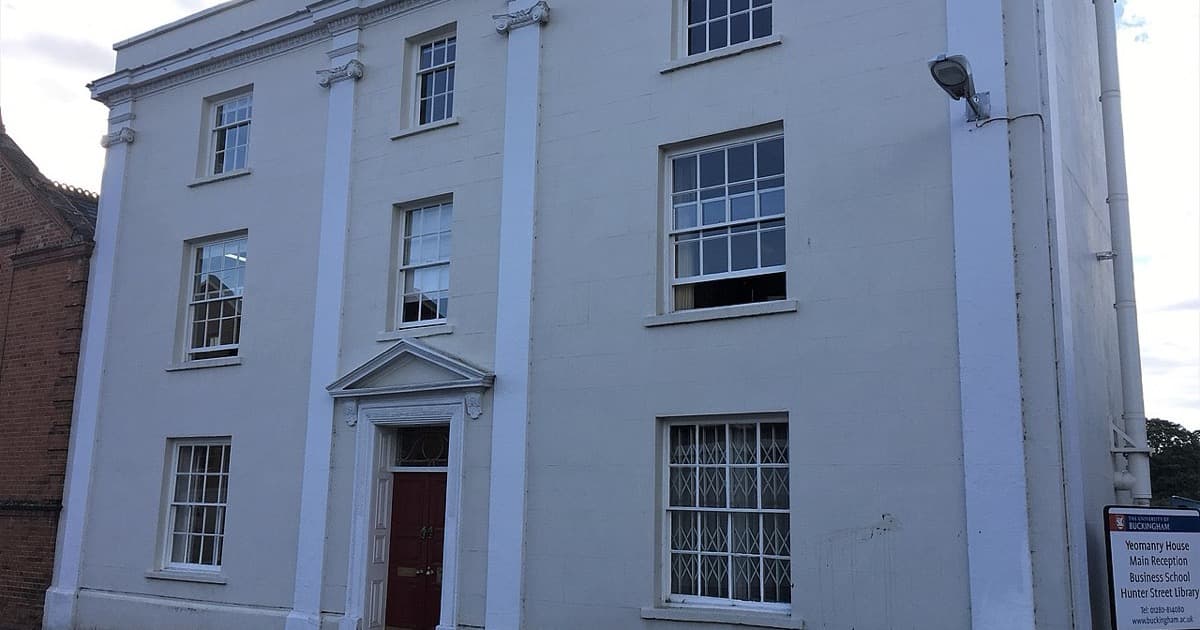
Address: Medical School, The University of Buckingham, Hunter Street, Buckingham, MK18 1EG
Telephone: +44 (0)1280 814080
Email: medicine-admissions@buckingham.ac.uk
Boost your medical school application
Buckingham is ranked 40th out of 40 UK medical schools for Medicine in the Complete University Guide 2027.
Buckingham is ranked 40th out of 40 UK medical schools for Medicine in the Complete University Guide 2027.
In the Complete University Guide 2027 it scores 57% for entry standards, 72% for student satisfaction and 98% for graduate prospects.
Minimum A level requirements for Buckingham Medical School is ABB.
Must include Chemistry or Biology.
Minimum GCSE grade requirements for Buckingham Medical School is at least Grade 4 in Maths and at least Grade 4 in English GCSE (or equivalent).
If you have not taken an A Level in Biology or Chemistry, you must have studied that subject to GCSE level (or equivalent) and achieved at least a grade B.
Yes, in limited circumstances. Applicants with lower grades at their first A Level attempt and significant mitigation can apply once they have attained the required grades of ABB (to include Chemistry or Biology). Predicted grades will not be considered for such applicants.
Minimum grade at first sitting: ABB + significant mitigation.
The UCAS course code for the standard Medicine course at Buckingham is 71A8, and the degree awarded is the MBChB.
The course is based in Buckingham, England and lasts 4.5 years.
No, Buckingham does not require the UCAT for entry to Medicine.
The UCAT is not used at Buckingham Medical School.
Stage One: Academic Selection.
Yes, Buckingham interviews applicants for Medicine, using a multiple mini interview (MMI) format.
Buckingham uses a multiple mini interview (MMI) format for Medicine interviews.
Yes. Our 1-1 medicine interview tutoring is online and your tutor is matched to Buckingham, so every mock runs in the multiple mini interview (MMI) format Buckingham uses, with written feedback after each one.
We cover every UK medical school and last year our students were offered places at every one, including Buckingham.
Ten hours is £749 (£75 an hour) and includes the £349 Ultimate Q&A Guide free (500+ questions with model answers written by doctors), plus WhatsApp support between sessions.
Book on the medical school interview coaching page at www.theukcatpeople.co.uk/medicine-interview-tutor-coaching, or start with a single £125 mock: upgrade within 7 days of your feedback and the full £125 comes off any package.
The Medicine interview at Buckingham covers role play scenarios, ethical decision making, motivation & course specifics, communication & empathy and teamwork & leadership.
The University of Buckingham has not published selection event dates for its MB ChB Medicine course. The schedule of selection events on the course page says only that upcoming dates will be featured soon, so there are no Multiple Mini Assessment or Multiple Mini Interview dates for the January 2027 or January 2028 intakes. Buckingham selects in three stages: academic screening, then a computer based Multiple Mini Assessment, then a Multiple Mini Interview. Exceptionally high performing applicants may receive an offer at the assessment stage. The course starts in January rather than September.
No, Buckingham does not offer a foundation or gateway year for Medicine.
Buckingham has no four-year graduate entry course for 2027 entry. One 4.5-year MBChB for everyone, starting in January, with private fees. Graduates need a 2:1 in a subject related to medicine.
Admissions test for graduates: Buckingham's own assessment (no UCAT or GAMSAT).
No, Buckingham does not formally score the personal statement for Medicine applicants.
A personal statement giving your reasons for wishing to study medicine is required, but it is not scored. At academic screening it is considered only so that mitigating circumstances can be taken into account; it may also form the basis of a reflection task at the Multiple Mini Interview.

Want expert help getting into Buckingham?
From admissions test prep and personal statement editing to interview coaching and our all-in-one Ultimate Package, we help applicants at every stage. Tell us where you are and we will recommend the right option.
Schools ranked closest to this one in the Complete University Guide 2027.
Ultimate Package students from our 2025/26 cycle, with their UCAT scores and offers, who trained with us for the UCAT, personal statements and interviews.
“Harry got my UCAT up to 2,590, working through the sections I kept dropping marks on week by week. Gemma then ran my interview practice so the MMI stations didn't catch me out, and Dr Akash mentored me the whole way through. I'm off to King's for Medicine.”
“The interview prep was the part that actually moved the needle. Proper mock MMIs, not just lists of questions, and feedback that was honest about what I was getting wrong. I ended up with four offers and firmed UCL.”
“The Ultimate Package kept me organised from UCAT through to interviews. They knew what dental schools actually ask and tightened up my personal statement. Four offers in the end, and I'm going to Birmingham.”
“Vet applications come down to the written SAQs as much as the interview. Dr Rebecca went through my SAQs line by line, sharpened my answers and prepped me for the panels. I came away with four offers and chose the RVC.”
Book your FREE consultation today
Click to book your free consultation