Interview Coaching
Mock MMI & panel interviews
Reviewed by Dr Akash Gandhi, MBBS MA (Cantab) DGM DRCOG MBA MRCGP
Trusted UK medicine admissions specialists since 2012 · 2,700+ students taught
At a glance
Surrey has not published medicine interview dates for 2027 entry yet. Most UK interviews run December to March. The interview format is MMI, virtual.
Source: University of Surrey official page, checked 16 September 2026. Universities can change interview dates, so confirm before you book travel.
Graduate Entry Only (at time of update: May 2024)
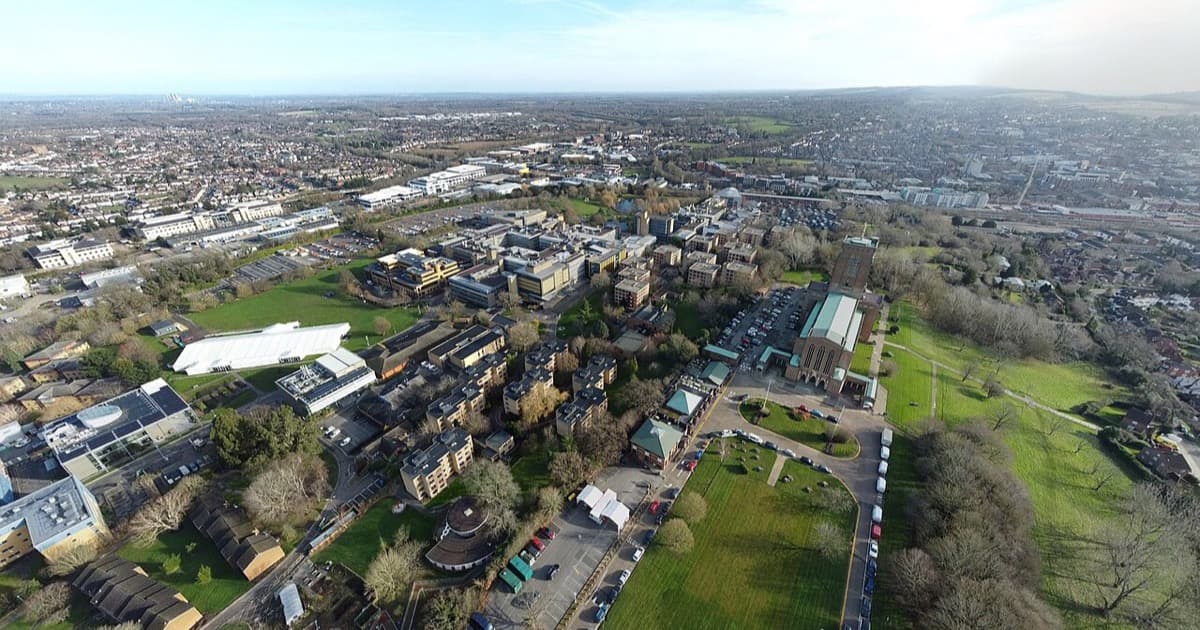
The University of Surrey offers a four-year Graduate Entry Medicine (BMBS) programme designed to prepare students for a career as foundation doctors in the UK or internationally.
The programme is delivered in the state-of-the-art Kate Granger Building, equipped with advanced clinical and diagnostic resources. The curriculum combines theoretical learning with extensive clinical practice, facilitated through structured placements with partner NHS trusts.
The course also incorporates a 'One Health, One Medicine' approach, linking human, animal, and environmental health in its teaching and research.
Surrey University employs advanced technology for anatomy teaching, including human prosections, ultrasound-guided surface anatomy, and live-streamed surgeries.
Surrey Medical school has a state-of-the-art simulation facility, the Surrey Clinical Simulation Centre. Featuring model wards, theatres and even an ambulance bay
A special study unit offers the option for full human dissection, enhancing students' understanding of human anatomy and preparing them for clinical practice.
Surrey medical school offers a spiral curriculum.
Year 1
The first year focuses on foundational medical knowledge and skills, including eight case units centred on medical scenarios and special study units. Students learn clinically relevant anatomy through human prosections, ultrasound-guided surface anatomy, and live-streamed surgeries. Placements begin from the first year of the programme, with opportunities to learn in GP and community mental health settings.
Year 2 and Year 3
In these years, students undertake clinical placements across various primary and secondary care specialities. Placements occur in settings such as emergency departments, operating theatres, clinics, and inpatient and outpatient facilities. The focus is on direct and experiential learning alongside all members of the clinical team, emphasising the multidisciplinary nature of healthcare.
Year 4
The final year involves placement blocks where students act as senior members of clinical teams. These immersive experiences develop diagnostic and management skills essential for passing the medical licensing assessment. The year includes an elective and student assistantships, preparing students for their roles as foundation doctors.
Community Medicine Placements at Surrey University
Surrey University's medical programme emphasises community medicine through diverse placements. Students undertake placements in various settings, including primary care, community mental health settings, emergency departments, and operating theatres.
They believe that such experiences help students explore different specialities and develop adaptability and resilience. From Year 1, placements enable students to apply their learning in real-world contexts, fostering a patient-centred approach to healthcare.
Your teaching will be delivered through a combination of:
They have a number of placement partners:
Surrey Medical School uses an integrated spiral curriculum built around real-world case scenarios from the first year. Students develop biomedical knowledge alongside clinical skills through case-based learning, simulation training, and early clinical placements. Teaching takes place in the Clinical Simulation Centre and the Centre for Anatomical and Surgical Education, using advanced technology and hands-on practice. Regular placements with NHS partners are combined with on-campus sessions to reinforce learning. The course emphasises clinical reasoning, professionalism, teamwork, and reflective practice throughout.
-
Universities revise entry requirements between cycles, usually in August and September. Always confirm with the university before you apply.
-
Compare this with the A-level requirements for every UK medical school.
GCSE (or equivalent): Maths and English at grade C (5) or above. Note this is a graduate entry only programme.
Still sitting your GCSEs? Protect the grades this course screens for with 1-1 GCSE Maths, Biology and Chemistry tutoring from medics.
-
-
-
Minimum of a 2:1 UK honours degree (or equivalent). The degree can be in any subject and all academic disciplines are given equal consideration.
GCSE (or equivalent): Maths and English at grade C (5) or above.
IELTS Academic: A score of at least 7.0 overall and at least 7.0 in all components.
Not Applicable. The University of Surrey offers the A101 Graduate Entry Medicine programme and does not score A Levels for entry.
Minimum grade at first sitting: N/A (graduate entry).
See A-Level & GCSE resit policies for every UK medical school →
No
Surrey's Medicine is graduate-entry only and requires a 2:1 honours degree, so applicants are adults; no separate minimum age is published.
Compare minimum age requirements at every UK medical school →
A-Level Requirements at University of Surrey Medical School →
Expert 1-1 support for your application
1-1 support from doctors and admissions experts across every stage of your medicine application.
Interview Coaching
Mock MMI & panel interviews
1-1 Mock Interview
Marked on real criteria
Ultimate Package
Full application support
Not stated. Surrey does not publish a contextual offer for medicine. A named outreach scheme may still exist, so it can be worth emailing the admissions team to ask.
Who it applies to, in the university's own words:
Nothing published for graduate entry medicine. The university-wide contextual offer is typically two A level grades lower than the published grade, home students only, and subject requirements are not reduced. The BMBS admissions policy does not contain the word contextual at all, and its widening participation criteria appear only under the Dawson Scholarships, which are funding rather than an admissions adjustment.
An A level based policy cannot apply to a degree-entry offer, which is why this is recorded as not stated despite Surrey running a live contextual scheme.
Source: Surrey contextual offers. Last checked 16 September 2026.
Compare contextual offers at every UK medical school, with each university's criteria in its own words.
Most useful
As a graduate entry only programme, Surrey mainly looks at the GAMSAT, however there are some situations where the UCAT can be looked at (see below).
As this is a relatively new course there are no known surrey UCAT cut off scores.
Stage 1: Preliminary Shortlisting
Stage 2: Aptitude Test - GAMSAT or UCAT
Stage 3: Multiple Mini Interviews (MMI)
IELTS Academic: A score of at least 7.0 overall and at least 7.0 in all components.
📝 PS - Have your PS checked - 5⭐ Rated
🎙️ Interviews - 1-1 Online Medicine Interview (Panel & MMI) Tutoring & Mocks tailored to Surrey - 5⭐ Rated
Yes
Work experience in caregiving is desirable but not essential. It is not formally scored during selection, but candidates are encouraged to gain caring experience to draw on at the MMI interview stage.
Personal statements are not scored as part of Surrey's selection, but may be reviewed during the application process (and are screened for plagiarism via the UCAS Similarity Detection Service). Shortlisting for interview is based on academic requirements and an anonymised ranking of the admissions-test (UCAT/GAMSAT) score.
Note: from 2026 entry, UCAS replaced the single free-text personal statement with three structured questions: why you want to study the course, how your studies have prepared you, and what else you have done to prepare. Any guidance above still applies; it is simply spread across those questions. For worked examples and a review of your own statement, see our medicine personal statement examples and review service.
See our medicine personal statement examples: model statements in the new UCAS format, each with commentary on what works and why.
Interview preparation
Our 1-1 medicine interview tutoring is online and your tutor is matched to Surrey, so every mock runs in the multiple mini interview (MMI) format Surrey uses, with written feedback after each one.
We cover every UK medical school and last year our students were offered places at every one, including Surrey.
Ten hours is £749 (£75 an hour) and includes the £349 Ultimate Q&A Guide free (500+ questions with model answers written by doctors), plus WhatsApp support between sessions.

 Most popular
1-1 Interview Coaching
Our best-value full programme
Free Q&A Guide (£349)
Buy
1-1 Interview Coaching
Deepest prep for multiple offers and Oxbridge
Free Q&A Guide (£349)
Buy

Interview Guide
Model answers to every common interview question
Free with any coaching package
BuyNot sure which option fits? Explore all interview coaching or book a free consultation.
Surrey runs a four-year graduate entry course. The full requirements, interview format and dates are on our Surrey graduate entry medicine page.
The University of Surrey's Medicine (Graduate Entry) BMBS programme selects candidates using a Multiple Mini Interview (MMI), and no offers are made without interview. The university states the MMI cycle "lasts under one hour" and is delivered through virtual/online interview events; it does not officially publish a fixed number of stations, so no station count is asserted here.
At each station, candidates are assessed and independently marked against agreed criteria, with outcomes sorted into offer, waiting list, or reject. As a graduate-entry course, the MMI is designed to assess suitability for medicine beyond academics, including motivation, ethical reasoning, communication and interpersonal qualities.
Applicants are directed to Surrey's official Admissions Process document for the relevant entry cycle for the most detailed guidance.
The University of Surrey has not published specific interview dates for BMBS Medicine (Graduate Entry) for 2027 entry. Its 2027 entry course page says shortlisted applicants are invited to an interview day chosen from a selection of virtual interview events, with the dates to be confirmed.
Surrey Medicine interviews are Multiple Mini Interviews held online and lasting under one hour. Invitations follow shortlisting on the GAMSAT or UCAT score, and after the MMI each candidate is placed in one of three categories: offer, hold on the waiting list, or reject.
Comparing this against your other choices? Every UK medical school's interview window is in one table, checked against each university's own website, in our UK medical school interview dates guide.
🎓 Surrey Medicine Interview Questions & Topics 2025 entry
Surrey has not provided any information on their MMI topics - here are some that we would prepare just in case.
These are suggested practice questions based on publicly available information and past trends. They are not official questions from the University and may not appear in your interview. Use them as part of a broader preparation strategy.
Motivation to Study Medicine
Personal Insight
NHS & Local Area
Ethical Scenarios
Other Questions
Prepare with 1-1 medicine interview coaching and practise with our medicine interview questions guide.
Practise under timed conditions with our free generator. It builds a randomised circuit from real Surrey interview themes, with follow-up questions and a notes summary you can keep. It opens preset to Surrey's own interview format, and you can record your answers to watch them back.
School of Medicine
University of Surrey
Address: Guildford, Surrey, GU2 7XH, United Kingdom
Tel: +44 (0)1483 300800
Email: admissions@surrey.ac.uk
Website: https://www.surrey.ac.uk/undergraduate/medicine-graduate-entry
Boost your medical school application
GCSE (or equivalent): Maths and English at grade C (5) or above. Note this is a graduate entry only programme.
Not Applicable. The University of Surrey offers the A101 Graduate Entry Medicine programme and does not score A Levels for entry.
Minimum grade at first sitting: N/A (graduate entry).
The UCAS course code for the standard Medicine course at Surrey is A101, and the degree awarded is the MB BS.
The course is based in Surrey, England and lasts 4 years.
Medicine at Surrey is a graduate entry programme.
Yes, Surrey requires the UCAT for entry to Medicine.
Only for applicants with degrees in Biochemistry, Biology, Biomedical Science, Chemistry or Natural Sciences . Mainly GAMSAT.
As a graduate entry only programme, Surrey mainly looks at the GAMSAT, however there are some situations where the UCAT can be looked at (see below).
As this is a relatively new course there are no known surrey UCAT cut off scores.
Stage 1: Preliminary Shortlisting.
Evaluation: Applications are reviewed based on academic achievement and predicted grades. Incomplete applications or those not meeting minimum requirements are rejected.
Yes, Surrey interviews applicants for Medicine, using a multiple mini interview (MMI) format.
Surrey uses a multiple mini interview (MMI) format for Medicine interviews.
Yes. Our 1-1 medicine interview tutoring is online and your tutor is matched to Surrey, so every mock runs in the multiple mini interview (MMI) format Surrey uses, with written feedback after each one.
We cover every UK medical school and last year our students were offered places at every one, including Surrey.
Ten hours is £749 (£75 an hour) and includes the £349 Ultimate Q&A Guide free (500+ questions with model answers written by doctors), plus WhatsApp support between sessions.
Book on the medical school interview coaching page at www.theukcatpeople.co.uk/medicine-interview-tutor-coaching, or start with a single £125 mock: upgrade within 7 days of your feedback and the full £125 comes off any package.
The Medicine interview at Surrey covers graduate entry motivation, surrey specifics & curriculum, ethical scenarios, role play & communication, teamwork & leadership (graduate level) and nhs & public health.
The University of Surrey has not published specific interview dates for BMBS Medicine (Graduate Entry) for 2027 entry. Its 2027 entry course page says shortlisted applicants are invited to an interview day chosen from a selection of virtual interview events, with the dates to be confirmed.
No, Surrey does not offer a foundation or gateway year for Medicine.
Yes. Surrey Graduate Entry Medicine (BMBS, UCAS code A101) is a four-year course in Guildford for graduates with at least a 2:1 UK honours degree (or equivalent) in any subject, GCSE Maths and English at grade C (5), and a GAMSAT result, or a UCAT result if your degree is in Biochemistry, Biology, Biomedical Science, Chemistry or Natural Sciences.
The full requirements, interview format and 2027 entry dates are on our Surrey graduate entry medicine page.
No, Surrey does not formally score the personal statement for Medicine applicants.
Personal statements are not scored as part of Surrey's selection, but may be reviewed during the application process (and are screened for plagiarism via the UCAS Similarity Detection Service). Shortlisting for interview is based on academic requirements and an anonymised ranking of the admissions-test (UCAT/GAMSAT) score.
The overseas standard-year fee is £48,400 for 2026 entry, rising in the later years of the graduate-entry programme.
No, Surrey does not offer an intercalated degree for Medicine.

Want expert help getting into Surrey?
From admissions test prep and personal statement editing to interview coaching and our all-in-one Ultimate Package, we help applicants at every stage. Tell us where you are and we will recommend the right option.
Ultimate Package students from our 2025/26 cycle, with their UCAT scores and offers, who trained with us for the UCAT, personal statements and interviews.
“Harry got my UCAT up to 2,590, working through the sections I kept dropping marks on week by week. Gemma then ran my interview practice so the MMI stations didn't catch me out, and Dr Akash mentored me the whole way through. I'm off to King's for Medicine.”
“The interview prep was the part that actually moved the needle. Proper mock MMIs, not just lists of questions, and feedback that was honest about what I was getting wrong. I ended up with four offers and firmed UCL.”
“The Ultimate Package kept me organised from UCAT through to interviews. They knew what dental schools actually ask and tightened up my personal statement. Four offers in the end, and I'm going to Birmingham.”
“Vet applications come down to the written SAQs as much as the interview. Dr Rebecca went through my SAQs line by line, sharpened my answers and prepped me for the panels. I came away with four offers and chose the RVC.”
Book your FREE consultation today
Click to book your free consultation