10 hours
1-1 UCAT tutoring
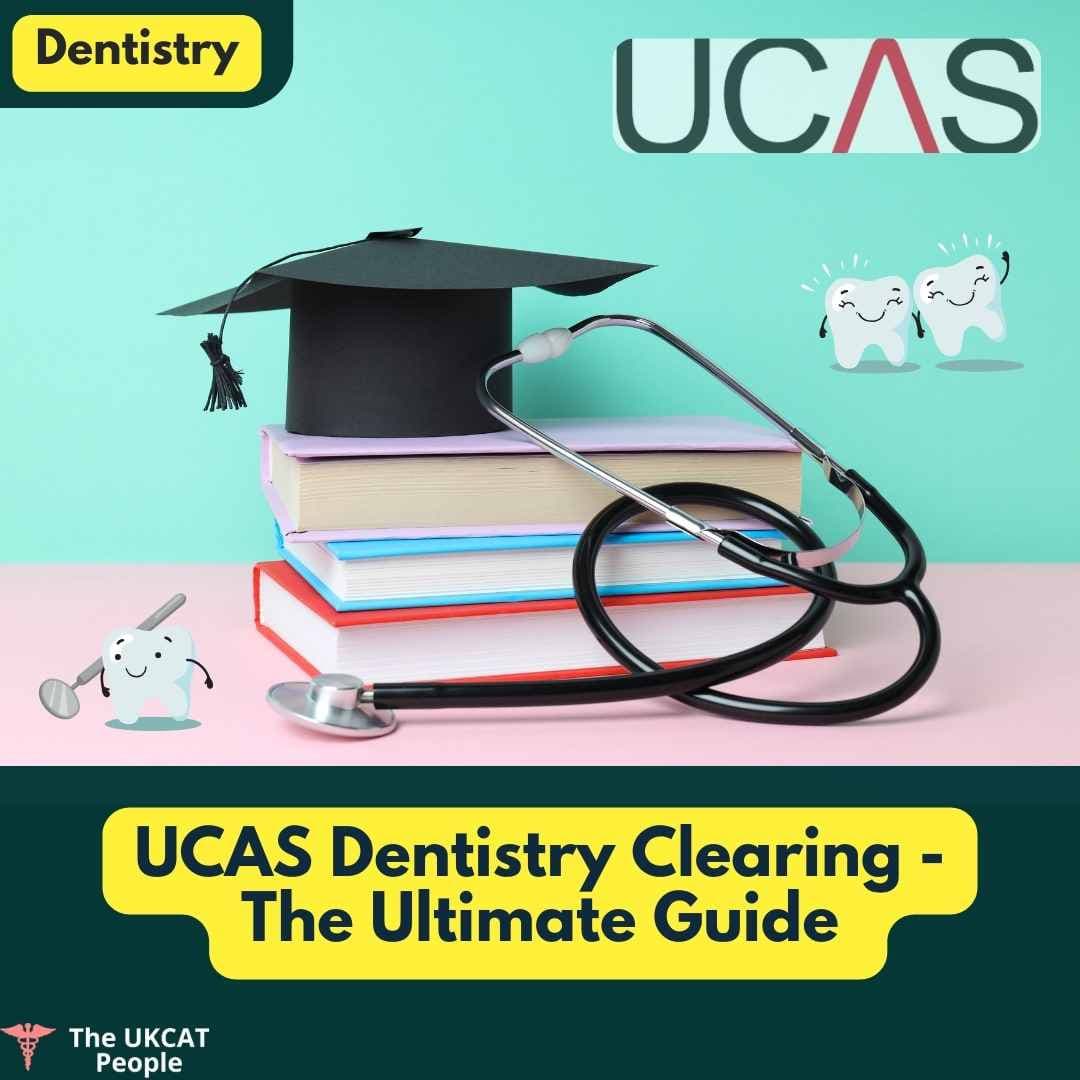
Everything that you need to know to maximise your chances of securing a place at dental school through clearing in 2026 and 2027.
Embarking on a journey into the field of dentistry can be both exciting and challenging, especially when navigating the intricacies of the clearing process. Our comprehensive Dentistry Clearing Guide for 2026 is tailored to assist you through every step, ensuring a smooth transition into your dream dental programme.
Whether you're exploring options for dentistry through clearing, seeking information on dental hygiene clearing, or curious about the possibilities of getting into dentistry via UCAS clearing, we've got you covered.
Aspiring dental students often ponder questions like 'Can you get into dentistry through clearing?' or 'Is there clearing for dentistry?' We provide clear, concise answers to these queries and more. Our guide delves into the specifics of dentistry clearing in the UK, highlighting key dates, requirements, and strategies to maximise your chances of success. We also explore the nuances of dental hygiene and dental therapy clearing for those considering alternative pathways in dental health care.
For students aiming for specific universities, we offer insights into institutions like Sheffield and Manchester, known for their outstanding dentistry programmes. Our guide also touches upon the concept of early entry and foundation year options in dentistry, catering to a wide range of academic backgrounds and aspirations.
Understanding the competitive nature of dentistry admissions, our guide is designed to equip you with knowledge about the clearing process. Whether you are a student aiming for dentistry clearing or seeking last-minute options in clearing for dentistry, our resource is an invaluable tool.
We also address common concerns, such as whether dentistry goes into clearing and the dynamics of first-come, first-serve policies.
Stay ahead in your journey towards a career in dentistry with our extensive Dentistry Clearing Guide, tailored to answer all your questions and guide you towards a successful application.
UCAS Clearing is the system that matches applicants to university places that have not been filled. Anyone without a confirmed place can use it, whether you received no offers, declined the ones you had, or missed your grades.
Dentistry is different from most subjects in one important way. Places are capped and heavily oversubscribed, so almost every dental school fills its BDS cohort through firm and insurance offers long before Clearing opens. Some years one or two schools have vacancies. Most years none do.
Dental school Clearing effectively begins on A-level results day, Thursday 13 August 2026, when grades are released and universities know which offer holders they have lost.
Rarely, and you should not plan around it. In most cycles no UK dental school lists a BDS vacancy in Clearing at all. When one does, it is usually a newer school, an international fee route, or a foundation year rather than standard first year entry, and the place is gone within hours.
What appears far more often is the wider dental family: dental therapy and dental hygiene courses, dentistry with a foundation year, and graduate entry. Those are covered in their own section below, and for most readers of this page they are the realistic option.
Honest answer: less realistic than for medicine, and medicine is already difficult. Dental school intakes are smaller, so a single withdrawal is absorbed by the reserve list rather than released to Clearing. Several dental schools say plainly on their own course pages that they do not enter Clearing at all.
That does not make calling pointless. It makes the order of your calls matter, because you have a morning and not a week. Work through the school by school call list below, and start with the university that already holds your application.
One thing that no longer exists: UCAS Adjustment, the old service that let students who exceeded their offer swap course while keeping their original place, was scrapped after summer 2021. If you do better than expected and want to look elsewhere, you now use the 'Decline my place' self release button, which puts you into Clearing and Clearing Plus. That decision cannot be undone, so read our walkthrough of accepting a dental school offer and how waitlists work before you touch it.
Read more: how to get into dentistry with low grades in the UK and dentistry UCAT cut offs by university.
These are the dates that decide what you can do and when, taken from UCAS and checked on 9 August 2026.
Some universities let you begin a Clearing application before results are out. Liverpool, for example, told applicants they could start a Clearing application from 15:00 on Tuesday 11 August 2026 and submit it from results day. Manchester said its vacancy list would go live on the evening of Wednesday 12 August 2026. Both were checked on 9 August 2026 and neither statement was specific to dentistry, but both tell you the working week starts before Thursday.
The practical version: build your call list and check each dental school's own page in the days before results day, because several publish their Clearing position in advance and let you cross them off.
Applicants to dentistry, medicine, veterinary medicine and veterinary science get four choices in those subjects rather than five, so many dentistry applicants can use Extra with a non dentistry fifth choice. For 2026 entry Extra ran from 26 February to 1 July 2026 and is now closed. If you are reading this in a later cycle, the Extra button appears automatically in the Choices section of your application if you are eligible.
Last checked: 9 August 2026. We update this section live on A-level results day, Thursday 13 August 2026, from the universities' own pages.
It is impossible to predict which dental schools will enter Clearing for 2026 entry. The only reliable source is each university's own admissions page, and many confirm only shortly before, or on, results day. Ignore any list that claims to know in advance.
We checked the dental schools below against their own course pages on 9 August 2026 and recorded exactly what each one said. Availability can change hourly, so always ring to confirm.
Updating live from the morning of Thursday 13 August 2026. Check back on results day.
These four said so in their own words. Do not spend a results day phone call on them.
Two of the most searched dental schools carry a general Clearing notice on every course page, including the BDS page. That is a site template, not a dentistry vacancy, and it is almost certainly why so many people search for Clearing at these two.
The BDS course pages at the University of Sheffield, King's College London, the University of Bristol and the University of Glasgow carried no Clearing statement of any kind. Absence is not a "no", but it is not a "yes" either. We could not reach the Cardiff, Leeds or Birmingham pages on 9 August 2026.
For context, the Complete University Guide Clearing search returned "No results for Dentistry" on 9 August 2026, and a single dental hygiene result. That is a normal August picture for this subject.
On the day, also check the official UCAS Clearing search, and phone every university you originally applied to, because spaces can open there first. Then work through the school by school call list.
Nobody can tell you which dental schools have Clearing places before results day. What we can tell you is where each school stands today, because that is the sensible order to work through your calls at 08:00 while you wait for vacancies to appear.
This is a record of what each school has said or done, not a prediction. Appearing below is not an indication that a school will have places in 2026. Always check the university's own admissions page before you ring.
How to read this: where we quote a page, we checked it on 9 August 2026 and the wording is theirs. Where we say we have no record, that means our own tracking of past cycles, not a statement by the university. Every school below also has a full entry requirements profile on this site, linked from its heading.
The only UK dental school we could confirm as open in Clearing for 2026 entry on 9 August 2026, for EU and international applicants on the BDS only. Portsmouth is a new dental school and the course holds GDC pre-accreditation approval rather than full accreditation. Its separate BSc Dental Hygiene and Dental Therapy course said it was not available in Clearing. Call this one first if you are an international applicant. See our Portsmouth dentistry profile.
Historically the most likely UK dental school to have late availability, because it runs a four year graduate entry BDS with a deliberately small cohort of roughly 29 places and a separate international route for overseas qualified dentists. It is also one of the few UK dental schools that takes international graduates. We could not confirm any 2026 Clearing vacancy on 9 August 2026, so ring rather than assume. Note the institution rebranded from the University of Central Lancashire to the University of Lancashire. See our University of Lancashire (UCLan) dentistry profile.
The single most searched dental school on this topic. Its BDS page carried the site-wide notice "Our clearing vacancies will be live from the evening of Wednesday, 12 August" on 9 August 2026, which is not a dentistry vacancy and should not be read as one. Check the vacancy list itself on the evening of Wednesday 12 August, then ring on the Thursday morning. See our Manchester dentistry profile.
The Dental Surgery BDS page carried the site-wide "We have places available on some courses for 2026 entry" on 9 August 2026, with no dentistry-specific statement. Liverpool is worth knowing for its timing rather than its odds: UK students could start a Clearing application from 15:00 on Tuesday 11 August 2026 and submit from results day, which is earlier than most. See our Liverpool dentistry profile.
The BDS page said on 9 August 2026 that the 15 October 2025 application deadline for September 2026 entry had passed and it was no longer accepting submissions. Plymouth runs a general "Register now for Clearing" sign up, which is university-wide and not dentistry-specific. See our Plymouth dentistry profile.
Explicitly out for 2026: "This course is not available in Clearing 2026", checked 9 August 2026. This one catches people out, because Newcastle is the most reliable repeat Clearing entrant on the medicine side and applicants assume dentistry works the same way. It does not. See our Newcastle dentistry profile.
Explicitly out: "We will not have any spaces available in Clearing for this course", checked 9 August 2026. Dundee states this in advance every year, which is genuinely helpful, because it lets you cross a school off the list before the morning. See our Dundee dentistry profile.
No Clearing statement of any kind on the BDS page on 9 August 2026, and we have no record of Sheffield releasing BDS places through Clearing in recent cycles. Sheffield's general Clearing hotline is heavily searched, but the hotline is university-wide. See our Sheffield dentistry profile.
No Clearing statement on the BDS page on 9 August 2026. We have no record of King's entering Clearing for dentistry. King's did enter Clearing for medicine in 2023, which is the likely reason "KCL dentistry clearing" is searched so often, but the two admissions processes are separate. See our King's dentistry profile.
Its Dental Therapy and Hygiene course said "Closed for Clearing" on 9 August 2026. Barts is the largest London dental school and the most likely target for "dentistry clearing universities London" searches, so it is worth stating plainly that the therapy and hygiene route there was shut before results day. See our Barts and The London dentistry profile.
We could not reach the BDS page on 9 August 2026 and have no record of Birmingham releasing BDS places through Clearing. Birmingham also runs a Dental Hygiene and Therapy BSc, which is the more plausible of the two to check. See our Birmingham dentistry profile.
No Clearing statement on the BDS Dentistry page on 9 August 2026, which listed only the standard 15 October UCAS deadline. No record of Clearing places. See our Bristol dentistry profile.
We could not reach the Dental Surgery BDS page on 9 August 2026. Cardiff is worth a call for a different reason: it runs both a three year BSc Dental Therapy and Hygiene and a two year DipHE Dental Hygiene, and Welsh students on those courses can access an NHS bursary covering tuition and living costs. See our Cardiff dentistry profile.
We could not reach the Dentistry BChD page on 9 August 2026 and have no record of Leeds entering Clearing for dentistry. See our Leeds dentistry profile.
No Clearing statement on the Dentistry BDS page on 9 August 2026, which listed only the 15 October deadline. Scottish results came out on 4 August 2026, so Scottish schools settle their numbers earlier than the rest of the UK. See our Glasgow dentistry profile.
No record of Clearing places for dentistry. As with Glasgow and Dundee, the Scottish cycle is a week ahead of the A-level one. See our Aberdeen dentistry profile.
No record of Clearing places for dentistry. Northern Ireland has its own funding and quota arrangements, which make released places rarer still. See our Queen's Belfast dentistry profile.
UEA is a dental provider rather than a BDS school, so it is the therapy and hygiene route you would be calling about. No record of Clearing places. See our UEA dentistry profile.
Students search every year for dentistry Clearing at Manchester, Sheffield, King's, Birmingham and Bristol in particular. Where a school is not shown above as open, we have no record of it entering Clearing for dentistry in recent cycles. That is not the same as saying it never will, and it is never a reason to skip calling them.
It is also worth contacting every university you originally applied to, to ask whether any spaces have opened. That should be high on your list, not an afterthought, because a school that already holds your application, your UCAT score and your reference can move fastest.
Compare entry requirements for all of these at our UK dental schools guide, and check the numbers you will be asked for at dentistry UCAT cut offs by university.
Be mentored 1-1 by a dentist
Every question answered, from choosing schools to interview day.
Every UK dental school’s Clearing phone number and dentistry admissions email is below, with what each number actually connects to and its results day hours. All 18 were read from the universities’ own websites on 11 August 2026.
There is no single dentistry Clearing phone number. Only 16 of the 18 take school leavers at all, and only 15 of those are recruiting for 2026 entry. Each dental school runs its own line, and not one of the 18 publishes a dentistry-only Clearing hotline. Every number below is a general university Clearing line, a central admissions line or a dental school office. 13 give you a number to ring and 5 do not, either because the number is not published until results day or because they run Clearing through an online form.
Jump straight to a dental school: Aberdeen · Birmingham · Bristol · Cardiff · Dundee · East Anglia (UEA), first intake 2027 · Glasgow · King's College London · Lancashire · Leeds · Liverpool · Manchester · Newcastle · Plymouth · Portsmouth · Queen Mary (Barts) · Queen's Belfast · Sheffield
Dental schools run public dental hospitals, so their websites publish patient appointment numbers alongside admissions contacts. We found eight, including two NHS trust dental appointment lines on one faculty contact page. None of them appears below. Check any number against the university’s own website before you dial.
Almost every school here also runs Dental Therapy or Dental Hygiene, with separate admissions contacts and separate Clearing availability. Those courses can have places when the dental degree does not. Nothing in these tables refers to them.
One naming point while you are ringing round: not every UK dental degree is a BDS. Leeds awards a BChD. It is the same primary dental qualification.
None of these has ruled Dentistry out of Clearing. That is not the same as having places, and most will not. Check the live UCAS Clearing search first, then work down. A general Clearing hotline cannot make a dentistry decision, so read the middle column before you dial.
Dental school | Phone | What this number is | Dentistry email |
|---|---|---|---|
Birmingham | Not published yet | Their own words: "Our hotline phone numbers will be published soon." Callable from 8am Thu. School office 0121 466 5542. | None published, enquiry form only |
Bristol | Not published yet | Published when Clearing opens. UK admissions 0117 394 1649, Mon to Fri 9am to 5pm. | choosebristol-ug@bristol.ac.uk |
Glasgow | 0141 330 2999 | Clearing Advice Line. Thu 8am to 6pm, Fri 9am to 5pm. Their Clearing contact page has no phone at all. | med-sch-dental-ug@glasgow.ac.uk |
King's College London | 020 3858 1050 | Clearing hotline, opens 8am Thu. KCL publishes no dentistry admissions phone or email at all. | None published |
Liverpool | No phone route | Liverpool states it has no Clearing phone number. Online form and chatbot. Live chat Thu 8.15am to 6pm. | dentenq@liverpool.ac.uk |
Queen's Belfast | 028 9097 5000 | Clearing hotline, opens 8am Thu. Central admissions 028 9097 3838, 10am to 12pm and 2pm to 4pm. | dentistry@qub.ac.uk |
Sheffield | 0114 212 9900 | Confirmation and Clearing helpline, Thu and Fri from 8am. Dental admissions officer 0114 215 9307. | dental.admissions@sheffield.ac.uk |
One dental school is open in Clearing for 2026, and it is closed to UK applicants. Portsmouth’s course page carries a generic "This course is available through Clearing" block directly above the restriction, so read both sentences before you ring.
Two of the 18 are brand new, and they are not in the same position. UEA has not opened yet: its first students start in September 2027, so it is not a 2026 route at all. Portsmouth did open in September 2026, but only to international and EU applicants, with UK places from 2027. Both are still working through GDC approval, so ask either of them about it before accepting.
Dental school | What the university says (checked 11 August 2026) | Phone | Dentistry email and source |
|---|---|---|---|
Portsmouth | "This course is available through Clearing. But also, on the same page: "This course is only accepting applications from EU and international students for September 2026 entry. UK students can apply for September 2027 entry."" | 023 9284 8090. Results day Thu 8am to 8pm. GDC approval provisional | admissions@port.ac.uk |
Each of these has said so on its own website, or has closed applications, or only admits applicants who already hold a degree. Their words are below with a link to the page. Checked 11 August 2026, and worth rechecking the UCAS Clearing search on the day before ruling anywhere out for good.
Dental school | What the university says (checked 11 August 2026) | Phone | Dentistry email and source |
|---|---|---|---|
Aberdeen | "You can apply through Clearing for most subjects, but please note that Medicine and Dentistry are not available. Their BDS is also graduate entry only and Aberdeen is "unable to consider applications for this programme of study from school leavers"." | +44 (0)1224 274 525 | dentistry@abdn.ac.uk |
Cardiff | "Dental Surgery (BDS). This course is not open for applications in Clearing for September 2026. Please call us on 0333 241 2800 to discuss alternative course options." | 0333 241 2800 | None published |
Dundee | "Medicine and Dentistry applications are now closed for September 2026. We will not have any spaces available in Clearing for this course." | 01382 386386. Thu 8am to 7pm | DentalAdmin@dundee.ac.uk |
East Anglia (UEA), first intake 2027 | "This course is open to UK and international fee-paying students. The entry point is in September each year. We have 25 UK places and 11 international places for 2027 entry." | See note | admissions@uea.ac.uk |
Lancashire | "Applications for September 2026 are now closed for UK students. The BDS here is a four year graduate entry pathway, so A-level applicants are not eligible." | 01772 830777. Thu 8am to 8pm | CEnquiries@uclan.ac.uk |
Leeds | "The School of Dentistry does not usually enter Clearing for Dental Surgery BChD however, this is subject to change. If places become available through Clearing this will be advertised via the University of Leeds Clearing Listings." | 0370 126 0606. Opens 8am Thu | denadmissions@leeds.ac.uk |
Manchester | "Unfortunately, Medicine and Dentistry courses are not usually available through UCAS Extra or Clearing. Note this sits on their international admissions page, not their dentistry pages." | 0161 529 4577 | ug.dentistry@manchester.ac.uk |
Newcastle | "This course is not available in Clearing 2026. This means there are no spaces available for Clearing 2026." | 0800 073 5050. Opens 8am Thu | Dental.Admissions@ncl.ac.uk |
Plymouth | "The application deadline for September 2026 entry has now passed (15 October 2025), and we are no longer accepting submissions." | 0333 241 6929. Thu 8am to 9pm | admissions@plymouth.ac.uk |
Queen Mary (Barts) | "Medicine and Dentistry programmes based in London (UK) are not available in Clearing this year. Their course page adds: "This course is not available in clearing."" | Not published yet | smdadmissions@qmul.ac.uk |
Most UK dental degrees are A200, but not all, and giving the wrong code on the phone wastes time. Bristol, Manchester, Newcastle and Plymouth are A206. King’s College London is A205. Aberdeen is A201 and Lancashire A202, both graduate entry. Portsmouth is the odd one out at B758.
Most open at 8am on Thursday 13 August 2026. Plymouth runs latest, to 9pm, followed by Lancashire and Portsmouth to 8pm and Dundee to 7pm. Sheffield answers on Thursday and Friday only, and Liverpool has no phone line at all.
Four schools have not published a Clearing number yet: Birmingham, Bristol and Queen Mary say theirs arrives closer to the day, and UEA says its hotline number is released at 8am on results day itself. Queen Mary warns that its Clearing numbers look very similar to one another and the last digits change, so take that one from its own site and nowhere else.
Only call a dental school if Dentistry is actually showing as available on the official UCAS Clearing search or on that university’s own Clearing page. Ringing on the off chance uses up time you do not have. Bear in mind Sheffield’s note that the UCAS Clearing application facility itself only opens after 1pm on Thursday.
When BDS has nothing, these are the routes where places actually turn up. They are also the ones most applicants overlook on the morning, and for this page they are the biggest single group of readers.
More often than BDS, yes, but do not mistake "more often" for "easy". There are more providers, cohorts are small, and competition for dental therapy and hygiene places is genuinely fierce. On 9 August 2026 the Complete University Guide Clearing search showed one dental hygiene vacancy in the whole of the UK, at London South Bank University, and none for dentistry.
It also varies by provider in ways you cannot guess. On the same day, Portsmouth's BDS was open in Clearing while its BSc Dental Hygiene and Dental Therapy said "This course is not available in Clearing", and Queen Mary's Dental Therapy and Hygiene said "Closed for Clearing". Check each provider individually.
The main university providers include Birmingham, Cardiff, Queen Mary (Barts), Portsmouth, Manchester, Leeds, Sheffield, Newcastle, Liverpool, Plymouth, UEA and Essex, alongside several NHS trust and college providers. Cardiff splits the route in two: a three year BSc Dental Therapy and Dental Hygiene and a two year DipHE Dental Hygiene, with an NHS bursary for eligible students. Entry is typically 120 to 128 UCAS points, or ABB at Queen Mary, and A level Biology is usually required.
Only providers approved by the General Dental Council can register you to practise, so check the GDC approved provider list before you accept anything you found through a third party Clearing search.
It can be, but be clear eyed about it. There is no automatic transfer from a therapy or hygiene degree into year one or year two of a BDS. What it gives you is three years of clinical experience, GDC registration, an income, and a genuinely strong reapplication if you still want BDS afterwards. Plenty of dentists took exactly this path. Plenty of others found they preferred therapy and stayed.
If you are going to make that call in a phone box on results day, make it because you want the job, not because it is the nearest thing to dentistry on the list.
If you take this route, we can help with the application: dental hygiene and therapy personal statement reviews and dental hygiene and therapy interview coaching.
A six year route: a foundation or gateway year that builds the science and study skills you need, then the standard five year BDS. Historically the most likely dentistry course to appear in Clearing, because entry requirements are lower than standard BDS. Most of these courses carry contextual eligibility rules covering things like school performance, household income and care experience, and those rules are checked, so read the criteria properly before you spend a call. Our guide to getting into dentistry with low grades in the UK lists the foundation and gateway options.
If you already hold a degree, graduate entry dentistry is a separate route with its own late availability. The University of Lancashire (formerly UCLan) runs a four year graduate entry BDS open to UK and international graduates, with a cohort of roughly 29. Most graduate routes want a 2:1 in a biomedical discipline plus the UCAT. See our graduate entry dentistry guide.
Medicine, veterinary medicine, pharmacy, biomedical science and the allied health professions all have their own Clearing picture, and they are worth a serious look rather than a consolation glance. Our medicine Clearing guide covers the same results-day tactics for A100, and our dentistry gap year and reapplication guide maps out a year that produces a stronger application than a rushed Clearing choice would.
Boost your UCAT with 1-1 tutoring
Rated 5.0 from 640+ reviews. 1-1 sessions with top-scoring tutors, weekly or more often, built around your weakest subtests.
10 hours
1-1 UCAT tutoring
20 hours
1-1 UCAT tutoring
30 hours
1-1 UCAT tutoring
Results Day and Clearing: What to Know and What to Do On The Day [UPDATED]
On results day, you will usually receive an email from UCAS or the university confirming whether you have secured a place. This typically comes in the morning. What happens next will depend on your situation.
A) If your place is confirmed
Congratulations! No further action is needed unless you are considering alternatives or deferring. It can still be useful to understand the clearing process in case anything changes.
B) If you have missed your offer:
C) If you do not have any offers/missed your offer with lower grades
Clearing becomes your route forward. Here are some practical steps to take:
1) BEFORE: Make a list of universities the day/week before results day:
Go through universities in advance and make a list of those you are interested in. Start with:
Key Tip: Check their websites carefully (before results day). Some will already state they are not entering clearing this year. If so, you can cross them off your list. Some will have forms that you can fill in to register for interest - it is definitely worth doing this! Have the relevant phone numbers and UCAS codes ready to go.
2) On results day, check UCAS before you start dialling
Universities can receive hundreds of calls on results day, so aim to get going first thing in the morning. Check the UCAS Hub and the official UCAS clearing search for any dentistry (BDS), dental therapy or dental hygiene courses that appear, but be realistic: BDS vacancies are rare and go almost immediately.
3) On the day, call universities directly & quickly
You can call:
Ask if they are accepting applicants through clearing and whether you meet their entry requirements.
4) Have your details ready
5) Other tips
If you do not secure a place through clearing
It is not the end of the road. There are still other options available. You may want to consider:
We have written a detailed article to help you understand your options and build a strong plan:
👉 No Offers for Medicine? What to Do Next (the same principles apply to dentistry)
If you would like tailored help with your next steps, our team offers free consultations and expert support. You are not alone in this there is always a way forward. We support many gap year students through their reapplications via our Ultimate Packages.
The following groups of individuals can apply to university through the clearing process:
Because BDS clearing places are so scarce, it is worth comparing dentistry with related routes. Some students secure a dental therapy or dental hygiene place in clearing more readily, then consider transferring or reapplying. To plan a stronger second attempt, see our gap year guide to reapplying for dentistry.
Do not worry! If you are unable to gain a place during clearing, taking a gap year and reapplying to Dentistry or other degrees is a great option.
Enjoy your gap year, gain experience, better your UCAS application, and apply with a stronger application.
Prepare for your dental school interviews
Rated 5.0 from 640+ reviews. Mock MMI and panel interviews with expert tutors, built around dental school questions.
10 hours
1-1 interview coaching
20 hours
1-1 interview coaching
30 hours
1-1 interview coaching
If you are planning to reapply to dentistry, we recommend reading our Ultimate Dental Gap Year Guide
Dentistry rarely goes into clearing. Most UK dental schools fill their BDS places through firm and insurance offers well before results day, so vacancies are uncommon and disappear quickly. A small number of universities occasionally release places, and dental therapy or hygiene courses appear more often than BDS. Treat clearing as a long shot rather than a reliable route into dentistry.
Yes, but it is uncommon. It is possible to secure a dentistry (BDS) place through clearing in occasional years when a university releases spaces, but these are very limited and competitive. You will usually still need to meet entry requirements, hold a UCAT score and may face an interview at short notice. Always have a backup plan such as a gap year and reapplication.
Clearing technically applies to dentistry in 2026, but available BDS places are scarce. Clearing opened on 2 July 2026 and the main activity starts on results day, Thursday 13 August 2026. Check the UCAS clearing search and call dental admissions teams from 8am, while keeping realistic expectations, as most dental schools do not enter clearing at all.
A-level results day is Thursday 13 August 2026, with results usually available from 8am. Clearing opened on 2 July 2026 and the last date to add a Clearing choice is 19 October 2026. You can phone universities from 8am on results day, but you cannot add a clearing choice in the UCAS Hub until 1pm. Scottish results day, now run by Qualifications Scotland rather than the SQA, was earlier, on Tuesday 4 August 2026.
There is no fixed list, because dental schools rarely enter clearing and any vacancies change yearly. We keep a live section on this page checked against each university's own course page, plus a school by school call list. Newer or smaller dental programmes are slightly more likely to have spaces than highly ranked schools, and some publish in advance whether they are taking clearing applicants. Check each university's website before results day and the UCAS clearing search on the day itself.
UCAS Adjustment was scrapped in 2021, so it no longer exists. It used to let students who exceeded their offer trade up without losing their place. Now, if you do better than expected and want to move, you use self-release (the Decline My Place button) to enter clearing. Clearing is the single route for finding a new place after results.
Have your UCAS Personal ID and clearing number, your GCSE and A-level (or equivalent) results, your UCAT score and your personal statement to hand. Prepare a shortlist of universities and courses, including non-dentistry backups, and be ready for a short-notice interview. Start calling dental admissions teams from 8am, as places go quickly.
Dental therapy and dental hygiene places do appear in clearing more often than BDS dentistry, because there are more providers and they are sometimes less oversubscribed. They are still competitive. Some students use a dental therapy or hygiene course as a stepping stone, gaining experience before reapplying to a BDS programme. Check entry requirements carefully, as they differ from dentistry.
There is no single clearing cut-off, but you will usually need a UCAT score that meets the university's standard entry threshold for dentistry. The UCAT is scored out of 2700 across four subtests (Abstract Reasoning was removed for 2025 entry). Strong scores help in clearing because spaces are limited and competitive, so admissions teams can still be selective.
It is rare. International dentistry places are very limited and capped, so most are filled long before clearing. A small number of universities may consider international applicants for any clearing vacancies, but expect strict entry requirements and high fees. Contact international admissions teams directly and early, and prepare alternatives, as international dentistry clearing places are exceptionally hard to secure.
It is not the end of the road. Many strong dentists reapply after a gap year. Use the time to gain dental work experience, retake the UCAT, improve grades if needed and strengthen your personal statement. You could also consider a related course such as dental therapy or biomedical science, then reapply to dentistry with a more competitive application.
Yes. If you have not yet applied for the current cycle, you can submit a UCAS application specifically for clearing once it opens. You will pay the application fee (£28.95 for 2026 entry, covering up to five choices) and can then contact universities about available places. For competitive subjects like dentistry, applying fresh in clearing is challenging, so manage expectations.
Dental schools that take clearing applicants may interview you within days. Review common MMI stations, NHS dentistry hot topics, the GDC standards and your motivation for dentistry. Keep your availability flexible and have a quiet space ready for an online interview. Practising a few core questions in advance means you can perform well even with little notice.
For most applicants, a planned gap year and reapplication gives a stronger chance than relying on scarce dentistry clearing places. Clearing is worth trying on results day, but because BDS vacancies are so rare, a gap year lets you boost work experience, retake the UCAT and reapply with a sharper application. Weigh both options against your results and circumstances.

Want expert help with your application?
From 1-1 tutoring and personal statement editing to interview coaching and our all-in-one Ultimate Package, we support every stage. Tell us what you are aiming for and we will recommend the right option.
Ultimate Package students from our 2025/26 cycle, with their UCAT scores and offers, who trained with us for the UCAT, personal statements and interviews.
“Harry got my UCAT up to 2,590, working through the sections I kept dropping marks on week by week. Gemma then ran my interview practice so the MMI stations didn't catch me out, and Dr Akash mentored me the whole way through. I'm off to King's for Medicine.”
“The interview prep was the part that actually moved the needle. Proper mock MMIs, not just lists of questions, and feedback that was honest about what I was getting wrong. I ended up with four offers and firmed UCL.”
“The Ultimate Package kept me organised from UCAT through to interviews. They knew what dental schools actually ask and tightened up my personal statement. Four offers in the end, and I'm going to Birmingham.”
“Vet applications come down to the written SAQs as much as the interview. Dr Rebecca went through my SAQs line by line, sharpened my answers and prepped me for the panels. I came away with four offers and chose the RVC.”
Book your FREE consultation today
Click to book your free consultation