UCAT Score Calculator 2026 - Convert Raw Marks to Scaled Scores Out of 2700
Enter your raw marks for an instant scaled score out of 2700, your national percentile and decile, and your Situational Judgement band. Then convert between the current 2700 scale and the pre-2025 scale out of 3600. Built on official UCAT statistics and used by thousands of applicants every cycle.
By Dr Akash Gandhi·NHS GP and Medicine Admissions Expert·Updated 5 October 2026
Updated for the 2026 UCAT exam (2027 university entry)
This free UCAT score calculator and UCAT score converter turns the raw marks from any practice test into a scaled score out of 2700, then shows exactly where that score sits nationally. It is built on the official UCAT statistics published by the UCAT Consortium, the same data universities see, and it is updated for the 2026 exam (2027 entry).
UCAT Score Calculator 2026: Raw Marks to Scaled Scores, Percentile and SJT Band
Type the raw marks from your mock or official score report. Each subtest converts to a scaled score between 300 and 900 as you type; once all three cognitive subtests are in, you get your total out of 2700 with your decile rank and national percentile from official UCAT data. Decision Making includes a partial marks mode for its two-mark questions, which most calculators ignore.
2026 score range
900 - 2700
Average score (2026)
1918
Top 10% (9th decile)
2250+
99th percentile
2471+
Subtest scale
300 - 900 each
SJT result
Band 1 - 4
Start here: free UCAT score calculator
UCAT Score Calculator 2026
Scaled scores, percentile, decile & SJT band | TheUKCATPeople
Updated for the 2026 UCAT exam (2027 entry) with the latest data
raw marks out of 44
raw marks out of 35
raw marks out of 36
Total score
-
Cognitive subtests, out of 2700
theukcatpeople.co.uk
2026 decile
-
Official 2026 decile boundaries
2026 percentile
-
Among 42,359 candidates in 2026
SJT band
-
Bands 1 (best) to 4
UCAT Score Converter: 2700 Scale to 3600 Scale and Back
Abstract Reasoning was removed from the UCAT in 2025, changing the total score range from 1200-3600 to 900-2700. To compare your score with siblings, older cohorts or university cut-offs published before 2025, convert by percentile in either direction below: 2025 to 2024 or 2024 to 2025, old scale to new and back. It works for any pre-2025 result, so scores from 2024, 2023 or earlier convert the same way.
Converted score out of 3600
-
2026 percentile
-
Among 42,359 candidates in 2026
2026 decile
-
Official final 2026 boundaries
Conversion runs on official UCAT decile statistics with shape-preserving interpolation between published anchor points. Equivalents are statistical, not official UCAT results.
Got your score? Here is what to do next.
See how every UK university uses the UCAT and find each medical and dental school's cut-off, so you know exactly where your score is competitive.
How This UCAT Calculator Works: Data and Methodology
Data sources. Percentile and decile figures come from the official test statistics published by the UCAT Consortium (final 2026 figures, the latest full cohort of 42,359 tests). Raw-mark to scaled-score bands are compiled from official guidance and thousands of verified student score reports.
Method. Raw marks map to scaled scores through equating bands; totals map to percentiles through the published ranges with interpolation inside each range. Decision Making partial marks (47-mark structure) are modelled separately. Cross-scale conversion matches scores by percentile, never by simple scaling.
Limitations. The UCAT equates every test version individually, so all results are close estimates, not official scores. Only your official score report is definitive.
Updates. We refresh the data as soon as the UCAT Consortium publishes final statistics each cycle. Current data version: official 2026 final statistics, published after the 2026 testing window closed.
Built and maintained by Dr Akash Gandhi, NHS GP and Lead UCAT Mentor, who has taught the UCAT to thousands of students, teaches in schools and runs our UCAT courses, supported by a tutor team who all scored in the top 10% of the exam.
Conversion table
UCAT Score Conversion Table 2026: Raw Marks to Scaled Scores
One table for all three subtests: find a scaled score on the left, then read across for the raw marks that produce it in each subtest.
The UCAT statistically equates each test version, so exact boundaries shift slightly between sittings. These bands are compiled from official guidance and verified score reports.
Verbal Reasoning score converter
VR has 44 questions and is the harshest-scaled subtest: around 40 of 44 raw marks are needed for 880, and the national VR average is the lowest of the three. Convert your VR raw marks to a scaled score in the calculator above or read the VR column of the table.
Decision Making score calculator
DM has 35 questions carrying 47 marks: 12 two-mark questions award 1 mark when partially correct. Use the partial marks mode in the calculator for the precise DM conversion, or the DM column above if you only know questions correct.
Quantitative Reasoning score converter
QR has 36 questions and the most generous top end: 33 of 36 raw marks reach 900, and the QR decile boundaries run higher than VR and DM at every rank. Convert your QR raw marks in the calculator above.
How it works
How Is the UCAT Score Calculated in 2026?
1
Count your raw marks per subtest
From your mock or practice test, note your raw marks: Verbal Reasoning out of 44, Decision Making out of 35 questions (47 marks with partial marking), and Quantitative Reasoning out of 36. Situational Judgement is out of 69 marks.
2
Convert raw marks to scaled scores
Enter each subtest's raw marks into the calculator. Each converts to a scaled score between 300 and 900 using equating bands compiled from official UCAT guidance and verified score reports.
3
Read your total, percentile, decile and SJT band
Your three cognitive scaled scores sum to a total between 900 and 2700. The calculator shows your national percentile and decile from the official final 2026 UCAT statistics, your SJT band (1 to 4), and the equivalent score on the pre-2025 scale out of 3600.
The UCAT is computer-marked with no negative marking, and raw marks are converted to scaled scores through statistical equating so that scores are comparable across different test versions. Read the full breakdown in our UCAT scores and scoring guide.
Percentiles
UCAT Percentile Calculator 2026 (Official Final 2026 Data)
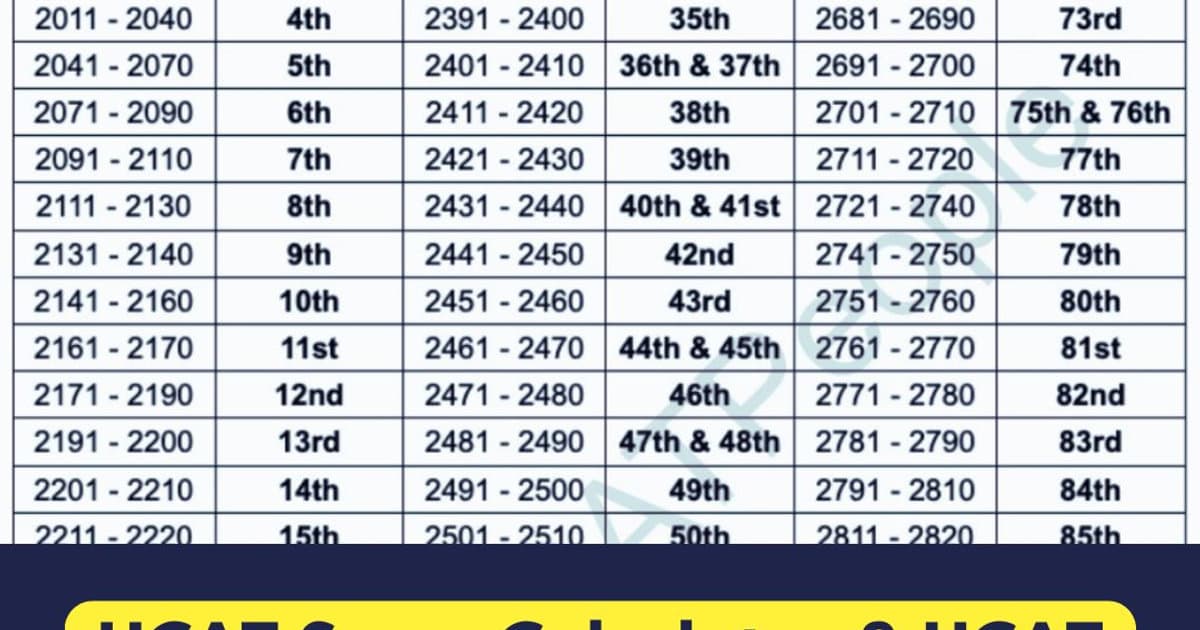
Every percentile from 1st to 99th with its total score range out of 2700: the most accurate published mapping for the current scoring scale.
Percentile
UCAT Score
1st
900 - 1400
2nd
1401 - 1440
3rd
1441 - 1470
4th
1471 - 1490
5th
1491 - 1510
6th
1511 - 1530
7th
1531 - 1550
8th
1551 - 1570
9th
1571 - 1580
10th
1581 - 1590
11th
1591 - 1610
12th
1611 - 1620
13th
1621 - 1630
14th
1631 - 1640
15th
1641 - 1650
16th
1651 - 1660
17th
1661 - 1670
18th
1671 - 1680
19th
1681 - 1690
20th
1691 - 1700
21st
1701 - 1710
22nd
1711 - 1720
23rd & 24th
1721 - 1730
25th
1731 - 1740
26th
1741 - 1750
27th & 28th
1751 - 1760
29th
1761 - 1770
Percentile
UCAT Score
30th
1771 - 1780
31st & 32nd
1781 - 1790
33rd
1791 - 1800
34th
1801 - 1810
35th & 36th
1811 - 1820
37th
1821 - 1830
38th & 39th
1831 - 1840
40th & 41st
1841 - 1850
42nd
1851 - 1860
43rd & 44th
1861 - 1870
45th
1871 - 1880
46th & 47th
1881 - 1890
48th
1891 - 1900
49th & 50th
1901 - 1910
51st
1911 - 1920
52nd & 53rd
1921 - 1930
54th
1931 - 1940
55th & 56th
1941 - 1950
57th
1951 - 1960
58th & 59th
1961 - 1970
60th
1971 - 1980
61st & 62nd
1981 - 1990
63rd
1991 - 2000
64th & 65th
2001 - 2010
66th
2011 - 2020
67th
2021 - 2030
68th & 69th
2031 - 2040
Percentile
UCAT Score
70th
2041 - 2050
71st
2051 - 2060
72nd
2061 - 2070
73rd & 74th
2071 - 2080
75th
2081 - 2090
76th
2091 - 2100
77th
2101 - 2110
78th
2111 - 2120
79th
2121 - 2130
80th
2131 - 2140
81st & 82nd
2141 - 2150
83rd
2151 - 2170
84th
2171 - 2180
85th & 86th
2181 - 2190
87th
2191 - 2210
88th
2211 - 2220
89th
2221 - 2240
90th
2241 - 2250
91st
2251 - 2270
92nd
2271 - 2290
93rd
2291 - 2300
94th
2301 - 2320
95th
2321 - 2350
96th
2351 - 2380
97th
2381 - 2410
98th
2411 - 2470
99th
2471+
Where two percentiles share one row (for example 17th & 18th), no score lands exactly on the higher percentile in the official data. Percentiles run 1st to 99th; there is no 0th or 100th.
Deciles
UCAT Deciles 2026: Official Final Decile Ranking
Official UCAT Consortium final 2026 decile boundaries by total and by subtest, with the 2025 total for comparison and the statistically equivalent pre-2025 total out of 3600.
Decile rank
2026 total
VR
DM
QR
2025 total
≈ /3600
1st
1590
500
520
530
1580
2140
2nd
1700
540
560
580
1680
2260
3rd
1780
560
590
600
1760
2360
4th
1850
580
620
640
1820
2440
5th
1920
600
640
670
1880
2520
6th
1980
620
670
700
1950
2590
7th
2050
640
690
730
2010
2680
8th
2140
670
710
780
2100
2780
9th
2250
710
760
820
2220
2920
Each decile boundary marks 10% of candidates: the 1st decile is the 10th percentile, the 9th decile the 90th. There is no 10th decile; a total above 2250 is simply in the top 10%. Read more in our UCAT deciles guide, find historical deciles, averages and year-by-year statistics in our UCAT scores guide, and see how each university uses these rankings in our UCAT cut-off scores guide.
Score lookup
What Does My UCAT Score Mean? Common Scores Explained
Percentile, decile and the pre-2025 equivalent for the scores applicants ask about most, computed from the same official data as the calculator.
Score /2700
Percentile
Decile
≈ /3600
What it means
1700
20th
2nd Decile
2260
Below average; strongest at universities that interview on other criteria
Around the average UCAT score; competitive with the right university choices
1980
60th
6th Decile
2590
Above average; a solid platform for most applications
2050
70th
7th Decile
2680
Top 30% of candidates; competitive at many medical schools
2100
76th
7th Decile
2735
Strong; close to the top 20% of candidates
2140
80th
8th Decile
2780
Top 20%; competitive at most UCAT-heavy schools
2200
87th
8th Decile
2860
Very strong; just below the top 10% boundary
2300
93rd
9th Decile (Top 10%)
2989
Excellent; competitive everywhere
2400
97th
9th Decile (Top 10%)
3116
Exceptional; among the strongest scores nationally
2500
99th
9th Decile (Top 10%)
3304
Elite; 99th percentile territory
Scored below where you hoped? See where to apply with a low UCAT score and check every university's threshold in our UCAT cut-off scores guide. Use this page as your score predictor while you train: enter each mock's raw marks to track your percentile as it climbs.
Situational Judgement
UCAT SJT Band Calculator 2026: Estimate Your Band from Raw Marks
Situational Judgement is reported as a band, not a score. Enter your SJT raw marks in the calculator above; the bands break down as follows.
Band
Approximate marks
What it means
Band 1
80-100% of SJT marks
Excellent: judgement mirrors the expert panel in most scenarios.
Band 2
65-79% of SJT marks
Good: judgement frequently matches the expert panel.
Band 3
50-64% of SJT marks
Modest: judgement differs from the panel in a substantial minority of scenarios.
Band 4
0-49% of SJT marks
Low: judgement differs from the panel in many scenarios. Some universities exclude Band 4.
In raw marks, roughly 56 or more out of 69 has corresponded to Band 1 in recent cycles, 45 to 55 to Band 2 and 35 to 44 to Band 3. Boundaries are set after each cycle, so treat these as close estimates. Learn how SJT is marked in our Situational Judgement guide.
All platforms
Using Medify, Medentry, MyUCAT, Medic Mind or Passmedicine? This Calculator Works with All of Them
Every major UCAT practice platform, and the official UCAT practice tests, reports raw marks per subtest, which is exactly what this calculator takes. Enter raw marks from any platform mock and you get your scaled score, percentile, decile and SJT band on the official UCAT scale. Platform-specific scaled scores and conversion tables can run generous or harsh; converting through raw marks is the fair way to compare your mocks with real national data and track progress between platforms.
Australia & New Zealand
UCAT ANZ Score Calculator: Same Test, Same Scale
UCAT ANZ uses the same three cognitive subtests, the same 300 to 900 scaling per subtest and the same 900 to 2700 total as the UK test, so the raw-mark calculator above works identically for Australian and New Zealand candidates. The percentile and decile tables on this page are UK-cohort figures; ANZ boundaries are published separately and typically sit slightly higher. Applying down under? Read our UCAT ANZ guide.
Benchmarks
What Is a Good UCAT Score for 2026 (2027 Entry)?
1920+
Above average
The 5th decile (2026 average 1918). A solid base, competitive at universities that weight the UCAT lightly.
2140+
Strongly competitive
Top 20% of candidates. Competitive at most UCAT-heavy medical schools.
2250+
Top 10%
Above the 9th decile boundary. Competitive everywhere, including the most UCAT-selective schools.
These benchmarks use the official final 2026 UCAT statistics (42,359 tests), the latest full-cohort data; we update them each year as soon as the final figures are published. A good score ultimately depends on where you apply: see exactly how every university uses the UCAT in our cut-off scores guide and compare against average UCAT scores by year.
Results
UCAT Scores Our Students Achieved
Genuine reviews from Trustpilot. Old-scale scores shown with today's equivalent, converted by this page's own tool.
“I was really struggling with the UCAT, especially the time pressure. My tutor, David, was fantastic - he was very patient, and his techniques for QR and AR were brilliant. My score went from average to over 3100.”
UCAT tutoring student3100 on the pre-2025 scale: about 2387 out of 2700 today, 97th percentile
“We signed up our daughter for 30 hours of UCAT tutoring, hoping for a bit of a boost. Her final score of 3240 was fantastic. We're so grateful and will be signing up for interview tutoring next.”
Parent of a UCAT student3240 on the pre-2025 scale: about 2467 out of 2700 today, 98th percentile
“My UCAT tutor, Rebecca, showed me how to look at questions a whole new way, and my score really jumped up. Thanks to them, I got a UCAT of 3120 and ended up with offers from Liverpool, Sheffield, Brighton and St George's.”
Medicine offer holder3120 on the pre-2025 scale: about 2404 out of 2700 today, 97th percentile
Work 1-1 with top-decile UCAT tutors on a plan built around your weakest sections and your test date. Choose the hours that suit you, or talk it through first on a free strategy call.
Enter your marks in the calculator above and we will suggest the bundle that fits your score.
UCAT Score Calculator FAQs: Common Questions Answered by a Doctor
Answers written and reviewed by Dr Akash Gandhi, NHS GP and Medicine Admissions Expert.
How is the UCAT scored in 2026?
The 2026 UCAT has three cognitive subtests: Verbal Reasoning, Decision Making and Quantitative Reasoning. Each is scaled from 300 to 900, giving a total between 900 and 2700. Abstract Reasoning was removed in 2025, which is why older scores run up to 3600.
Situational Judgement is reported separately as Band 1 (best) to Band 4 rather than contributing to the total score.
What is the UCAT out of in 2026?
The UCAT total score runs from 900 to 2700 in 2026. Each of the three cognitive subtests (Verbal Reasoning, Decision Making, Quantitative Reasoning) is scaled between 300 and 900. Situational Judgement does not add to the total; it is reported as a band from 1 to 4. Before 2025 the test had four scored subtests and totals ran from 1200 to 3600.
How accurate is this UCAT score calculator?
The raw-mark to scaled-score bands are compiled from official UCAT guidance and thousands of verified student score reports, and the percentile and decile figures use the official statistics published by the UCAT Consortium. The UCAT applies statistical equating that varies slightly between test versions, so treat results as a close estimate rather than an official score.
How do I convert a UCAT score out of 3600 to the new score out of 2700?
Use the converter above: enter your score out of 3600 and it returns the statistically equivalent score out of 2700, matched by percentile against the latest cohort (2026). For example, a score at the 90th percentile on the old scale (about 2920) corresponds to about 2250 on the current scale. This is essential when comparing against university cut-offs published before 2025.
What is a good UCAT score for 2026 entry (2027 university entry)?
In the final 2026 statistics the average total was 1918. Roughly 2050 or above put you in the top 30% of candidates, 2140 in the top 20% and 2250 or above in the top 10%, which is competitive for almost every medical school. What counts as good also depends on how each university weighs the UCAT, so check the cut-off scores for your target schools.
What is the average UCAT score?
The official final mean total in 2026 was 1918 out of 2700, from 42,359 tests, close to the 5th decile boundary of 1920. Mean subtest scores were 602 for Verbal Reasoning, 640 for Decision Making and 675 for Quantitative Reasoning. Averages move slightly each year, and we update this page when new statistics are published.
What is the highest UCAT score?
The maximum possible UCAT score is 2700 (900 in each of the three cognitive subtests). In practice, any total of 2471 or above already sits in the 99th percentile, and scores approaching 2700 are exceptionally rare. On the pre-2025 scale the maximum was 3600.
What percentile is my UCAT score?
Enter your total in the calculator or converter above for an instant answer, or look it up in the percentile table on this page. As reference points from the official final 2026 data: 1920 is the 5th decile (the 50th percentile), 2140 the 80th, 2250 the 90th and 2471 or above the 99th. Percentiles run from 1st to 99th; there is no 0th or 100th percentile.
Does the calculator work with Medify, Medentry, MyUCAT, Medic Mind or Passmedicine mocks?
Yes. Practice platforms report raw marks per subtest, which is exactly what this calculator takes as input. Enter your raw marks from any platform mock, including the official UCAT practice tests, and you get a scaled score, percentile, decile and SJT band on the official UCAT scale, so you can compare performance across platforms fairly.
How does UCAT Decision Making partial marking work?
Decision Making has 23 one-mark questions and 12 two-mark questions, 47 marks in total. On the two-mark questions a fully correct answer earns 2 marks and a partially correct answer earns 1 mark. Most online calculators ignore this and only count questions; the partial marks mode in our calculator takes your one-mark, fully correct and partially correct answers separately for a more precise Decision Making estimate.
How are UCAT Situational Judgement bands calculated?
Your SJT raw marks are compared with an expert panel's answers and reported as a band. Scoring roughly 80% or more of the available SJT marks gives Band 1, 65 to 79% Band 2, 50 to 64% Band 3 and below 50% Band 4. Several universities require Band 1 to 3, and some score Band 1 favourably at interview.
How many marks do I need for SJT Band 1?
Approximately 56 or more of the 69 SJT marks (around 80%) has corresponded to Band 1 in recent cycles. Roughly 45 to 55 marks gives Band 2 and 35 to 44 marks Band 3. The UCAT Consortium sets exact band boundaries after each cycle, so treat these as close estimates rather than guarantees.
Does this calculator work for UCAT ANZ (Australia and New Zealand)?
Yes. UCAT ANZ uses the same subtests, the same 300 to 900 scaling and the same 900 to 2700 total as the UK test, so the raw-mark conversion works identically. Note that the percentile and decile figures on this page are from the UK cohort; ANZ percentile boundaries are published separately and typically sit slightly higher.
Do universities use UCAT percentiles or total scores?
Both, depending on the university. Some rank applicants by total score, others use decile or percentile boundaries, and some apply a minimum SJT band on top. That is why this page shows your score, percentile, decile and band together.
Why do older UCAT scores go up to 3600?
Before 2025 the UCAT had four scored cognitive subtests including Abstract Reasoning, each scaled 300 to 900, giving a 1200 to 3600 range. From 2025 Abstract Reasoning was removed, so totals now run from 900 to 2700. Scores from the two eras can only be compared by percentile, which is what the converter on this page does.
Is there a 10th decile in the UCAT?
No. Official UCAT reporting uses nine decile boundaries. The 9th decile boundary (2250 in 2026) marks the 90th percentile; any score above it is simply in the top 10% of candidates. A score below the 1st decile boundary (1590) is in the bottom 10%.
What is the most accurate UCAT score calculator?
The most accurate calculators are built on official UCAT statistics rather than a single straight-line formula. This calculator uses the UCAT Consortium's published percentile and decile data, raw-mark bands verified against thousands of real score reports, and Decision Making partial marking, which most calculators ignore. No calculator can be exact because the UCAT statistically equates each test version, so treat every estimate, ours included, as a close guide rather than an official result.
What is the 90th percentile UCAT score?
In the official final 2026 data, scores of 2241 to 2250 sit at the 90th percentile, with 2250 as the 9th decile boundary. For comparison, the 95th percentile is 2321 to 2350 and the 99th percentile is 2471 or above.
How do I convert a UCAT percentage to a score?
Percentage correct does not convert directly to a scaled score because each subtest is equated separately. Instead, turn your percentage back into raw marks (for example 75% in Verbal Reasoning is 33 of 44 marks), then enter the raw marks into the calculator above for the scaled score, total and percentile.
Can I convert UCAT scores from 2024, 2023 or earlier?
Yes. Any UCAT score from 2024 or earlier uses the 1200 to 3600 scale, so the converter above works for all pre-2025 results: enter the old score and you get the equivalent on the current 900 to 2700 scale, with its percentile and decile. The same works in reverse if you want to compare a 2026 score against an older sibling's result or a cut-off published before 2025.
Next step
UCAT tutoring with experts
From diagnostic to test day: a structured plan with 1-1 expert support at every stage.
Rated 5.0 from 660+ reviews · 2,700+ students taught
Ultimate Package students from our 2025/26 cycle, with their UCAT scores and offers, who trained with us for the UCAT, personal statements and interviews.
Ultimate Package
S
Sophie
Medicine, King's College London
2025 UCAT2,590 / 2,700
“Harry got my UCAT up to 2,590, working through the sections I kept dropping marks on week by week. Gemma then ran my interview practice so the MMI stations didn't catch me out, and Dr Akash mentored me the whole way through. I'm off to King's for Medicine.”
Ultimate Package
D
Daniel
Medicine, University College London
Medicine offers4 offers
“The interview prep was the part that actually moved the needle. Proper mock MMIs, not just lists of questions, and feedback that was honest about what I was getting wrong. I ended up with four offers and firmed UCL.”
Ultimate Package
A
Aisha
Dentistry, University of Birmingham
Dentistry offers4 offers
“The Ultimate Package kept me organised from UCAT through to interviews. They knew what dental schools actually ask and tightened up my personal statement. Four offers in the end, and I'm going to Birmingham.”
Ultimate Package
C
Charlotte
Veterinary Medicine, Royal Veterinary College
Vet offers4 offers
“Vet applications come down to the written SAQs as much as the interview. Dr Rebecca went through my SAQs line by line, sharpened my answers and prepped me for the panels. I came away with four offers and chose the RVC.”