10 hours
1-1 UCAT tutoring
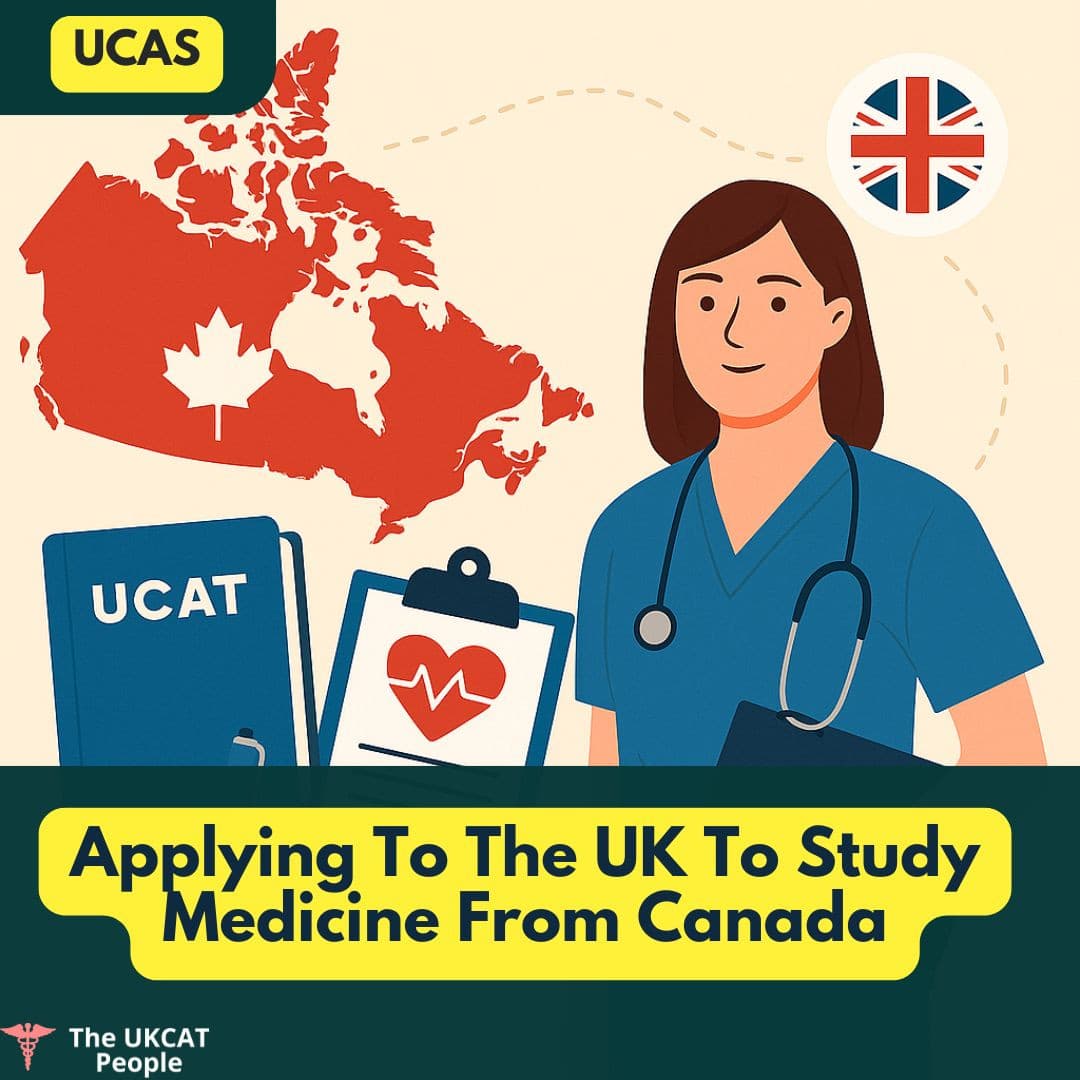
Are you thinking about studying medicine in the UK as a Canadian student? You're not alone - more students from Toronto, Vancouver, Mississauga, Burlington and North Vancouver apply each year.
The UK offers a direct path into medicine straight from high school, unlike Canada, where you must complete an undergraduate degree before applying.
You’ll also benefit from a shorter time to qualification, world-class medical schools, and recognised routes back to practice in Canada.
This guide breaks down everything you need to know - from UCAT in Canada to tuition fees, visa requirements, and our top tips for success, based on our 13 years of experience helping international students gain places to study in the UK.
UK medical schools accept Canadian students straight from Grade 12. That means no need to complete a separate undergraduate degree. It’s one application through UCAS and one entrance exam (UCAT) - and you can start your medical training right away.
By skipping four years of undergrad in Canada, you’ll enter the profession sooner and avoid extra tuition fees. UK MBBS and MBChB degrees typically last five or six years.
If you are weighing up all your options abroad, it is also worth reading our guide to studying medicine in Ireland, which covers the Atlantic Bridge Programme, the single application route built specifically for students applying from Canada and the US.
Graduates from recognised UK universities can return to Canada by completing licensing requirements such as the MCCQE and CaRMS. Many also choose to practise in the UK or apply through the US system.
We support Canadian students every year - with many securing places at universities such as St Andrews, Queen’s Belfast, Birmingham, and Manchester (+ many more)
If you're a Canadian student applying to UK medical schools, you'll be pleased to know that most UK universities are well-acquainted with Canadian curricula and grading systems.
Entry requirements will vary slightly depending on your province and chosen qualifications.
Please check each medical school's own website for up to date info on minimum grade requirements, the following are a rough guide:
Some universities (e.g. St Andrews, Edinburgh, UCL) accept AP scores of 5 in relevant subjects as equivalent to A-levels.
Usually requires at least 3-4 APs, including Biology and Chemistry.
If taken, universities typically expect A*AA to AAA, including Biology and Chemistry.
The UCAT (University Clinical Aptitude Test) is the main admissions test required by UK medical schools. All Canadian applicants must take the UCAT at an official Pearson Vue test centre in Canada.
The UCAT is a two-hour computer-based test made up of four subtests. The three cognitive subtests are each scored from 300 to 900, giving a total out of 2700, and the Situational Judgement Test is reported separately as Band 1 to Band 4. Abstract Reasoning was removed from 2025, so the subtests are now:
It’s designed to assess the skills needed for a medical degree - but many Canadian students find it challenging due to the tight timing and unfamiliar format.
You can sit the UCAT in person at Pearson Professional Centres across Canada.
Popular UCAT test centre locations include:
👉🏼 We recommend booking early, as Canadian UCAT test centres fill up quickly.
For full subtest breakdowns, scoring and a revision plan, use our UCAT Guides hub, and practise under timed conditions with the UCAT online question bank.
At TheUKCATPeople, we offer 1-1 UCAT tutoring online for Canadian students, delivered by top-scoring UCAT experts who’ve sat the test themselves.
📘 Our UCAT Canada tutoring includes:
Be mentored 1-1 by a doctor
Every question answered from abroad, from fee status to interview day, in your time zone.
For students applying in 2026 or 2027, our Ultimate Package is the most comprehensive way to maximise your chances of success.
This is more than just UCAT coaching - it’s complete 1-1 mentorship through every stage of your UK medicine application.
Most UK medical schools use the MMI (Multiple Mini Interview) format. You’ll be expected to discuss ethical scenarios, teamwork, motivation for medicine, and NHS topics - even if you haven’t lived in the UK.
Yes. UK universities accept work experience gained in Canada. We know that it is not easy to come to the UK to come and do work experience, and we, at TheUKCATPeople, generally would advise against paying for longer work experience programmes in the UK
You could consider doing any of the following in Canada:
Even one or two weeks of meaningful experience can help demonstrate commitment, maturity, and insight into a career in medicine, provided there was enough reflection in your responses and thoughts.
Boost your UCAT with 1-1 tutoring
Rated 5.0 from 640+ reviews. 1-1 sessions with top-scoring tutors, weekly or more often, built around your weakest subtests.
10 hours
1-1 UCAT tutoring
20 hours
1-1 UCAT tutoring
30 hours
1-1 UCAT tutoring
Most UK medical schools require the IELTS UKVI Academic exam - even if English is your first language.
Studying medicine in the UK is an investment - but remember, you’re saving four years of undergrad in Canada.
👉🏼 Compare UK Medical School Fees for International Students
Here are some of the most popular and accessible universities for Canadian applicants:
Compare every UK medical school side by side, with entry requirements and UCAT thresholds, using our UK medical schools ranking hub before you lock in your four choices.
Choose your Ultimate Package, mentored from abroad
Rated 5.0 from 640+ reviews. 1-1 mentoring from doctors across UCAT or UCAT ANZ, personal statement, fee-status shortlisting and online interviews, scheduled in your time zone.
Bronze
20 hours
Silver
35 hours
Gold
50 hours
Platinum
75 hours
Applying to medicine in the UK from Canada takes planning and organisation. Below is a step-by-step timeline to guide you through the entire process if you are aiming to apply in 2026 or 2027
Start early. This is the best time to begin exploring your options and building your profile.
This is the perfect time to begin preparing for the UCAT exam.
This is the UCAT testing window. You will need to sit the exam at an official test centre.
This is the UCAS application deadline for all UK medical schools.
This is the interview period. Most UK interviews for international students are now held online.
This is when you will receive offers and begin preparing for your move.
Have a qualified doctor oversee your application via our Medicine Ultimate Packages
Yes. Canadian students can apply to UK medical schools directly from Grade 12, without first completing an undergraduate degree as you would in Canada. You apply through UCAS to up to four medical schools, sit the UCAT, and usually take IELTS. UK medical degrees take five or six years, so you qualify as a doctor sooner than via the Canadian route.
Most UK medical schools want a Canadian Grade 12 average of around 85 to 90 percent in your top five or six academic courses, including Biology and Chemistry, with some preferring Maths or Physics too. If you take APs, schools such as St Andrews, Edinburgh and UCL accept scores of 5 in relevant subjects; IB applicants typically need 36 to 40 points with 6s and 7s at Higher Level. Always check each school's own page for the current cycle.
Yes. UK medical schools are familiar with Canadian curricula and accept the provincial Grade 12 diploma (Ontario, BC, Alberta, Quebec CEGEP and others), Advanced Placement and the IB. The exact mix of grades, APs or IB points varies by school, but Biology and Chemistry at Grade 12 or equivalent are almost always required. The SAT and ACT are not needed for UK medicine.
You apply through UCAS, the UK's central admissions service, choosing up to four medical schools. You submit predicted or final Grade 12 grades, a personal statement, a school reference and your UCAT result. The deadline for 2027 entry is 6pm UK time on 15 October 2026, and late medicine applications are not considered, so prepare early.
Popular and accessible choices for Canadians include St Andrews (its Scottish-Canadian medical programme is built for Canadian students), Queen's University Belfast, Exeter, Birmingham, Manchester, Bristol, King's College London, Sheffield and Glasgow. These schools are used to Canadian qualifications and offer strong international support. Compare entry requirements and UCAT thresholds across all UK schools before choosing your four.
On the current scoring (out of 2700 across three cognitive subtests for 2026 entry), a total of roughly 2400 or higher, around 800 per subtest, is competitive, alongside a strong Situational Judgement band. The mean total is usually near 1900 to 2000, so scoring well above the average widens your options. Some universities set their own thresholds, so check each school for the current cycle.
You sit the UCAT in person at Pearson VUE professional test centres in Canada, in cities including Toronto, Vancouver, Calgary, Ottawa and Montreal. The 2026 test window runs roughly from mid July to late September. Canadian centres fill quickly, so book your slot as soon as registration opens to secure your preferred date and location.
The UCAT is the UK admissions test, sat before you apply, and it measures aptitude (verbal reasoning, decision making, quantitative reasoning and situational judgement) rather than science knowledge. The MCAT is the North American test used for graduate-entry medicine after a degree, and it tests science content in depth. For direct entry to UK medicine from Grade 12 you take the UCAT, not the MCAT.
Most UK medical schools require the IELTS UKVI Academic test, even if English is your first language, because it is also used for the student visa. A typical requirement is 7.0 to 7.5 overall with no band below 6.5. Testing centres are widely available across Canada. A few schools may waive IELTS if your schooling was taught entirely in English, so check each school's policy.
Yes. UK medical schools accept healthcare experience gained in Canada, such as hospital or care home volunteering, GP or specialist shadowing, hospice work and virtual placements. What matters is reflection, not the country: even one or two weeks can demonstrate insight, empathy and commitment if you can discuss what you learned about patient care and a career in medicine.
International medicine tuition for 2026 and 2027 entry runs from about £38,000 to £67,000 per year, with clinical years usually the most expensive, plus living costs of roughly £12,000 to £18,000 a year. Scholarships for international medicine are rare, so most Canadian students plan to self-fund. Remember you save the four years of undergraduate tuition the Canadian route requires.
For many Canadians the UK route is more accessible, mainly because UK schools admit students directly from Grade 12, whereas Canadian medical schools require a completed undergraduate degree and have very few seats for very many applicants. The UK is still competitive, with the UCAT, interviews and high grades all required, but the direct-from-school pathway and wider choice of schools open more doors earlier.
Yes, with planning. Graduates of recognised UK medical schools can return to Canada by meeting Canadian licensing requirements, typically the Medical Council of Canada exams (MCCQE) and the CaRMS residency match. Many graduates instead stay to train in the UK or move to the US. Research the licensing pathway for your target province early, as some steps are easier to complete during or soon after your degree.
Begin researching schools and arranging work experience in Grade 11, start UCAT preparation in the spring or summer before Grade 12, then sit the UCAT in the July to September window. Submit your UCAS application by 15 October, interview between November and March (most international interviews are online), and respond to offers and arrange your visa and accommodation in the spring.
No. The BMAT was discontinued after the 2024 cycle, so no UK medical school uses it any more. The UCAT is now the single admissions test for UK medicine. For 2026 entry it is scored out of 2700 across three cognitive subtests, with the Situational Judgement Test reported separately as Band 1 to Band 4. Abstract Reasoning was removed from 2025.

Want expert help with your application?
From 1-1 tutoring and personal statement editing to interview coaching and our all-in-one Ultimate Package, we support every stage. Tell us what you are aiming for and we will recommend the right option.
Ultimate Package students from our 2025/26 cycle, with their UCAT scores and offers, who trained with us for the UCAT, personal statements and interviews.
“Harry got my UCAT up to 2,590, working through the sections I kept dropping marks on week by week. Gemma then ran my interview practice so the MMI stations didn't catch me out, and Dr Akash mentored me the whole way through. I'm off to King's for Medicine.”
“The interview prep was the part that actually moved the needle. Proper mock MMIs, not just lists of questions, and feedback that was honest about what I was getting wrong. I ended up with four offers and firmed UCL.”
“The Ultimate Package kept me organised from UCAT through to interviews. They knew what dental schools actually ask and tightened up my personal statement. Four offers in the end, and I'm going to Birmingham.”
“Vet applications come down to the written SAQs as much as the interview. Dr Rebecca went through my SAQs line by line, sharpened my answers and prepped me for the panels. I came away with four offers and chose the RVC.”
Book your FREE consultation today
Click to book your free consultation