10 hours
1-1 UCAT tutoring
Reviewed by Dr Shaneil Tanna
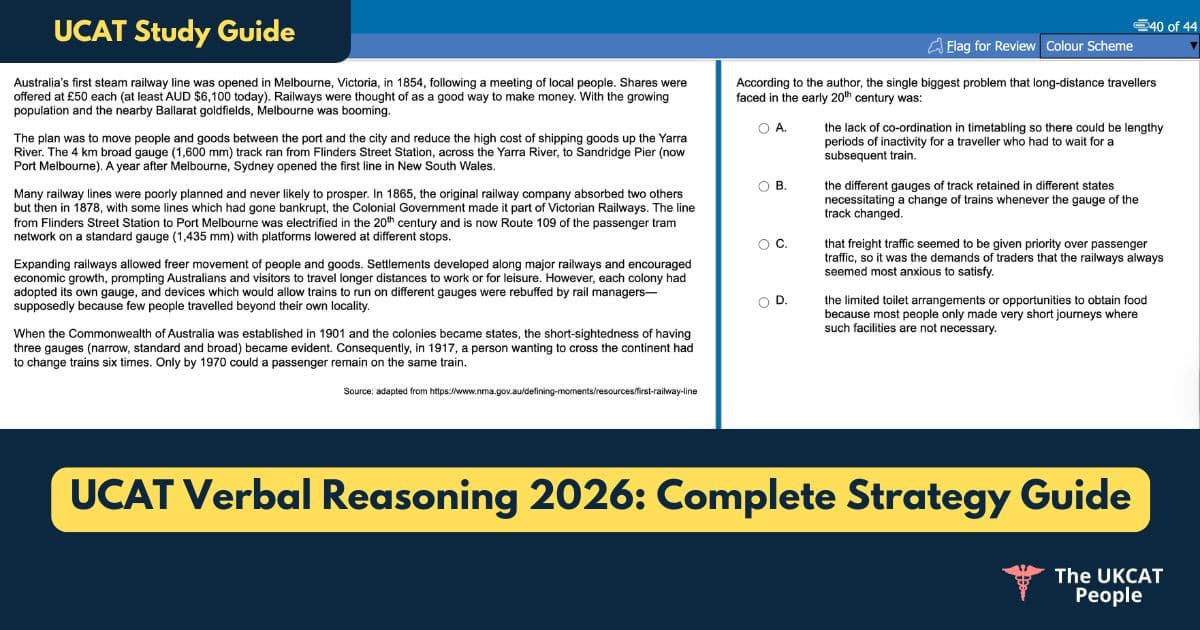
At TheUKCATPeople, I, Dr Akash, and the UCAT tutoring team have worked with thousands of students across this section over the past 14 years. UCAT Verbal Reasoning has the lowest average score of any section in the exam (in 2025 it was 602), and it almost always comes down to the same root cause: students answer from instinct rather than from text.
This guide covers everything you need: timing, question types, reading technique, worked examples, and links to every dedicated strategy guide we have written.
In our experience working with students over 14 years, those who combine focused VR technique work with reflective practice typically see meaningful score improvement within 4 - 6 weeks - the students who improve fastest are those who stop doing more questions and start diagnosing why they're getting specific question types wrong.
Remember - verbal Reasoning is the first section you sit. Getting off to a confident start matters more than most students realise. Medical and dental schools use your VR score as a measure of how well you will handle clinical reading: extracting the right conclusion from complex information, quickly, under pressure.
👉🏼 Read More: UCAT Verbal Reasoning: Strategy & Worked Examples
Verbal Reasoning does not reward fast readers or well-read students. It rewards students who understand one rule: the passage is the only authority.
Every question in UCAT VR is asking some version of the same thing: does the passage support this claim? The claim might be a direct statement, an implied conclusion, a negation, or the author's personal view. Regardless of format, the answer must always be traceable to specific text.
Your background knowledge is irrelevant, and if the topic is something you know well, it is actively dangerous. Students who know a lot about a passage topic consistently outscore their ability in the section, in the wrong direction, because they answer from knowledge rather than text.
The section has two core question formats.
Key Takeaway: VR is a passage-based reasoning test. Students who treat every answer as a retrieval task from the text, rather than a judgement call from memory, consistently outperform those who do not.
You have 22 minutes for 44 questions across 11 passages. Each passage has 4 questions attached to it.
The raw time split works out as follows:
In practice, the passages vary significantly in length and density. A short, clearly written passage on a familiar topic can be read in 25 seconds. A dense legal or policy text may take 50. Knowing how to adapt your reading approach to passage type is part of the skill.
The average UCAT Verbal Reasoning score in recent cycles has been:
Whilst your individual subsection score does not really matter in isolation (except for some medical schools such as Nottingham, which in the past have placed emphasis on the UCAT VR Section in their scoring, or City SGUL where it expects a miminum of 500 in each section). Whether that matters depends on where you are applying.
Check exactly how each university weights the section at the UCAT Cut Offs for Universities guide, and use the UCAT Score Calculator to convert your practice scores and benchmark them accurately.
Key Takeaway: You need approximately 2 minutes per passage block to stay on pace. Tight time management across the full 11 passages is a greater determinant of score than speed on individual questions.
👉 UCAT Verbal Reasoning Speed: Skimming vs Scanning Strategies
This is the most debated tactical question in VR preparation, and the honest answer is that it depends on you, not on a universal rule.
If you are a naturally fast reader who retains structure well, reading the passage first gives you a mental map before you engage with the questions. You spend 30 to 40 seconds building that map, then answer each question knowing roughly where to look. This works well for multiple choice and inference questions, where understanding the overall argument of the passage helps you evaluate which conclusion is actually supported.
If you are a slower reader, or someone who reads carefully but loses time doing so, the passage first approach will consistently leave you short at the end. In that case, reading each question first and scanning the passage for the specific evidence you need is the more time efficient route. You are not reading to understand the whole passage. You are reading to answer four specific questions about it.
Aiming for a top-decile UCAT score?
The middle ground that works for most students: a 20 to 25 second skim of the passage to get the topic and rough structure, then read each question and scan back for the relevant section. You are not trying to absorb every detail upfront. You are just orientating yourself so the scanning that follows is faster.
One practical way to figure out which approach suits you is to do 10 passage blocks timed with each method and compare your accuracy and your time remaining. Most students discover a clear preference within a session of deliberate testing. The UCAT Skills Trainer is useful for this kind of structured technique testing.
Key Takeaway: Fast readers with strong retention tend to benefit from passage first. Slower or more deliberate readers tend to do better with question first scanning. Test both under timed conditions and commit to whichever produces better results for you.
Knowing the question type before you engage with the question is one of the most efficient habits you can build. Each type has a specific decision rule.
True, False, Can't Tell
This is the most common format and the one with the most traps. The decision rule is strict:
The error most students make is treating Can't Tell as a soft middle ground for anything uncertain. It is not. If the passage directly negates a claim, the answer is False, not Can't Tell.
If the passage confirms something by strong implication, the answer may be True. Can't Tell is specifically for statements the passage simply does not address. The full breakdown with worked examples is in the UCAT Verbal Reasoning True, False, Can't Tell guide.
Multiple Choice (Best Answer)
Four options, one correct, all of them plausible enough to create doubt. The technique is elimination: identify the two options that are clearly not supported and compare the remaining two directly against the passage text.
The correct answer is never the most reasonable-sounding one. It is the one most directly supported by text. Full technique in the UCAT Verbal Reasoning Multiple Choice guide.
Inference Questions
These ask what can be concluded from the passage, not just what is explicitly stated. The distinction that matters: a valid inference is one that must follow logically from the text. An overreach is one that could follow but is not certain.
Students repeatedly mark speculative answers correct because they sound plausible. The test is: if the passage is true, must this conclusion also be true? If the honest answer is "probably," that is not a supported inference. The UCAT Verbal Reasoning Inference Questions guide covers this in full.
Author Opinion and Tone Questions
You are asked what the author believes, not what the passage reports. The trap is confusing reported evidence with personal endorsement. An author can describe a study, quote a critic, and outline a counterargument without holding any of those views personally. Look for evaluative language: "it is striking," "unfortunately," "this suggests." Neutral description is not opinion. Full breakdown in the UCAT Verbal Reasoning Author Opinion and Tone guide.
Negative Questions (Not, Except, Least)
The question asks which option is NOT supported or LEAST likely. These are where careless errors under time pressure are most common. Slow down slightly on these, reframe the question in your head, and work through each option methodically. UCAT Verbal Reasoning Negative Questions guide.
Key Takeaway: Identify the question type first. Applying the wrong decision rule to a question type is the most consistent source of avoidable errors in this section.
The question of whether to read the passage or the question first does not have a single correct answer. It depends on the question type and your reading pace.
For True, False, Can't Tell questions, the fastest and most reliable method for most students is to read the statement first, extract the key noun or phrase, then scan the passage for that specific term. You do not need a full read of the passage to answer most T/F/CT questions. You need to find the one or two sentences that address the topic in the statement. This is the keyword scanning technique, and it reliably saves 10 to 15 seconds per question once it is practised properly. Full technique in the UCAT Verbal Reasoning Keyword Scanning guide.
For multiple choice and inference questions, a 30 second skim of the passage before reading the questions pays off. You are not trying to memorise content. You are building a rough mental map of which topic sits in which part of the passage, so when you read a question you already know roughly where to look.
Passages on unfamiliar topics, tax law, medieval history, pharmaceutical regulation, are not harder to answer than familiar ones. They require the same process. Find the relevant sentence. Make the decision. Do not slow down because the subject matter feels unfamiliar.
Choose your 1-1 UCAT package
Rated 5.0 from 660+ reviews. 1-1 sessions with top-scoring tutors, weekly or more often, built around your weakest subtests.
10 hours
1-1 UCAT tutoring
20 hours
1-1 UCAT tutoring
30 hours
1-1 UCAT tutoring
One pattern I see consistently in students who sit around the 590 to 620 range: they read thoroughly, answer carefully, and run out of time on the final two or three passages. The marks lost at the end of the section from rushing are rarely recovered by increased accuracy on the passages they did read fully. Training yourself to read less of each passage, more precisely, is where the score improvement comes from.
Key Takeaway: Keyword scanning is the highest yield technique for True, False, Can't Tell. A brief skim before questions helps on multiple choice and inference. Slow thorough reading of entire passages is the most common cause of time collapse.
These four patterns account for the majority of avoidable errors in VR. Once you can name them, you stop falling for them.
The Dispersion Trap
A statement combines two pieces of information from different parts of the passage to create a claim the passage never actually makes. Each individual piece of information is accurate. Together, as stated in the question, they form a conclusion the passage does not support. Always verify the statement as a whole, not just its component parts.
The Contradiction Trap
The passage contains two pieces of information on the same topic, one of which contradicts the statement. Students select True because they found text that matches part of the statement, without noticing the passage also contradicts it elsewhere. Read the full picture on a topic before deciding.
Absolute Language Traps
Statements using "always," "never," "all," or "only" are frequently False because the passage uses qualified language like "typically" or "in most cases." However, sometimes the passage genuinely does use absolute language. Do not assume absolutes are automatically False. Check the passage wording carefully.
Inference Overreach
An answer option goes one step beyond what the passage proves. It is plausible, sounds reasonable, and feels like a natural conclusion. But the passage does not actually establish it. The test: must this be true if the passage is true? If the honest answer is "not necessarily," the option is not supported.
More worked examples of all four traps are in the UCAT Verbal Reasoning Common Traps guide.
Key Takeaway: These four traps are not random. They appear in predictable formats and can be neutralised once you know what to look for.
Work through each one before reading the explanation.
Example 1: True, False, Can't Tell
Passage: Between 2018 and 2022, several UK hospital trusts piloted a four day working week for administrative staff. Trusts that adopted the model reported a reduction in staff sickness absence over the trial period. No trust extended the pilot to clinical staff, as concerns were raised about patient safety implications. A national evaluation of the pilots was commissioned in 2023 but had not reported by the end of that year.
Statement: At least one UK hospital trust has trialled a four day week for clinical staff.
Answer: False
Why: The passage explicitly states that no trust extended the pilot to clinical staff. This is a direct contradiction. The common mistake here is selecting Can't Tell, reasoning that absence of evidence is not evidence of absence. That logic applies when the passage is silent on a topic. Here, the passage specifically rules it out.
Example 2: True, False, Can't Tell
Passage: Antibiotic resistance has been identified by the World Health Organisation as one of the leading threats to global health. The overprescription of antibiotics in primary care settings has been cited as a contributing factor in several high income countries. Some low income countries lack sufficient access to antibiotics altogether, meaning resistance patterns in those settings arise primarily through hospital acquired infections rather than community prescribing.
Statement: Overprescription of antibiotics contributes to resistance in all countries.
Answer: Can't Tell
Why: The passage says overprescription is a contributing factor in several high income countries, and that in some low-income countries the primary driver is hospital acquired infection rather than community prescribing. The passage does not establish whether overprescription occurs in low-income countries at all. The statement claims "all countries." The passage does not confirm this, but it also does not explicitly rule it out. Can't Tell is correct. This is not a False because the passage never says overprescription is absent in low income settings, only that the primary driver differs.
Example 3: Multiple Choice Best Answer
Passage: The introduction of congestion charging in central London in 2003 was accompanied by significant investment in public transport, including increased bus frequency and extended operating hours on key routes. Traffic volumes within the charging zone fell by approximately 15 percent in the first year. Subsequent studies found that while congestion initially decreased, the effect diminished over the following decade as vehicle ownership in Greater London continued to rise.
Question: Which of the following is best supported by the passage?
Answer: B
Why: The passage states that the scheme was accompanied by public transport investment, and that traffic volumes fell.
Example 4: Inference Question
From diagnostic to test day: a structured plan with 1-1 expert support at every stage.
Passage: Studies on bilingual children have consistently found that they outperform monolingual peers on tasks requiring executive function, including attention switching and inhibitory control. Researchers attribute this advantage to the constant cognitive demand of managing two language systems. The same advantage has not been consistently demonstrated in studies of adult bilinguals, with some meta-analyses finding no significant difference.
Question: Which of the following can most reasonably be inferred from the passage?
A) Bilingual children perform better than monolingual children in all cognitive tasks.
B) The cognitive benefits of bilingualism may diminish with age.
C) Adults who learn a second language do not gain cognitive benefits.
D) Executive function is the most important cognitive domain in educational settings.
Answer: B
Why: The passage shows a consistent advantage in children that is not consistently replicated in adult studies. The most logical inference is that the advantage changes over time.
Example 5: Negative Question
Passage:The Mars Curiosity rover, launched in 2011, was designed to assess whether Mars had ever had conditions suitable for microbial life. The rover's instruments confirmed the presence of ancient riverbeds and chemical signatures associated with liquid water in the planet's distant past. Curiosity also detected organic molecules in Martian rock samples, though scientists noted these could have formed through non biological processes.
Question: Which of the following is NOT supported by the passage?
A) Curiosity was launched before 2015.
B) Mars may have had liquid water at some point in its history.
C) Organic molecules detected on Mars were confirmed to be of biological origin.
D) Curiosity's mission included assessing historical habitability.
Answer: C
Why: The passage explicitly states that organic molecules could have formed through non biological processes. It does not confirm biological origin. Option C inverts this: it claims the biological origin was confirmed, which directly contradicts the passage. Options A, B, and D are all directly supported by the text.
Key Takeaway: Every answer above cites specific language from the passage. If you cannot point to the sentence that supports your answer, you are not ready to commit to it.
👉 UCAT Skills Trainer: Free Practice Tool
Each guide below covers one question type or technique in full. Once you have read this overview, go into the area you find hardest first rather than working through them in order.
Question Type Guides
Speed and Technique Guides
Trap and Error Guides
Key Takeaway: Use this page as your navigation point for VR. Each guide above targets one specific skill. Focused practice on your weakest area will move your score faster than untargeted mock sittings.
To practise free, build core reading speed in our VR speed reading trainer, sharpen retention with the rapid recall trainer, and locate evidence faster with the keyword scanning trainer. Then move to reasoning with the inference trainer and the not or except trainer, and consolidate everything with full VR practice questions.
44 questions across 11 passages, with 22 minutes. That is roughly 30 seconds per question, but in practice you need to factor in passage reading time of 30 to 45 seconds per passage. A realistic per passage block target is 2 minutes for the reading plus 4 questions combined.
The 2025 mean was 602. A score of 620 to 630 puts you above the national average. Scores above 660 sit in the upper band. Use the UCAT Score Calculator at theukcatpeople.co.uk to benchmark your practice scores accurately.
False means the passage directly contradicts the statement. Can't Tell means the passage does not address it, neither confirming nor denying. The most common error is selecting Can't Tell when the passage has actually ruled the claim out, which makes the answer False.
For True, False, Can't Tell: read the statement first and keyword scan the passage. For multiple choice and inference: a brief 30 second skim of the passage before reading the questions helps you map where information sits. There is no single rule that works across all formats.
Identify and fix your specific error pattern rather than doing more questions. Most students who plateau are making one or two consistent logical mistakes: Can't Tell overuse, inference overreach, or falling for absolute language. Diagnosing the error type first produces faster score improvement than volume practice.
No. Passages cover law, history, science, economics, and anything else. Subject knowledge is irrelevant and can be a risk, as it makes it easier to answer from memory rather than the text in front of you.
Universities vary. Some apply a minimum VR threshold for shortlisting, others use it as part of a combined UCAT aggregate. A small number specifically weight VR. See exactly how each school uses the section at the UCAT Cut Offs for Universities page on theukcatpeople.co.uk.

Want expert UCAT tutoring?
From 1-1 UCAT tutoring to our intensive UCAT courses, we can take your prep further than free guides alone. Tell us your test date and where you are and we will recommend the right option.
Ultimate Package students from our 2025/26 cycle, with their UCAT scores and offers, who trained with us for the UCAT, personal statements and interviews.
“Harry got my UCAT up to 2,590, working through the sections I kept dropping marks on week by week. Gemma then ran my interview practice so the MMI stations didn't catch me out, and Dr Akash mentored me the whole way through. I'm off to King's for Medicine.”
“The interview prep was the part that actually moved the needle. Proper mock MMIs, not just lists of questions, and feedback that was honest about what I was getting wrong. I ended up with four offers and firmed UCL.”
“The Ultimate Package kept me organised from UCAT through to interviews. They knew what dental schools actually ask and tightened up my personal statement. Four offers in the end, and I'm going to Birmingham.”
“Vet applications come down to the written SAQs as much as the interview. Dr Rebecca went through my SAQs line by line, sharpened my answers and prepped me for the panels. I came away with four offers and chose the RVC.”
Book your FREE consultation today
Click to book your free consultation