Complete University Guide 2027
1stof 40 UK medical schools
Top40th
- Overall score
- 100%
- Entry standards
- 91%
- Student satisfaction
- 74%
- Research quality
- 91%
Source: Complete University Guide 2027 medicine league table.
Reviewed by Dr Akash Gandhi, MBBS MA (Cantab) DGM DRCOG MBA MRCGP
Trusted UK medicine admissions specialists since 2012 · 2700+ students taught
At a glance
Cambridge Medicine excels in league tables. Cambridge has 3 pre-clinical years, after which you can, if you get a place, continue at Cambridge for 3 clinical years or complete them somewhere else (many go on to medical schools in London or Oxford).
The pre-clinical years are rigorous with lots of lectures, practicals and small-group supervised sessions. In the third year, students study a chosen subject in more depth. This is usually one related to biological medicine but can be a research project or something unrelated to medicine. The emphasis during the clinical years is on learning in clinical settings: at the bedside, in outpatient clinics and in GP surgeries, which is supported by seminars, tutorials and discussion groups.
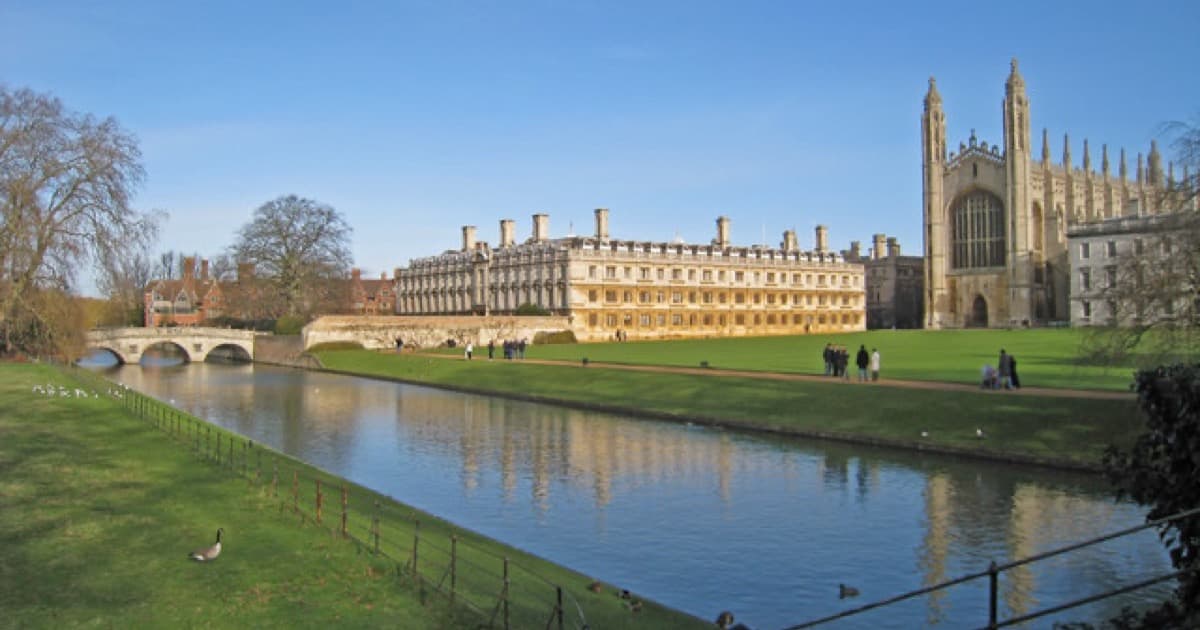
Founded in 1209, Cambridge has a reputation for excellence in teaching and research. The university offers a range of undergraduate and postgraduate medical programs, including an MPhil in Medical Science. Cambridge has a strong emphasis on research, and students have the opportunity to work alongside leading researchers in their fields. The university also has an impressive range of facilities, including the Cambridge Biomedical Campus and the Addenbrooke's Hospital.
Complete University Guide 2027
Source: Complete University Guide 2027 medicine league table.
The Guardian University Guide 2026
Source: The Guardian University Guide 2026 medicine league table.
For 2025 entry, Cambridge received 1,791 applications for Medicine. It made 288 offers, so 16% of applicants received an offer.
All applicants (home and international)
| Entry year | Applications | Interviewed% of applicants | Offers | Post-interview success% of interviewed | Offer rate% of applicants |
|---|---|---|---|---|---|
| 2025 | 1,791 | — | 288 | — | 16% |
| 2024 | 1,754 | — | 288 | — | 16% |
Last checked June 2026.
1-1 support from doctors and admissions experts across every stage of your medicine application.



At Cambridge, you study the medical sciences first, before learning to apply that knowledge to medical practice as a clinical student. The first three years (pre-clinical studies) involve lectures, practical classes (including dissections) and supervisions, with typically 20-25 timetabled teaching hours each week. The emphasis during the clinical studies (Years 4, 5 and 6) is on learning in clinical settings: at the bedside, in outpatient clinics and in GP surgeries, which is supported by seminars, tutorials and discussion groups.
The first 3 years involve lectures, practical classes that include dissections, and small-group supervisions. There are typically 20 to 25 teaching hours each week.
The last 3 years focus on learning in clinical settings: at the patients’ bedside, in outpatient clinics and in GP doctor surgeries. Teaching is supported by seminars, tutorials and discussion groups.
In year 3 you specialise in one of a wide range of other subjects offered by the University (sometimes known elsewhere as intercalation) to qualify for the BA degree (Cambridge Medicine Intercalation).
Options include:
Typical A level offer grades in Cambridge Medical School is A*A*A
Must include Chemistry & Biology/Maths/Physics.
Most colleges require a second science or maths subject in addition to Chemistry and your first science — requirements vary, so check each college.
Average A-Level Predicted Grades for Offer Holders at Cambridge Medical School:
No specific requirements, but successful applicants will generally have 7s and above in all GCSEs.
Average GCSE Grades for Offer Holders at Cambridge Medical School:
41-42 points with 776 at Higher Level
Typically 3 Advanced Highers (or 2 Advanced Highers + 1 Higher) in S6; Scottish Highers alone are not sufficient. See the Advanced Higher requirement.
A1, A1, A2 in Advanced Highers (Cambridge banding), including A1 in Chemistry plus two of Biology, Maths or Physics.
2:1 or above. The accelerated Graduate Course in Medicine (A101) is offered at Hughes Hall, Lucy Cavendish, St Edmund's and Wolfson Colleges; applicants without recent science A-levels should contact a College.
IELTS:normally a minimum overall grade of 7.5, usually with 7.0 or above in each element
Resits are not usually permitted, except for professional qualifying exams.
No
You cannot apply if you will not be 18 by 1 November of Year 1, due to national restrictions on clinical contact.
A-Level Requirements at University of Cambridge Medical School →
Most useful
The UCAT was used for the first time in 2025 entry. Here is the available data:
👉🏼 AVERAGE UCAT score per year OFFERED a place at Cambridge [Home]:
📝 PS - Have your PS checked - 5⭐ Rated
🎙️ Interviews - 1-1 Online Medicine Interview (Panel & MMI) Tutoring & Mocks tailored to Cambridge - 5⭐ Rated
** PLEASE NOTE: For 2025 Entry for Medicine at Cambridge - the BMAT will not be used. Instead, the UCAT will be used **
How Does Cambridge Medical School Look At The BMAT? Is there a BMAT Cut off for Cambridge?
What is a good BMAT Score for Cambridge Medicine?
Given that the average successful BMAT score for Cambridge is 6.1, anything >6 in both S1 and S2 of the BMAT would place you in a competitive position when applying - but don't worry if you score lower than this!
What is the lowest BMAT score for Cambridge?
No official lowest or minimum BMAT score is needed for Cambridge, as each application is considered holistically. This is why every year there are some students who have 4s in either S1 or S2 and still receive an offer. However, please remember that the higher you score the better your chances!
Average BMAT Scores For Offer Holders at Cambridge Medical School
No
To develop understanding of what a career in Medicine involves and your suitability for your intended profession, you’re strongly advised (though not required) to undertake some relevant work experience (either paid or voluntary) in a health or related area.
Cambridge reads your UCAS personal statement in full to understand your academic interests and motivation, but does not give it a formal score — it is considered holistically as one part of the application alongside your academic record, the admissions test and interview. (Cambridge also requires the separate My Cambridge Application.)
Note: from 2026 entry, UCAS replaced the single free-text personal statement with three structured questions — why you want to study the course, how your studies have prepared you, and what else you have done to prepare. Any guidance above still applies; it is simply spread across those questions. For worked examples and a review of your own statement, see our medicine personal statement examples and review service.
Interview preparation
Practise with our expert interview tutors: university-specific mock MMI and panel interviews with personalised feedback. Every session is tailored to Cambridge's interview format and marking criteria.
Not sure which option fits? Explore all interview coaching or book a free consultation.
You can apply as an affiliate student (taking the pre-clinical component of the Standard Course in Medicine (A100) in two years instead of the usual three) to one of Lucy Cavendish, St Edmund's or Wolfson Colleges. Requirements: a good Honours degree (2:1 or above) in any discipline and passes at A Level.
You can apply to the accelerated Graduate Course in Medicine (A101) at Hughes Hall, Lucy Cavendish College, St Edmund's College or Wolfson College. The A101 course is only available to UK students.
A101 selection uses an online Multiple Mini Interview and an asynchronous interview (video upload). Applicants are expected to be in the top 50% of overall UCAT scores and to achieve SJT Band 1, 2 or 3.
You can apply for both the Standard Course in Medicine (A100) and the Graduate Course in Medicine (A101). However, if you choose to do so you must apply to the same College for both courses.
University of Cambridge interviews for 2025 entry: are usually in the first three weeks of December. Results usually in January (changes every year)
Much of the Cambridge Medical School Interview will revolve around science and scientific principles. This is different to almost all other interviews (other than Oxford). The goal is not solely to see how much knowledge you have, it is more to understand your thought process.
Often the interviewers will push you to the end of your knowledge, before helping you through the problem and seeing how you cope and use the information that is provided to you.
There are no trick questions here, the examiners are extremely friendly. They will try and mimic a Cambridge supervision, where a professor will often teach you concepts and topics that go beyond the curriculum.
There is no predetermined list of questions, but will often be around common biological and human concepts such as the nervous system, cardiovascular system, neurological system and genetics.
There is no set method of scoring the Cambridge interviews that is publicly available. The interviews are usually scored within each college before the college determines who to give offers to. This is usually in combination with the academic grades that are provided as well as your BMAT score.
These are suggested practice questions based on publicly available information and past trends. They are not official questions from the University and may not appear in your interview. Use them as part of a broader preparation strategy.
Practise under timed conditions with our free generator. It builds a randomised circuit from real Cambridge interview themes, with reading time, follow-up questions and a notes summary you can keep.
Free practice tool
A timed mock interview in your browser, built from this university's real interview themes. Choose MMI, panel or SAMMI, answer out loud, and keep a summary of how it went.
0
day streak · 0 mocks
Real timings
Reading and answering phases with bells, exactly like the live circuit.
Follow-up questions
Press for more on each station, the way a real interviewer would.
Notes to keep
Rate each answer and save a written summary to review with a tutor.
Free to use. No sign-up needed.
Cambridge Admissions Office
University of Cambridge
Fitzwilliam House
32 Trumpington Street
CB2 1QY
Tel: 01223 333308
Email: admissions@cam.ac.uk
Website: www.med.cam.ac.uk
Cambridge is ranked 1st out of 40 UK medical schools for Medicine in the Complete University Guide 2027.
Cambridge is ranked 5th out of 36 UK medical schools for Medicine in the Guardian University Guide 2026.
Cambridge is ranked 1st out of 40 UK medical schools for Medicine in the Complete University Guide 2027.
In the Complete University Guide 2027 it scores 91% for entry standards, 74% for student satisfaction and 99% for graduate prospects.
Typical A level offer grades in Cambridge Medical School is A*A*A Must include Chemistry & Biology/Maths/Physics.
Most colleges require a second science or maths subject in addition to Chemistry and your first science — requirements vary, so check each college.
2021: 92% had A*A*A*.
2022: 95% had A*A*A*.
No specific requirements, but successful applicants will generally have 7s and above in all GCSEs.
2021: 9.72 A*s, 0.6 As, 0.23 Bs + Below.
2022: 9.70 A*s, 0.4 As, 0.12 Bs + Below.
The UCAS course code for the standard Medicine course at Cambridge is A100, and the degree awarded is the MB BChir.
The course is based in Cambridge, England and lasts 6 years.
Cambridge also offers the 4 year graduate entry route (UCAS code A101).
Yes, Cambridge requires the UCAT for entry to Medicine (new for 2025 entry).
The UCAT was used for the first time in 2025 entry. Here is the available data AVERAGE UCAT score per year OFFERED a place at Cambridge [Home] 2025 Entry: 3081 (Home), 3207 (International).
AVERAGE UCAT score OFFERED a place at Cambridge PER College [Home] Pembroke - 3247.5.
Clare - 3217.5.
Christ’s - 3203.3.
Selwyn - 3198.0.
Trinity - 3189.0.
Corpus Christi - 3172.9.
Gonville & Caius - 3172.4.
Murray Edwards - 3163.0.
Sidney Sussex - 3138.9.
Robinson - 3120.9.
Queens’ - 3114.6.
For 2025 entry, 16% of applicants to Medicine at Cambridge received an offer (288 offers from 1,791 applications). An offer is not a confirmed place.
Cambridge uses a Panel (A100); Online MMI plus asynchronous video interview (A101) interview format for Medicine interviews.
University of Cambridge interviews for 2025 entry: are usually in the first three weeks of December. Results usually in January (changes every year).
No, Cambridge does not offer a foundation or gateway year for Medicine.
Yes, Cambridge accepts graduate entry applicants for Medicine.
The graduate entry route into Medicine at Cambridge has the UCAS course code A101 and leads to the MB BChir, which lasts 4 years.
You can apply as an affiliate student (taking the pre-clinical component of the Standard Course in Medicine (A100) in two years instead of the usual three) to one of Lucy Cavendish, St Edmund's or Wolfson Colleges. Requirements: a good Honours degree (2:1 or above) in any discipline and passes at A Level.
No, Cambridge does not formally score the personal statement for Medicine applicants.
Cambridge reads your UCAS personal statement in full to understand your academic interests and motivation, but does not give it a formal score — it is considered holistically as one part of the application alongside your academic record, the admissions test and interview. (Cambridge also requires the separate My Cambridge Application.).
Yes, you need to be 18 to study Medicine at Cambridge.
The international tuition fee is £70,554 per year for 2026/27 entry, and international students must also pay a separate annual College fee of roughly £11,500 to £14,950 depending on their College.
Ultimate Package students from our 2025/26 cycle, with their UCAT scores and offers, who trained with us for the UCAT, personal statements and interviews.
“Harry got my UCAT up to 2,590, working through the sections I kept dropping marks on week by week. Gemma then ran my interview practice so the MMI stations didn't catch me out, and Dr Akash mentored me the whole way through. I'm off to King's for Medicine.”
“The interview prep was the part that actually moved the needle. Proper mock MMIs, not just lists of questions, and feedback that was honest about what I was getting wrong. I ended up with four offers and firmed UCL.”
“The Ultimate Package kept me organised from UCAT through to interviews. They knew what dental schools actually ask and tightened up my personal statement. Four offers in the end, and I'm going to Birmingham.”
“Vet applications come down to the written SAQs as much as the interview. Dr Rebecca went through my SAQs line by line, sharpened my answers and prepped me for the panels. I came away with four offers and chose the RVC.”
Book your FREE consultation today
Click to book your free consultation