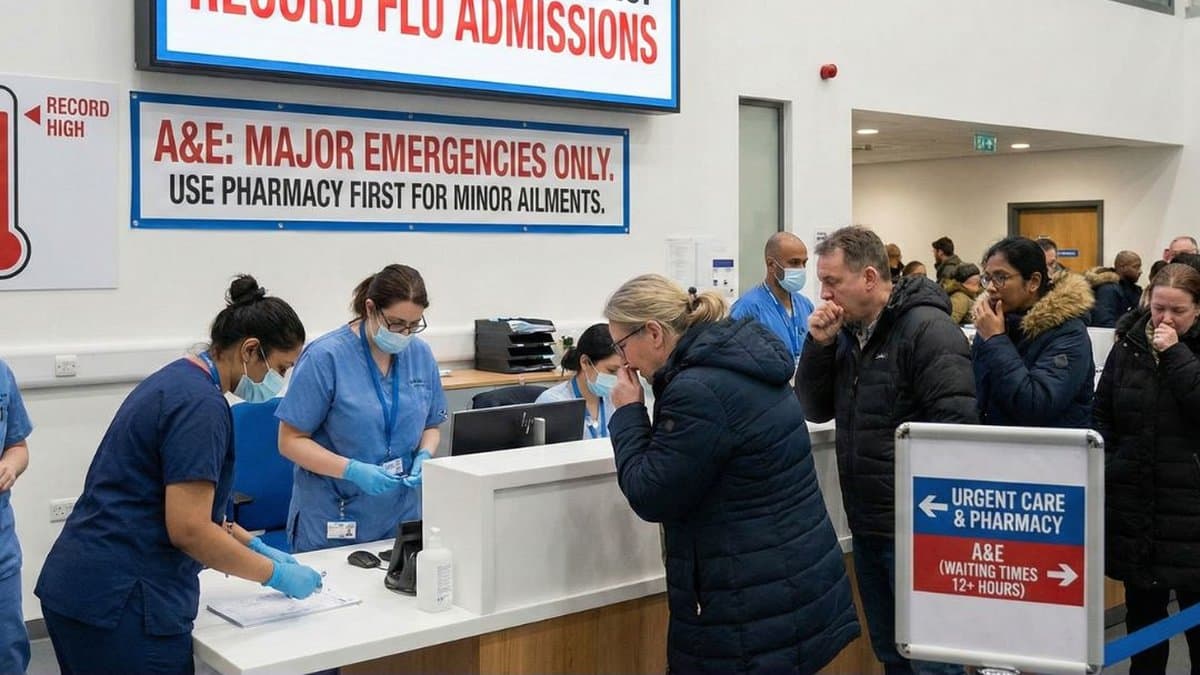
As a practising GP in London, I see the full force of NHS winter pressures every year. The pattern is now depressingly predictable: a winter surge in flu and other respiratory viruses pushes hospitals to near-full capacity, while a striking number of patients still attend A&E for minor conditions like sore throats and earaches that could be managed elsewhere. In 2025-26, flu hospitalisations peaked at over 3,000 patients a day in mid-December 2025 before easing in the new year (NHS England).
For aspiring medical students, understanding these specific pressures - from the 200,000 avoidable A&E visits to the impact of the 'Pharmacy First' scheme - is absolutely vital for your interviews.
Quick Answer: Every winter the NHS faces a predictable surge in demand driven by flu and the "quad-demic" (flu, COVID-19, RSV and norovirus). In 2025-26 this pushed bed occupancy to near-record levels, kept A&E performance below the 78% four-hour target and fuelled "corridor care". Pressure is worsened by avoidable A&E visits for minor ailments. To manage it, NHS leaders urge the public to use Pharmacy First and NHS 111, expand primary care through the ARRS scheme and run the annual flu and COVID vaccination programme.
What are NHS winter pressures and the latest flu statistics?
Winter pressures refer to the surge in demand the NHS faces during colder months, primarily due to respiratory illnesses like flu, COVID-19, and RSV.
The winter 2025-26 figures show how sharp the seasonal spike can be. NHS England data recorded flu inpatients climbing through December to a peak of over 3,000 patients a day in mid-December 2025, before falling back to roughly 1,987 a day by late January 2026. Critical care admissions for flu rose steeply at the peak. Importantly, although overall winter demand ran at near-record levels, flu actually occupied fewer beds than the severe 2024-25 season, helped by higher vaccine uptake (NHS England, January 2026).
From my perspective on the frontline, this isn't just about numbers. At the December 2025 peak, flu was occupying a meaningful share of an already-full hospital estate, with average daily bed occupancy running very high (around 94,000 beds, close to 95% occupancy). The safe threshold is widely cited as 85%, so hospitals operating in the mid-90s have almost no slack to absorb a surge. For you as an applicant, this is a textbook example of the NHS bed shortages and "capacity versus demand" challenge you may be asked to discuss in a medicine interview.
Key Takeaway: Flu hospitalisations reached a record high for the time of year (over 3,000 a day in December 2025), hitting earlier than usual and occupying vital bed space needed for other emergencies.
What is the NHS "quad-demic" and how does it cause winter pressures?
Winter pressures are no longer just about flu. NHS leaders now talk about the "quad-demic": four viruses circulating at once, namely flu, COVID-19, respiratory syncytial virus (RSV) and norovirus. In winter 2025-26, alongside the flu peak, there were on average around 950 patients in hospital with norovirus and over 1,100 beds closed or occupied because of it each day, plus several hundred COVID-19 inpatients (NHS England, January 2026).
Norovirus is particularly disruptive because it forces wards to close to control infection, taking beds out of action exactly when the NHS needs them most. RSV mainly hits the very young and very old. This is why the NHS now runs a broader vaccination programme: flu jabs for over-65s, clinical risk groups, pregnant women and children; COVID-19 boosters for those aged 75 and over and the immunosuppressed; and an RSV vaccine for pregnant women and adults aged 75 and over.
In an interview, referencing the quad-demic shows you understand that winter pressure is multi-factorial, not a single "flu crisis". A strong candidate links the surge in viral demand to its downstream effect on flow: full wards, A&E crowding, ambulance handover delays and cancelled operations.
UCAT tutoring
Boost your UCAT with 1-1 tutoring
Rated 5.0 from 660+ reviews. 1-1 sessions with top-scoring tutors, weekly or more often, built around your weakest subtests.
A significant factor contributing to A&E overcrowding is the attendance of patients with minor conditions that could be treated elsewhere.
NHS England recently released data revealing that between November and February, there were over 200,000 A&E attendances that could have been managed by other services. The data breakdown is quite shocking:
96,998 visits for sore throats
83,705 visits for earaches
6,382 visits for nasal congestion
As a GP, I often get asked by students: "Why do patients go to A&E for a sore throat?" The answer is complex. It often boils down to a lack of health literacy or difficulty accessing GP appointments. When patients cannot get through to their surgery on the phone - a common frustration - they often perceive A&E as their only "open door".
However, this misuse diverts critical resources. Every doctor attending to a sore throat in A&E is one less doctor available for a cardiac arrest or major trauma. This is a classic Resource Allocationethical dilemma you might face in an MMI station.
It is worth noting that demand also collides with workforce strain: this is part of the same picture explored in our guide on why resident doctors are leaving the NHS, which feeds directly into winter staffing gaps.
Key Takeaway: Over 200,000 A&E visits were for minor issues like sore throats or earaches, often driven by poor health literacy or perceived lack of GP access.
1-1 doctor mentoring
Be mentored 1-1 by a doctor
Every question answered, from choosing schools to interview day.
1-1 mentoring from a practising NHS doctor, never a salesperson
Personal statement and interview coaching with expert tutors
Honest, tailored guidance for your target medical schools
What is the A&E four-hour target and what is "corridor care"?
The A&E four-hour standard is the headline measure of emergency care: NHS England's operational target is for 82% of patients to be admitted, transferred or discharged within four hours. Performance has sat below this for years; in spring 2026 it was around 75 to 76%, and it typically dips further over winter. Just as worrying are "12-hour waits": tens of thousands of patients each month now wait more than 12 hours from a decision to admit, a figure far higher than before the pandemic.
When hospitals are full, the result is "corridor care": patients assessed and treated on trolleys in corridors, waiting rooms and other non-clinical spaces. In a landmark January 2025 report, the Royal College of Nursing surveyed over 5,000 nursing staff; more than 90% said patient safety was being compromised, and some described patients deteriorating or dying in corridors. The RCN called it a "national emergency". The underlying cause is exit block: patients who are medically fit to leave cannot be discharged because of social care shortages, so beds stay occupied.
In my experience as a GP, this is the part interviewers care about most. They want you to connect the dots: avoidable A&E attendances are one pressure, but the deeper problem is whole-system flow, social care and bed capacity. Mentioning corridor care and the four-hour target with specific, dated figures signals genuine awareness rather than headline-skimming.
How does Pharmacy First reduce NHS winter pressure?
Pharmacy First is a government initiative allowing pharmacists to treat seven common conditions without a GP appointment, aiming to free up 10 million GP appointments a year.
This scheme is a crucial part of the solution to the A&E crisis. Instead of waiting for a GP or sitting in A&E for four hours for a sore throat, patients can now walk into a pharmacy and receive treatment - including antibiotics if necessary - for conditions such as:
Uncomplicated urinary tract infections (UTIs) in women
In my clinics, I now regularly refer patients to this service. It is a fantastic example of a multidisciplinary team (MDT) working, utilising the skills of pharmacists to reduce the burden on doctors. When discussing solutions to NHS pressures in your interview, mentioning Pharmacy First shows you are up-to-date with the current NHS strategy.
Key Takeaway: Pharmacy First empowers pharmacists to treat seven common conditions, directly reducing unnecessary GP and A&E visits.
What is the ARRS scheme and how does it improve GP access?
The Additional Roles Reimbursement Scheme (ARRS) provides funding to Primary Care Networks (PCNs) to recruit additional staff like physiotherapists, paramedics, newly qualified GPs, and pharmacists.
One of the main causes of A&E misuse is the difficulty in getting a GP appointment. The ARRS scheme aims to solve this by diversifying the workforce. It means that when a patient calls my surgery with back pain, they might see a First Contact Physiotherapist instead of me. If they have a minor injury, they might see a Paramedic Practitioner.
Recently, the government has also expanded ARRS to include newly qualified GPs, helping to keep more doctors working in primary care. This is a critical point to mention if you are asked about the GP Shortage and Crisis or workforce planning. It shows you understand that "seeing a doctor" isn't always the only or best option for patient care.
Key Takeaway: ARRS funds roles like physios and paramedics (and also newly qualified GPs) in GP practices, expanding the workforce and improving patient access to the right professional.
Ultimate Package
Choose your Ultimate Package
Rated 5.0 from 660+ reviews. 1-1 mentoring from doctors across UCAT, personal statement and interviews.
How do resident doctor strikes affect NHS winter planning?
Industrial action by resident (junior) doctors significantly reduces the NHS's capacity to handle winter surges by removing a large portion of the workforce.
NHS leaders have argued that planning for industrial action alongside a winter surge is extremely difficult and risks a "perfect storm". While the resident (formerly junior) doctor disputes are driven by genuine concerns over pay restoration and retention, action during a flu peak strains an already stretched system. Resident doctors were renamed from "junior doctors" in 2024, so use the current term in interviews.
During strike days (such as the planned walkouts from December 17-22), consultants step down to cover emergency care, which leads to thousands of elective (planned) operations being cancelled. This exacerbates the NHS waiting list backlog. In an interview, you must be able to appreciate both sides: the right of staff to fair pay as advocated by the British Medical Association (BMA), and the impact of strikes on patient safety during a crisis.
For the full picture of how cancelled operations and winter pressure feed the elective waiting list, see our companion guide on the NHS backlog and waiting list crisis, which examines the 7.4 million-strong list and the recovery plan.
Key Takeaway: Strikes during winter reduce workforce capacity, leading to cancelled operations and increased pressure on remaining staff during flu peaks.
Medical school interview questions on NHS winter pressures
Discussing winter pressures requires you to balance empathy for patients with a logical understanding of NHS systems and resource management.
If you are applying to medical school this year, there is potential for you to face "Hot Topic" station on this. Interviewers are looking for more than just regurgitating facts; they want to see critical thinking.
Potential Interview Questions To Get You Thinking:
"The NHS is facing record demand this winter. What measures would you implement to reduce A&E waiting times?"
"Should patients be charged for attending A&E with minor conditions like sore throats? Discuss the ethical implications of this."
"How can the NHS improve public awareness of services like Pharmacy First?"
"Is it ethical for doctors to strike during a winter flu crisis? Explain your reasoning."
Why expert help matters:
While reading articles like this is a great start, framing these answers under pressure is a different skill. Many students struggle to balance the arguments or get flustered by follow-up questions. This is why I helped design TheUKCATPeople's Medicine Interview Tutoring to be the most comprehensive preparation available.
Unlike generic mock interviews, our 1-to-1 sessions simulate these exact "Hot Topic" stations, giving you personalised feedback on your delivery and ethical reasoning. If you want to ensure you can discuss the flu crisis with the confidence of a future colleague, I strongly recommend booking a Free Strategy Consultation with us.
Key Takeaway: Practice answering questions on A&E misuse and strikes using a balanced, ethical framework – consider professional tutoring to perfect this skill.
Related NHS hot topics for your medicine interview
From 1-1 tutoring and personal statement editing to interview coaching and our all-in-one Ultimate Package, we support every stage. Tell us what you are working towards and we will recommend the right option.
FAQs
Frequently asked questions
What are NHS winter pressures?
NHS winter pressures are the predictable surge in demand on the health service during colder months. They are driven mainly by respiratory and seasonal viruses, alongside cold-weather illness and falls. The result is rising A&E attendances, near-full hospitals and difficulty discharging patients, which together create dangerous delays and reduced capacity for planned care.
Why does the NHS face a winter crisis every year?
The NHS faces winter pressure every year because cold weather drives up flu, COVID-19, RSV and norovirus at the same time that beds are already running close to full. With bed occupancy often near 95% (safe is around 85%), there is little spare capacity to absorb a surge. Delayed discharges due to social care shortages, an ageing population and workforce gaps make it worse each winter.
What is the "quad-demic"?
The "quad-demic" is a term NHS leaders use for four winter viruses circulating together: flu, COVID-19, respiratory syncytial virus (RSV) and norovirus. Each adds pressure differently: flu and COVID-19 fill beds, RSV hits the very young and old, and norovirus forces wards to close for infection control. Combined, they push hospitals beyond safe occupancy levels.
Was winter 2025-26 a record flu season for the NHS?
Not the worst on record, but severe. Flu hit early in 2025-26, peaking at over 3,000 patients a day in mid-December 2025 before easing to roughly 1,987 a day by late January 2026 (NHS England). Overall winter demand ran near record levels, but flu actually occupied fewer beds than the severe 2024-25 season, helped by higher vaccine uptake. Always date flu figures, as seasons vary.
What is the A&E four-hour target and is the NHS meeting it?
The A&E four-hour standard is for 82% of patients to be admitted, transferred or discharged within four hours, the current NHS England operational target. The NHS is not meeting it: performance was around 75 to 76% in spring 2026 and usually falls further over winter. It has not consistently hit the old 95% standard since the mid-2010s.
What are 12-hour trolley waits?
A 12-hour trolley wait is when a patient waits more than 12 hours from the decision to admit them until they reach a ward bed, usually held in A&E on a trolley. These waits are now common, with tens of thousands recorded each month, far above pre-pandemic levels. Long trolley waits are linked to increased harm and avoidable deaths, which is why they are a key safety indicator.
What is "corridor care" in the NHS?
Corridor care is when patients are assessed and treated in corridors, waiting rooms and other non-clinical spaces because there are no beds or cubicles free. In a January 2025 report, the Royal College of Nursing surveyed over 5,000 nurses; more than 90% said patient safety was being compromised, and the RCN called it a "national emergency". It reflects whole-system overcrowding, not just A&E demand.
What causes ambulance handover delays in winter?
Ambulance handover delays happen when A&E is too full to take patients from arriving ambulances, leaving crews queuing outside instead of responding to new 999 calls. They are driven by exit block: full wards mean A&E cannot move patients on. In winter 2025-26 handover delays improved on the previous year, but a significant share still exceeded 30 minutes against the 15-minute standard.
How does flu affect NHS waiting times?
Flu degrades hospital flow by filling beds needed for both emergencies and planned surgery. When bed occupancy exceeds safe levels (around 85%), hospitals suffer exit block: A&E patients cannot be admitted to wards, causing long A&E waits, ambulance handover queues and cancelled operations. This is why a flu surge ripples across the entire system, not just emergency departments.
What is the Pharmacy First scheme?
Pharmacy First lets community pharmacists assess and treat seven common conditions (including sore throat, sinusitis, earache, infected insect bites, impetigo, shingles and uncomplicated UTIs in women) without a GP appointment, supplying medicines including antibiotics where appropriate. Launched in 2024, it aims to free up millions of GP appointments a year and divert minor ailments away from GPs and A&E.
Can I go to A&E for a sore throat or earache?
No. You should not attend A&E for minor ailments like sore throats or earaches unless you have serious symptoms such as difficulty breathing or swallowing. NHS guidance directs these to a pharmacy (via Pharmacy First), NHS 111 or an urgent treatment centre. Misusing A&E diverts staff away from life-threatening emergencies such as strokes, heart attacks and major trauma.
What is the ARRS scheme in the NHS?
The Additional Roles Reimbursement Scheme (ARRS) funds Primary Care Networks to recruit wider roles into general practice, such as clinical pharmacists, first contact physiotherapists, paramedics and, more recently, newly qualified GPs. By expanding the multidisciplinary team, it helps patients see the right professional faster, easing GP access pressures that otherwise push people towards A&E.
How do the flu and COVID vaccination programmes reduce winter pressure?
The autumn and winter vaccination programme reduces serious illness, hospital admissions and deaths in the most vulnerable. Flu jabs are offered to over-65s, clinical risk groups, pregnant women and children; COVID-19 boosters to those aged 75 and over and the immunosuppressed; and an RSV vaccine to pregnant women and adults aged 75 and over. Higher uptake in 2025-26 helped flu occupy fewer beds than the previous winter.
Is it ethical for doctors to strike during a winter flu crisis?
This is a classic interview dilemma with no single right answer. Strong responses balance both sides: doctors have a legitimate right to fair pay and safe conditions (supported by the BMA), and strikes maintain emergency cover. Against this, action during a flu peak strains a stretched system and can delay planned care. Use the four pillars of medical ethics and acknowledge competing duties rather than picking a side.
What winter pressures questions could come up in a medicine interview?
Expect questions like: "What would you do to reduce A&E waiting times?", "Should patients be charged for attending A&E with minor conditions?", or "Is it ethical for doctors to strike in winter?". Interviewers want structured, balanced reasoning, not memorised facts. Link causes (the quad-demic, exit block, social care) to solutions (Pharmacy First, ARRS, vaccination) and reference ethics where relevant.
How can I prepare for NHS hot topic interview questions?
Move beyond facts to analysis: use the four pillars of medical ethics, weigh competing arguments and link current affairs together (winter pressures, the backlog, workforce and social care). Reading reliable sources such as NHS England, the BMA, the King's Fund and the BMJ is essential, but practising verbal delivery matters more. Mock interviews with experienced doctors help you structure balanced, high-scoring answers under pressure.
Ultimate Package students from our 2025/26 cycle, with their UCAT scores and offers, who trained with us for the UCAT, personal statements and interviews.
Ultimate Package
S
Sophie
Medicine, King's College London
2025 UCAT2,590 / 2,700
“Harry got my UCAT up to 2,590, working through the sections I kept dropping marks on week by week. Gemma then ran my interview practice so the MMI stations didn't catch me out, and Dr Akash mentored me the whole way through. I'm off to King's for Medicine.”
Ultimate Package
D
Daniel
Medicine, University College London
Medicine offers4 offers
“The interview prep was the part that actually moved the needle. Proper mock MMIs, not just lists of questions, and feedback that was honest about what I was getting wrong. I ended up with four offers and firmed UCL.”
Ultimate Package
A
Aisha
Dentistry, University of Birmingham
Dentistry offers4 offers
“The Ultimate Package kept me organised from UCAT through to interviews. They knew what dental schools actually ask and tightened up my personal statement. Four offers in the end, and I'm going to Birmingham.”
Ultimate Package
C
Charlotte
Veterinary Medicine, Royal Veterinary College
Vet offers4 offers
“Vet applications come down to the written SAQs as much as the interview. Dr Rebecca went through my SAQs line by line, sharpened my answers and prepped me for the panels. I came away with four offers and chose the RVC.”