10 hours
1-1 UCAT tutoring
Reviewed by Dr Akash Gandhi·10 September 2026
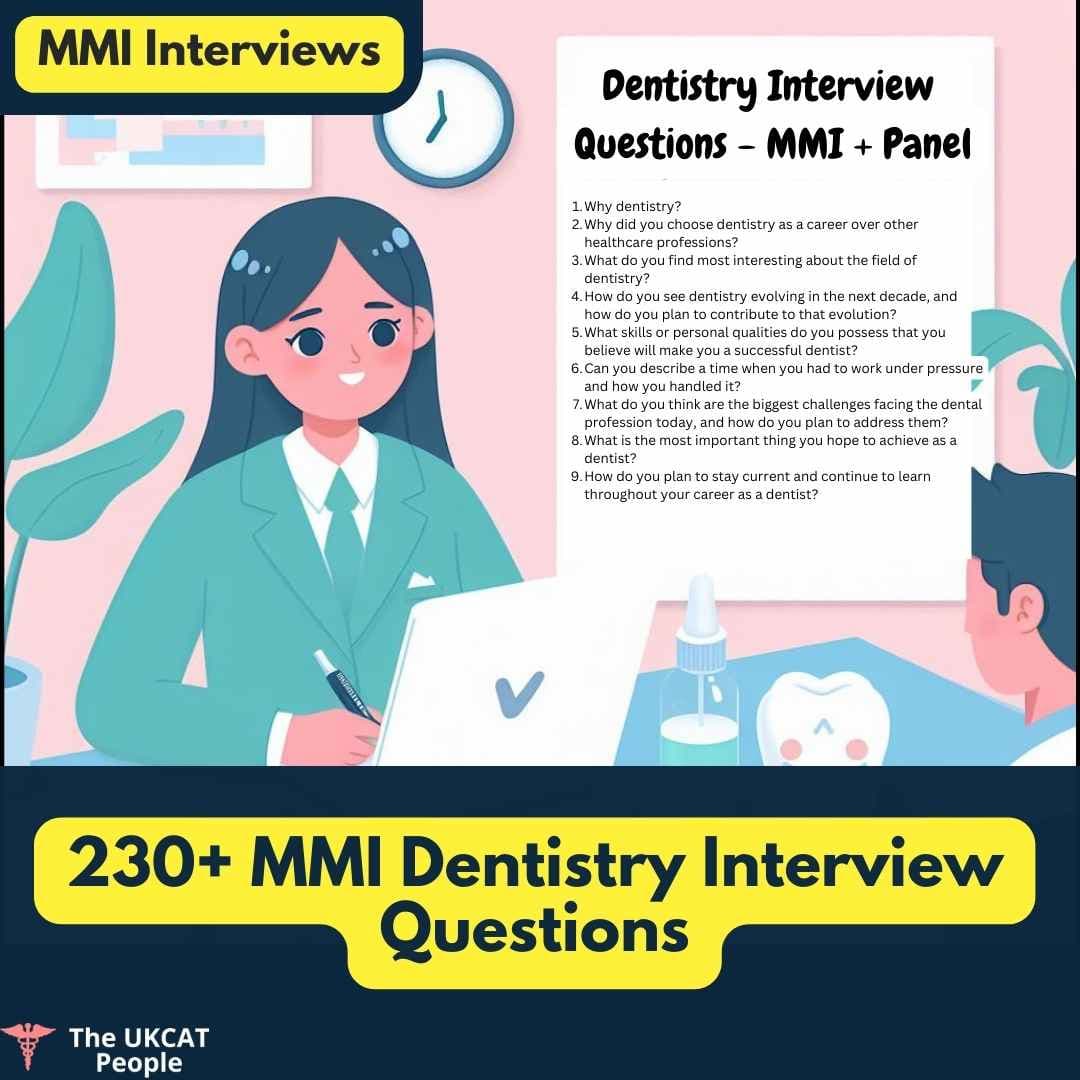
Dentistry ethical scenarios are interview stations that hand you a dilemma from dental practice, such as a patient refusing treatment or a colleague putting patients at risk, and ask how you would respond. They matter because dental school interviews use them to test your reasoning, honesty and safety, rather than your clinical knowledge.
I'm Dr Sonal Gandhi, a GDC-registered dentist and the dentistry admissions lead at TheUKCATPeople, and every December I work through dentistry ethical scenarios with applicants who already know the four pillars by heart. The gap is always the same: they can define autonomy, then freeze when a station describes a real practice with a real patient in it. Our guide to a career in dentistry sets the wider scene.
Dentistry ethical scenarios are short interview tasks that describe a situation with a conflict inside it, then ask what you would do and who you would tell. They appear as timed MMI stations, as roleplay with an actor, and as follow-ups to your work experience.
The appointments that stay with me are the ones where a patient nods along to a plan they haven't really understood, and I only find out when they never come back.
The table below is most of what you need.
Scenario type | What it's really testing | The principle to name | One line to say |
|---|---|---|---|
A patient refuses the treatment you recommended | Whether you respect an adult's right to choose badly | Autonomy | "She can decline the crown, so my job is to make sure she's declining it with the full picture." |
A child with untreated decay and repeated missed appointments | Whether you spot a safeguarding concern without accusing a parent | Safeguarding and dental neglect | "I'd raise it with the practice safeguarding lead rather than decide on my own what it means." |
A colleague turns up unsafe to work | Whether patient safety outweighs loyalty to a team you like | GDC Principle 8, raise concerns if patients are at risk | "I'd tell whoever is running the practice that day, because the next patient can't know." |
A dentist steers a patient towards the private option | Whether you notice a conflict of interest that nobody names | Put patients' interests first | "The patient still needs to hear what's available on the NHS before she chooses." |
A 15 year old asks for tooth whitening | Whether you know that consent has legal limits | Valid consent and Gillick competence | "Whitening isn't done under 18 unless it treats disease, so I'd explain why rather than just say no." |
A patient asks you to keep something from the dentist | Whether you promise confidentiality you cannot deliver | Confidentiality and honesty | "I can't promise to keep something secret before I know what it is." |
A filling fails and the patient was never told why | Whether you stay open when the news reflects badly on you | Duty of candour | "She is entitled to know what happened, an apology, and what we will do next." |
A patient asks for antibiotics for toothache | Whether you understand harm that lands beyond one patient | Non-maleficence | "Antibiotics won't fix the tooth, and resistance is a problem everyone inherits." |
An adult who cannot weigh the options needs an extraction | Whether you know capacity is decision-specific and assumed | Mental Capacity Act and best interests | "I'd start by assuming she has capacity and supporting her to decide, not by asking the family." |
A patient cannot afford the private treatment on offer | Whether you hold fairness and reality in the same answer | Justice | "Cost is a clinical factor here, not an awkward question we skip." |
Key Takeaway: These stations ask how you think under pressure, so slow down, say what you are weighing, and name who you would involve.
Answer any ethical scenario by working outwards from the facts: what happened, who it affects, which duties pull against each other, and who needs to know. The same sequence carries a consent station, a colleague station and a money station.
This is the order I use when coaching someone, and it's deliberately slow enough to stop you jumping to a verdict.
Key Takeaway: Name what you'd need to know, the duties in tension, the action you are allowed to take, and who you would escalate to.
Be mentored 1-1 by a dentist
Every question answered, from choosing schools to interview day.
Dentistry uses the same four pillars as medicine: autonomy, beneficence, non-maleficence and justice. Our guide to the four pillars explains where they come from, so what follows is what each looks like in the chair.
Key Takeaway: Name the two pillars fighting in this scenario, then explain what would make you let one of them win.
The General Dental Council sets out nine principles in Standards for the Dental Team, and they bind everyone on the register, from dentists to dental nurses. The nine are:
The GDC states that the principles are equally important and not listed in order of priority. Four carry most interview stations: putting patients' interests first, obtaining valid consent, protecting patients' information, and raising concerns if patients are at risk. Our guide to the nine GDC standards covers each with examples.
Alongside them sits the duty of candour: telling a patient promptly when something has gone wrong, apologising and saying what happens next, which in England is also a legal requirement enforced by the Care Quality Commission.
Key Takeaway: Quote the GDC principle in its actual wording, then apply it to the patient in front of you.
Boost your UCAT with 1-1 tutoring
Rated 5.0 from 660+ reviews. 1-1 sessions with top-scoring tutors, weekly or more often, built around your weakest subtests.
10 hours
1-1 UCAT tutoring
20 hours
1-1 UCAT tutoring
30 hours
1-1 UCAT tutoring
Valid consent means the patient understood what is proposed, including the risks, alternatives and cost, and agreed voluntarily. Cost belongs on that list in a way it rarely does elsewhere in the NHS.
Safeguarding is why a dental team looks at more than teeth. Injuries around the lips, bruising that doesn't match the story, or untreated decay in a child whose appointments keep being missed can all point to something at home. Dental neglect means a persistent failure to meet a child's oral health needs.
When I was a student on outreach, the first concern I raised turned out to be nothing, and my supervisor thanked me anyway, because a team that stops noticing is far more dangerous.
Key Takeaway: Assume capacity, treat consent as a conversation that includes cost, and say openly that confidentiality gives way when somebody is at risk.
Each scenario places you as a student or an observer, and each is worth working through out loud.
The scenario: On work experience you see a shadow under a filling on an x-ray, then hear the dentist call it fine.
What lands well: curiosity first, with a willingness to escalate if the answer doesn't reassure you.
The scenario: A 15 year old asks whether she can have her teeth whitened, and says her mum would refuse.
What lands well: answering the person as well as the question, and being accurate about why.
The scenario: A woman with advanced dementia has a painful broken tooth. One daughter wants it out, the other says her mother would refuse.
What lands well: treating the daughters as witnesses to her wishes, not as the decision makers.
The scenario: On work experience, the nurse you have been shadowing smells strongly of alcohol as the first patient arrives.
What lands well: handing the concern over at once, with compassion for the colleague.
The scenario: A man is offered an NHS extraction or a private root canal and crown. He wants the tooth kept and cannot afford it.
What lands well: taking cost seriously as part of the clinical picture, not an aside.
The scenario: A fellow dental student posts an unusual x-ray on social media, captioned as the strangest thing she saw on clinic.
What lands well: dealing with it directly and kindly, while making clear you would take it further.
Key Takeaway: In all of these the winning move is the same: gather the facts, act inside your role, and hand the problem upwards.
Talk about ethics through things you have actually seen, because a station is easier to answer from a real memory. A week of dentistry work experience gives you consent conversations and price lists on the wall, and a part-time job gives you conflicts about honesty and money.
Structure an answer from your own experience like this:
Interviewers are usually testing a short list of things:
Our 1-1 dentistry interview tutoring pairs you with a dentistry interview expert matched to your universities for mock interviews built around these stations, which is the quickest way to hear how your reasoning sounds.
Key Takeaway: Ground every ethical answer in something you have genuinely seen, then reason forwards instead of reciting a framework.
Prepare for your dental school interviews
Rated 5.0 from 660+ reviews. Mock MMI and panel interviews with expert tutors, built around dental school questions.
10 hours
1-1 interview coaching
20 hours
1-1 interview coaching
30 hours
1-1 interview coaching
You are unlikely to be asked any of these word for word, and you do not need a prepared answer to each one. Use them to check your understanding: if you could speak for a minute on most of them, you know this topic well enough for whatever the interviewer actually asks.
"You are a dental student on placement. A mother brings her seven year old son in with several badly decayed teeth, and the notes show three missed appointments in a row. She says she keeps forgetting. What would you do?"
My first thought is that I am a student here, so nothing gets decided by me alone, and the person I would speak to is my supervising clinician.
Before that, I would want to understand the situation rather than assume it. Missed appointments can mean shift work, no transport, other children at home, or a parent who is unwell herself, so I would want the conversation with his mother to be warm, not an interrogation.
I would also pay attention to what the child's mouth is telling us. Several decayed teeth in a seven year old, on top of repeatedly missed appointments, raises the question of dental neglect, which means a persistent failure to meet a child's basic oral health needs. That is a question rather than a conclusion.
So I would share what I had seen with my supervisor, and I would expect the practice to have a safeguarding lead whose role is exactly this. I would want the next appointment made easy to attend, and if the pattern continued I would expect the safeguarding lead to take it further.
I would far rather raise something that turns out to be nothing than stay quiet about something that was not.
Why this answer works:
Key Takeaway: Answer as the student you are, name the concept once, and make the escalation explicit.
Take one sentence in with you: gather the facts, name the duties in tension, act within your role, and tell someone senior.
For more practice, work through our dental school practice interview questions, then read the issues behind these scenarios: current NHS dentistry hot topics, dental tourism and Turkey teeth and the dental amalgam phase-out.
Ethics stations reward candidates who say "I would ask" and "I would tell my supervisor" out loud. Interviewers cannot give credit for caution you only thought about.
Key Takeaway: Gather the facts, name the duties in tension, act within your role, and tell someone senior.
They are short interview tasks describing a situation with a conflict inside it, such as a patient refusing treatment or a colleague acting unsafely, and asking what you would do. Dental schools use them to see how you reason, whether you know your own limits, and whether you escalate appropriately.
No. Interviewers want clear reasoning, not quoted legislation. Knowing that the Mental Capacity Act assumes capacity, that Gillick competence exists for under-16s, and that tooth whitening is not offered to under-18s except to treat disease is plenty. Naming a concept correctly matters far more than knowing where it sits in statute.
Rarely. Most scenarios are built so two thoughtful people could decide differently and both answer well. There are wrong answers, though: acting outside your role, promising a patient secrecy, ignoring a risk to keep the peace, or refusing to commit to anything after weighing both sides.
Autonomy, beneficence, non-maleficence and justice, exactly as in medicine. Autonomy is the patient's right to choose, beneficence is acting in their interest, non-maleficence is avoiding harm including over-treatment, and justice is fairness across everyone needing care. In dentistry, justice usually appears as NHS access, waiting lists and cost.
Put patients' interests first, communicate effectively, obtain valid consent, maintain and protect patients' information, have a clear complaints procedure, work with colleagues in patients' best interests, work within your knowledge and skills, raise concerns if patients are at risk, and maintain public confidence through your personal behaviour. The GDC says none outranks another.
Sometimes. A young person under 16 who genuinely understands what a treatment involves may be Gillick competent and able to consent, and dental teams assess this case by case. They will still encourage the young person to involve a parent, and some treatments, such as tooth whitening, are unavailable regardless.
When a child or vulnerable adult may be at risk of harm, when somebody else faces serious harm, or when the law requires disclosure. The dentist shares only what is needed, with the people who need it, and would normally tell the patient what is being shared and why unless that would increase the risk.
It is the duty to be open when something goes wrong: telling the patient promptly, apologising, explaining what happened and saying what will be done next. For registered dental practices in England it is a legal requirement enforced by the Care Quality Commission, as well as a professional expectation of everyone on the GDC register.
A dentist may decline to take on or continue with a patient, for example after a breakdown in trust, provided the reason is not discriminatory and the patient is not left without care. Urgent problems and pain are still managed, and the patient should be told clearly how to access treatment elsewhere.
Say your answers out loud against a timer, ideally to someone who will interrupt you. Work through a bank of scenarios using the same sequence every time, then ask for feedback on where your reasoning was hard to follow. Mock interviews with a dentistry interview expert give you the closest thing to real pressure.

Want expert help with your application?
From 1-1 tutoring and personal statement editing to interview coaching and our all-in-one Ultimate Package, we support every stage. Tell us what you are aiming for and we will recommend the right option.
Ultimate Package students from our 2025/26 cycle, with their UCAT scores and offers, who trained with us for the UCAT, personal statements and interviews.
“Harry got my UCAT up to 2,590, working through the sections I kept dropping marks on week by week. Gemma then ran my interview practice so the MMI stations didn't catch me out, and Dr Akash mentored me the whole way through. I'm off to King's for Medicine.”
“The interview prep was the part that actually moved the needle. Proper mock MMIs, not just lists of questions, and feedback that was honest about what I was getting wrong. I ended up with four offers and firmed UCL.”
“The Ultimate Package kept me organised from UCAT through to interviews. They knew what dental schools actually ask and tightened up my personal statement. Four offers in the end, and I'm going to Birmingham.”
“Vet applications come down to the written SAQs as much as the interview. Dr Rebecca went through my SAQs line by line, sharpened my answers and prepped me for the panels. I came away with four offers and chose the RVC.”
Book your FREE consultation today
Click to book your free consultation