UCAS Medicine Application Guide & Timeline 2026: A Comprehensive Guide

Thinking of applying to study medicine via UCAS? Find out everything that you need to know about applying for Medicine (A100) via UCAS in 2026 for 2027 entry.
Applying for medical school in the UK is a complex and competitive process that requires careful planning and organisation.
With numerous important dates and deadlines to keep track of, it is essential to have a clear understanding of the medicine application timeline.
In this comprehensive guide, we will walk you through every step of the application process and show you how our Ultimate Package can provide all the support you need for a successful application.
You should note that an application to study medicine is due at an earlier date than an application to study most other courses.
Remember the key UCAS dates for 2027 entry (ie you will be starting university in 2026):
The UCAS Medicine Deadline for 2027 entry is the 15th of October 2026 at 18:00.
If you are reading this for 2026 entry, that deadline (15 October 2025 at 18:00) has already passed; the next medicine deadline is 15 October 2026 at 18:00 for 2027 entry. Late medicine applications are not given equal consideration, so aim to submit well before the cut-off. For the bigger picture on competition ratios and places, see our UCAS medicine statistics analysis.
What is the UCAS medicine application?
Anyone applying to study medicine in the United Kingdom must do so via UCAS.
UCAS (Universities and Colleges Admissions Service) is the centralised body that manages all higher education applications in the UK.
Your UCAS application is then sent to all four medical universities to which you are applying, so you don’t need to worry about applying to each of them individually.
This guide features all the information you need - from how many universities you can apply to in the UK to what you can expect in terms of costs.
Key UCAS Dates for 2027 Entry (in 2026):
These are the confirmed dates for UCAS applications in 2026 for 2027 Entry (or 2028 deferred entry).
- 28 April 2026: UCAS search tool displays 2026/27 courses.
- 12 May 2026: Undergraduate applications open for 2027 entry.
- 1 September 2026: Completed undergraduate applications can be submitted to UCAS.
- 15 October 2026 [18:00]: Applications for Oxford, Cambridge and most courses in medicine, dentistry, and veterinary medicine/science should arrive at UCAS by 18:00 (UK time).
- 25 February 2027: UCAS Extra opens
- 2 July 2027: UCAS Clearing opens
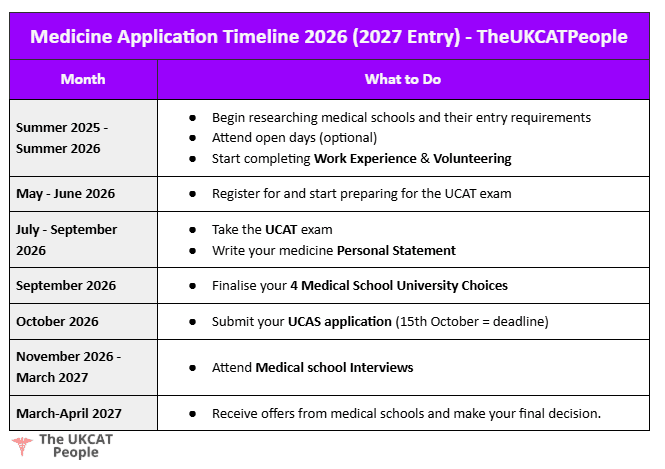
What is the timeline for medicine 2027 entry?
The key aspects of your UCAS Medicine application, which will be considered in this timeline are:
- Deciding on Medicine
- Work Experience
- Volunteering
- Wider Reading
- UCAT
- BMAT (no longer used; cancelled after the 2024 cycle, so UCAT is now the only UK admissions test)
- Personal Statement
- University Choices
- Interviews
For careers such as Medicine, Dentistry and Veterinary Medicine - UCAS tariff points are generally not looked at.
Step 1: Deciding on Medicine
We know how difficult it is to decide on your career path while young. But really, the earlier the better, to give you a better chance of successfully planning and organising all of the components of a strong medicine UCAS application.
Step 1. Deciding on Medicine
First, it’s important to ensure that a career in medicine is right for you! Crucially, you should look into what being a doctor is like - by looking online or reading relevant books, and talking to any contacts you may have in the medical world.
The career certainly isn’t for everyone, and it’s important not to view it through rose-tinted glasses.
👉🏼 Check out our guide to Deciding on Studying Medicine in the UK
👉🏼 Read more: Compared: UK Medical School Fees For International Students (2026 Updates)
Step 2: Organising Work Experience
Medicine Work Experience
Having some work experience and volunteering under your belt is fundamental for your medicine application. This is best done in the summer between years 11 and 12 or in the summer between years 12 and 13, and it can also be done online.
Struggling to find placements? Use our free work experience finder to locate GP practices, hospitals, care homes and hospices near your postcode.
Of course, work experience can be done throughout the year - it is completely up to you. But it takes time to organise - so get organised!
There are many benefits to medical work experience:
- First, it will help you be sure that Medicine is the right career path for you!
- Second, it shows universities that you’ve really thought about this and bolsters your application significantly. You can get work experience in local hospitals, work experience in GP practices, volunteering in care homes and even online medicine work experience.
👉🏼 Check out our Comprehensive UK Medicine Work Experience Guide
Volunteering for Medicine
Volunteering is a crucial aspect of any medicine application for UK universities, as it not only demonstrates a strong commitment to helping others but also showcases the development of essential skills and qualities required for a successful career in medicine.
Medical schools value applicants who have gained real-world experience through volunteering, as it reflects compassion, empathy, and an understanding of the challenges faced by patients and healthcare professionals.
To strengthen your application, seek out volunteering opportunities in various healthcare settings, such as hospitals, care homes, hospices, or even local community projects. Engaging in diverse experiences will provide you with a broader perspective on healthcare and allow you to develop key skills, such as communication, teamwork, and problem-solving.
By dedicating your time to volunteering, you will not only enhance your personal and professional growth but also demonstrate your passion and dedication to a career in medicine.
Be mentored 1-1 by a doctor
Every question answered, from choosing schools to interview day.
- 1-1 mentoring from a practising NHS doctor, never a salesperson
- Personal statement and interview coaching with expert tutors
- Honest, tailored guidance for your target medical schools
Step 3: Doing Well In Your A-Level Mock Exams
Step 3: Sitting Your School Exams
How hard is it to get into medical school? Well, unfortunately, the answer is that getting into medical school can be very hard - and only around 30% of applicants are successful.
However, you can maximise your chances with great grades that will help you to stand out when applying to medical school.
In particular, look to take Biology and Chemistry to a high level.
For more specific information on grade requirements and recommended A-level combinations for Medicine:
👉🏼 Check out Our Article On Medicine Entry Requirements
Step 4: Sitting the UCAT Exam
Step 4: Sitting the UCAT
Almost all UK medical schools require you to sit the UCAT, an admissions test designed to assess the cognitive and behavioural skills doctors need. Since the BMAT was scrapped after 2024, the UCAT is now the single admissions test used across UK medicine, so there is no longer a choice between two exams.
The UCAT is now made up of 4 subtests (Verbal Reasoning, Decision Making, Quantitative Reasoning and Situational Judgement); Abstract Reasoning was removed for 2025 entry. The four cognitive subtests are scored on a scale of 1,200 to 2,700 (not the old 3,600), and the Situational Judgement Test is reported in bands. You should still check the exact requirements for each school that interests you.
The UCAT requires no prior knowledge beyond basic maths skills and is an extremely time-pressured multiple-choice exam - but it does require preparation.
For most people, it is important that you do sit the UCAT to keep your options open.
For structured revision, our UCAT Guides hub walks through every subtest and scoring, and you can practise full mock papers on the UCAT online trainer.
Key Dates
- Account Creation: 20th May 2026 [you must do this before you can book]
- UCAT Booking: 23rd June 2026 [you must wake up at 06:00 BST to be quick to book the test]
- Testing runs from 13th July 2026 until 24th September 2026 (you can select when you sit the exam)
See more information on UCAT registration here
Our Ultimate Package includes expert tutoring, practice questions, and exam strategies to help you excel in these challenging exams and boost your chances of securing a place at your desired medical school.
👉🏻 Get in touch with our expert tutoring team
👉🏼 UCAT Guide
Step 5: Writing Your Personal Statement (Summer)
Step 5: Writing a Medicine Personal Statement
When you submit your UCAS application to your chosen universities, you will be asked to provide a short medicine personal statement or dentistry personal statement to support your application.
We would recommend writing your medicine personal statement over the summer between year 12 and 13.
Universities will use this to ascertain information about you beyond your grades. You will have 4000 characters to use across 3 separate questions to demonstrate your motivation to study medicine, depth of work experience, relevant extra-curricular activities and fitness to be a medical student.
For advice on how to write a personal statement:
Boost your UCAT with 1-1 tutoring
Rated 5.0 from 550+ reviews. Weekly 1-1 sessions with top-scoring tutors, built around your weakest subtests.



Step 6: Selecting Your 4 Medical Schools
Step 6: Selecting Medical Schools
It’s important to have a rough idea from an early stage of what medical schools you may want to target, even if you don’t know specifics.
This is because they vary in their requirements - from what school subjects you should take to which entrance exam they require their candidates to sit.
It is absolutely fundamental that you spend time working this out and researching. It is one of the most common reasons why a student receives 4 rejections.
Touring medical schools and checking out their websites & prospectuses are great ways of making sure that you’re picking the best ones for you.
For more tips:
Step 7: Submitting Your UCAS Application
7. Submitting Your UCAS Application
Anyone applying to study medicine in the United Kingdom must do so via UCAS.
The deadline for applications this year is 15th October 2026. UCAS (Universities and Colleges Admissions Service) is the centralised body that manages all higher education applications in the UK.
Your UCAS application is then sent to all universities to which you are applying, so you don’t need to worry about applying to each of them individually.
Your medicine UCAS application consists of the following components:
- Your basic information & GCSE grades / A-Level Predicted grades / UCAT grades
- The 4 medical schools to which you would like to apply
- A medicine personal statement - read more in our Ultimate Personal Statement Guide
- A reference from your school (the same length as your personal statement)
Check out our UCAS guide for information on how the process works and what the associated costs are.
Step 8: The Medicine Interviews
Step 8: Acing Your Medical School Interviews
After your UCAS application has been submitted, you’ll start hearing back with some medicine interview offers if your application has been successful! The interviews are usually held from November to March every cycle and can be both in person or online.
At this point, you’ll want to practice and prepare for these all-important medicine interview days.
Our full medicine interview guide contains all that you need to know, and our expert tutors are waiting to help you out with medicine interview tutoring as well as panel and MMI mock interviews.
👉🏼 Medicine Interview Tutoring
9. Waiting!
After your interviews, all you can do is wait for the hopefully good news! After this, the hard part begins - 5-6 years of medical school and post-medical school training as a doctor.
It takes 5-6 years to become a doctor in the UK, but many more before you complete your training because a UK medical degree is just the start. For more information on this training, check out our guide to a doctor’s training pathway.
The cost of studying medicine in the UK
It is also vitally important to consider the costs of studying medicine before you apply. Studying medicine in England or Wales costs up to £9,250 per year.
In Scotland and Northern Ireland, fees vary depending on where you are from - for instance, Scottish students can study in Scotland for free.
Any UK or EU medical student is entitled to a full loan to cover the costs of studying medicine, which you can apply for here: https://www.gov.uk/student-finance-register-login.
Additionally, you can apply for assistance with the costs of living in the form of either a loan or grant, which you can check eligibility for here.
These can be applied through the link above. Some universities also offer their own bursaries and scholarships which you can check for on their website.
There is also a price to apply through UCAS. If you’re wondering how much a UCAS application costs, then check with your school as most will pay the fee for you. If they don’t, however, then you can expect to pay £20 for a single choice or £25 for multiple choices.
Of course, the costs to study medicine in the UK as an international medical student fees for medicine in the UK are far higher, ranging from £20000 to £60000 per annum in the UK.
Learn more about International Medicine Fees In The UK
Tips to boost your UCAS Medicine Application
It is extremely important that you consider your UCAS application for medicine in a holistic manner. There are many aspects of your application that different universities place great weight upon. This includes:
- GCSEs
- A-Level Predicted Grades
- UCAT Score
- Medicine Personal Statement
- Medical Interview
It is vital that you try and optimise each area of your application towards this - which is something that we at TheUKCATPeople have been doing for 12 years - we help with every aspect of the application.
Check out the latest entry requirements for medicine in the UK here.
Choose your Ultimate Package
Rated 5.0 from 550+ reviews. 1-1 mentoring from doctors across UCAT, personal statement and interviews.


Applying through UCAS with a disability
Most medical schools require that you will be fit to practice Medicine by the end of your degree. If you have a disability that would not prevent you from being able to practice Medicine, then you will still be able to study it.
If you have any questions about whether a particular medical school will suit your needs, then you should explore this further - you can check their website, go to an open day, or contact them directly.
Most universities, if not all, will have designated Disability Services who specialise in helping people in your position and will be able to give you any information that you need.
You can also declare your disability on your UCAS form so that universities know what support to prepare for you before you arrive. Additionally, as a disabled student, you may be eligible for the DSA (disabled student’s allowance) - which you can find out more about here.
How many universities can you apply to study medicine in the UK?
You can only apply to four universities to study medicine in the UK.
Through UCAS, you can apply to no more than 5 courses. However, only 4 of these can be medicine (course code A100). Your fifth extra non-medicine UCAS choice - if you choose to make one - must be to a different course. It can, however, be to a different course at one of the 4 universities to which you are applying to study medicine.
As medicine is a highly competitive course, and every year many candidates do not receive any offers for it, we strongly encourage you to apply for a 5th “backup” course. Sadly, there is no way of adding a 5th extra medicine UCAS option.
Frequently asked questions
When is the UCAS medicine deadline?
The UCAS medicine deadline is 15 October at 18:00 (UK time), earlier than the main UCAS deadline for most other courses. For 2026 entry it was 15 October 2025; for 2027 entry it is 15 October 2026. This same deadline also applies to dentistry, veterinary medicine and all courses at Oxford and Cambridge. Late medicine applications are not given equal consideration.
What is the UCAS medicine deadline for 2026 entry?
The UCAS deadline for medicine for 2026 entry was 15 October 2025 at 18:00 (UK time). That date has now passed. If you are applying for the next cycle, the medicine deadline for 2027 entry is 15 October 2026 at 18:00. Medicine, dentistry and veterinary applications all share this earlier October deadline rather than the January one.
When do medical school applications open?
UCAS undergraduate applications for 2027 entry open on 12 May 2026, and completed applications can be submitted from 1 September 2026. The UCAS search tool shows the new cycle's courses from 28 April 2026. You should register and start drafting well before the 15 October 2026 medicine deadline, because everything from UCAT to references takes time to organise.
How many medical schools can you apply to through UCAS?
You can apply to a maximum of 4 medical schools (course code A100) through UCAS. UCAS lets you choose up to 5 courses in total, so you may use the 5th choice for a non-medicine backup such as biomedical science. Because medicine is so competitive and many applicants receive no offers, we strongly recommend using that 5th backup choice.
What is the timeline for a medicine application?
Work roughly a year ahead. Decide on medicine and gain work experience and volunteering (often the summer of Year 12), register for and sit the UCAT over summer, write your personal statement, research and select your 4 schools, then submit before the 15 October deadline. Interviews typically run from November to March, with most offers confirmed by spring.
When do medicine interviews start?
Medical school interviews usually begin in November and run through to March, after the October UCAS deadline. Most are Multiple Mini Interviews (MMIs) or panel interviews, and shortlisting is heavily influenced by your UCAT score and academics. You will not hear from every school at once, so expect invitations to arrive at different times across the winter.
When do you apply for medical school in the UK?
You apply in the autumn of the year before you want to start, submitting your UCAS application by 15 October at 18:00. For 2027 entry that means submitting by 15 October 2026. Most applicants apply in Year 13 (or during a gap year), having sat the UCAT over the preceding summer. Preparation realistically begins 12 to 18 months earlier.
Is the UCAS medicine deadline different from other courses?
Yes. Medicine, dentistry and veterinary medicine, plus all courses at Oxford and Cambridge, have an earlier UCAS deadline of 15 October at 18:00. Most other undergraduate courses have a later deadline (mid-January). This earlier date exists because these competitive courses run admissions tests and interviews, so universities need applications in sooner.
Do I still need to sit the BMAT for medicine?
No. The BMAT was discontinued after the 2024 application cycle, so no UK medical school now uses it. The UCAT is the single admissions test used across UK medicine. The UCAT now has 4 subtests (Abstract Reasoning was removed for 2025 entry) and the cognitive sections are scored from 1,200 to 2,700, with the Situational Judgement Test reported in bands.
What are the UCAT key dates for 2027 entry?
For applicants in the 2026 testing cycle (2027 entry), UCAT account creation typically opens around 20 May 2026, booking from 23 June 2026, and testing runs from mid-July to late September 2026. You must sit the UCAT before the 15 October UCAS deadline. Always confirm the exact dates on the official UCAT website before you book.
How competitive is getting into medical school?
Very competitive: only around 30% of applicants are successful in any given year, and many receive no offers at all. Strong GCSEs and predicted A-levels (especially Biology and Chemistry), a high UCAT score, a compelling personal statement and good interview performance all matter. Choosing your 4 schools strategically against their entry criteria is one of the most important steps.
How much does it cost to study medicine in the UK?
Home tuition fees in England and Wales are up to £9,250 per year, with variations in Scotland and Northern Ireland depending on where you are from. UK students can take out tuition and maintenance loans via Student Finance. International medicine fees are far higher, typically £20,000 to £60,000 per year. Some universities also offer bursaries and scholarships.
What does a UCAS medicine application include?
Your UCAS medicine application includes your personal and qualification details (GCSEs, predicted A-levels and UCAT score), your 4 chosen medical schools (A100) plus an optional 5th non-medicine backup, your personal statement (4,000 characters across 3 structured questions since the 2025 change for 2026 entry), and a reference from your school or college.
Can you apply to medicine with a disability?
Yes. Medical schools require that you can meet fitness-to-practise standards by the end of your degree, but a disability does not automatically prevent you from studying medicine. You can declare a disability on your UCAS form so universities can prepare support, contact each school's disability services, and you may be eligible for the Disabled Students' Allowance (DSA).
What happens if I miss the 15 October medicine deadline?
Late medicine applications are not given equal consideration, and in practice you cannot add medicine to your UCAS choices after 15 October. If you miss it, your main options are to apply the following cycle (often as a gap-year applicant), consider Clearing for related courses, or look at graduate-entry or overseas routes. Aim to submit at least 10 days early to avoid technical issues.

Want expert help with your application?
From 1-1 tutoring and personal statement editing to interview coaching and our all-in-one Ultimate Package, we support every stage. Tell us what you are aiming for and we will recommend the right option.
More UCAS guides
- Applying to Study Medicine (MBBS) in the UK: International Students Guide 2026
- Medicine Clearing Guide 2026
- How to Study Medicine Abroad in 2026
- Studying Medicine In Ireland: The Ultimate Guide To Applying In 2026 & The Atlantic Bridge Programme
- Studying Medicine in the UK from Australia and New Zealand: Complete Guide for 2026 and 2027 Entry
- Applying to Study Medicine in Europe in 2026
- Studying Medicine in the UK from Canada: A Complete Guide - 2026
- Applying to Medicine in the UK from the UAE in 2026