“Harry got my UCAT up to 2,590, working through the sections I kept dropping marks on week by week. Gemma then ran my interview practice so the MMI stations didn't catch me out, and Dr Akash mentored me the whole way through. I'm off to King's for Medicine.”
RCSI University of Medicine and Health Sciences
One of Europe's most international medical schools: over a fifth of its medicine students come from the US or Canada.
Trusted UK and international medicine admissions specialists since 2012 · 2700+ taught

At a glance
- Location
- Dublin, Ireland
- Founded
- 1784
- Reputation
- Top 250 worldwide (THE 2026); one of Europe's most international medical schools
- Degree awarded
- MB BCh BAO
- Programmes
- Undergraduate (5 or 6 years) and Graduate Entry (4 years)
- Non-EU tuition
- €61,000 per year (2026/27)
- Graduate entry
- Yes (4 years)
- Annual intake
- 75 EU and 225 non-EU school-leaver places (2026 entry)
- Admissions tests
- HPAT (EU) · GAMSAT/MCAT (graduate)
- North American route
- Atlantic Bridge
- Recognised by UK GMC
- Yes
Overview
The Royal College of Surgeons in Ireland is a not-for-profit health-sciences university in central Dublin, founded in 1784 and focused solely on medicine and health sciences.
It is one of the most international medical schools in Europe and pioneered Graduate Entry Medicine in the Republic of Ireland in 2006. Its MB BCh BAO degree is recognised by the UK General Medical Council.
- Founded in 1784; teaches only medicine and health sciences.
- Over 20% of its medicine students come from North America.
- Ran the first Graduate Entry Medicine programme in the Republic of Ireland (2006).
Why RCSI is popular with international students
Top 250 worldwide (THE 2026); one of Europe's most international medical schools
RCSI is Ireland's only university dedicated entirely to medicine and the health sciences, which gives it a single-minded focus that students notice from day one: there is no arts faculty or sprawling general campus, just medicine, pharmacy, physiotherapy and nursing taught together in the centre of Dublin. That focus, plus a long surgical heritage going back to 1784, is a large part of why it is so well known internationally.
It is also one of the most genuinely international medical schools in Europe. More than a fifth of its medicine students come from Canada or the United States, and it has a North American alumni network of over 2,000 practising doctors, so North American applicants arrive to find a large, established community rather than a handful of overseas students. RCSI is ranked inside the world's top 250 universities (Times Higher Education 2026) and was placed first in the world for Good Health and Well-being in the THE Impact Rankings 2025.
Campus, city and teaching hospitals
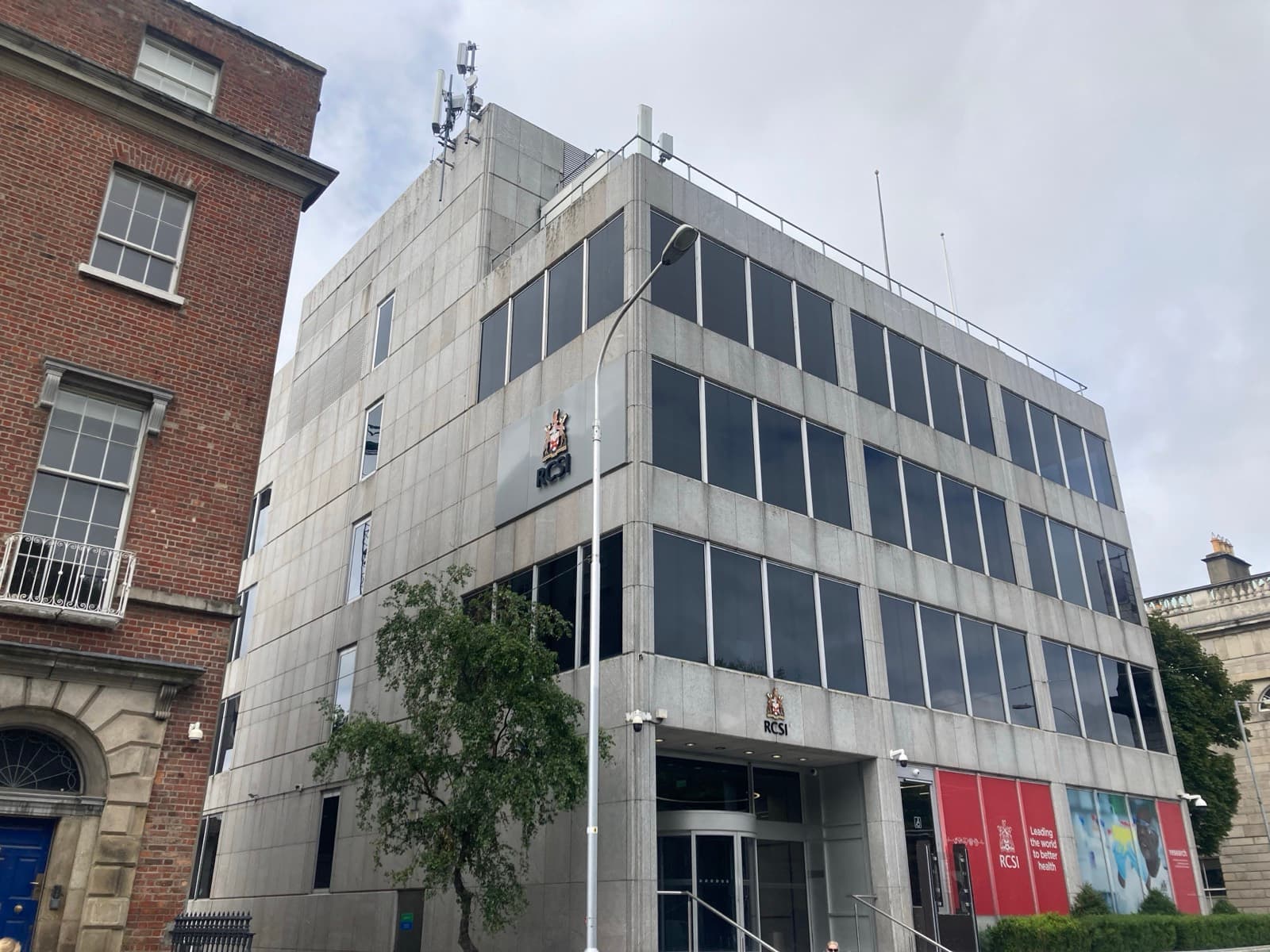
RCSI's campus sits on St Stephen's Green and York Street in the heart of Dublin, with its flagship 26 York Street building housing one of Europe's largest clinical-simulation and surgical-skills centres. It is a compact, city-centre, professional environment rather than a parkland campus.
Where you train
- Beaumont Hospital and Connolly Hospital (Blanchardstown) as the principal teaching hospitals
- The wider RCSI Hospitals Group, including the Rotunda maternity hospital and Our Lady of Lourdes Hospital, Drogheda
How international students apply
Which route you use depends on where you are applying from, not which school you choose:
- North America (Canada and the US): apply through the Atlantic Bridge Programme.
- Other non-EU (UAE and Dubai, India, the wider Middle East, Asia, Africa): apply directly to RCSI.
- EU, UK and EEA: apply through the CAO.
Applying from Canada or the US?
North American students apply to RCSI through the Atlantic Bridge Programme: one application and one set of documents covering all six Irish medical schools. Our Atlantic Bridge Programme guide walks through eligibility, the MCAT or GAMSAT, Casper, deadlines, the personal statement and how to get in.
For the full picture across all six schools, see our guide to studying medicine in Ireland and the Irish medical schools comparison.
Entry requirements and admissions tests
- HPAT-Ireland for EU undergraduate applicants via the CAO; non-EU undergraduates are exempt.
- Graduate Entry: MCAT (minimum 503) or GAMSAT (minimum 60), valid for four years.
- Casper situational judgement test is required for RCSI's 5- and 6-year programmes for North American (Atlantic Bridge) applicants.
RCSI publishes a structured interview for mature-entry (23+) applicants; a set format for the main school-leaver intake is not published.
Tips for applying to RCSI
- North American applicants apply through the Atlantic Bridge Programme, not directly to RCSI.
- Casper is required for the 5- and 6-year programmes and is held on a fixed date in January. RCSI stops taking new applications shortly before it, so book and sit Casper early rather than waiting for the deadline.
- Graduate-entry applicants need a completed degree plus a competitive MCAT (minimum 503) or GAMSAT (minimum 60); aim comfortably above the minimum.
Fees for international students
| Non-EU undergraduate | €61,000 per year (2026/27) |
|---|---|
| Non-EU graduate entry | €62,500 per year (2026/27) |
| EU / UK / EEA | EU students who qualify for the Free Fees Initiative pay only ancillary charges (around €3,000 a year); EU graduate entry is part-funded by the HEA. |
US federal loans: RCSI participates in the US Federal Direct Loan programme (Stafford and Grad PLUS) for eligible US citizens studying at least half-time. It is the only Irish medical school to do so for medicine; confirm your loan eligibility and RCSI's school code with the RCSI student finance office before you rely on it.
Compare costs across all six schools in our Ireland medicine fees breakdown. Fees rise most years, so confirm the figure for your year of entry on the official course page.
Graduate Entry Medicine
4-year Graduate Entry Medicine, the first programme of its kind in the Republic of Ireland (introduced 2006).
Graduate entry needs a 2:1 degree plus a GAMSAT or MCAT score. See our Graduate Entry Medicine guide and GAMSAT guide.
Applying to medicine?
Complete medicine application support: UCAT tutoring, personal statement reviews and interview coaching from doctors.
Can you return to the US or Canada after graduating?
An Irish medical degree from RCSI is internationally recognised, but how you get home matters and is worth planning from your first year. Here is what the route back looks like:
North American applicants can read the full route home, including the USMLE, ECFMG and the residency match, in our Atlantic Bridge Programme guide.

Want expert help applying to RCSI?
From personal statement editing and interview coaching to our all-in-one Ultimate Package, we support applicants to RCSI at every stage. Tell us where you are applying from and we will recommend the right option.
Medicine application tutoring with experts
Work with doctors and admissions experts across every stage of your application.
RCSI: frequently asked questions
How do international students apply to medicine at RCSI?
North America (Canada and the US): apply through the Atlantic Bridge Programme.
Other non-EU (UAE and Dubai, India, the wider Middle East, Asia, Africa): apply directly to RCSI.
EU, UK and EEA: apply through the CAO.
How much does medicine at RCSI cost for international students?
Non-EU undergraduate medicine at RCSI costs €61,000 per year (2026/27), and graduate entry €62,500 per year (2026/27). EU students who qualify for the Free Fees Initiative pay only ancillary charges (around €3,000 a year); EU graduate entry is part-funded by the HEA.
Does RCSI offer graduate entry medicine?
4-year Graduate Entry Medicine, the first programme of its kind in the Republic of Ireland (introduced 2006).
Can I return to practise in the US or Canada after studying medicine at RCSI?
Yes. RCSI graduates pursue US practice on the standard international medical graduate route: ECFMG certification, the USMLE exams and the ERAS/NRMP residency match. RCSI is the one Irish medical school that participates in the US Federal Direct Loan (Stafford/Grad PLUS) programme for eligible US students, and it offers structured careers support for up to three years after graduation, including for the US match.
Canadian graduates return through the Medical Council of Canada route (the MCCQE and NAC examinations) and the CaRMS R-1 match, which is open to Canadian citizens and permanent residents. RCSI's large North American alumni network includes graduates who have matched at institutions such as McGill, McMaster and the University of Toronto.
Why is RCSI a popular choice for international medical students?
RCSI is Ireland's only university dedicated entirely to medicine and the health sciences, which gives it a single-minded focus that students notice from day one: there is no arts faculty or sprawling general campus, just medicine, pharmacy, physiotherapy and nursing taught together in the centre of Dublin. That focus, plus a long surgical heritage going back to 1784, is a large part of why it is so well known internationally.
It is also one of the most genuinely international medical schools in Europe. More than a fifth of its medicine students come from Canada or the United States, and it has a North American alumni network of over 2,000 practising doctors, so North American applicants arrive to find a large, established community rather than a handful of overseas students. RCSI is ranked inside the world's top 250 universities (Times Higher Education 2026) and was placed first in the world for Good Health and Well-being in the THE Impact Rankings 2025.

Is a medical degree from RCSI recognised in the UK?
Yes. The MB BCh BAO is recognised by the UK GMC for registration. Graduates can register with the GMC and enter the UK Foundation Programme.