10 hours
1-1 UCAT tutoring
Reviewed by Dr Shaneil Tanna
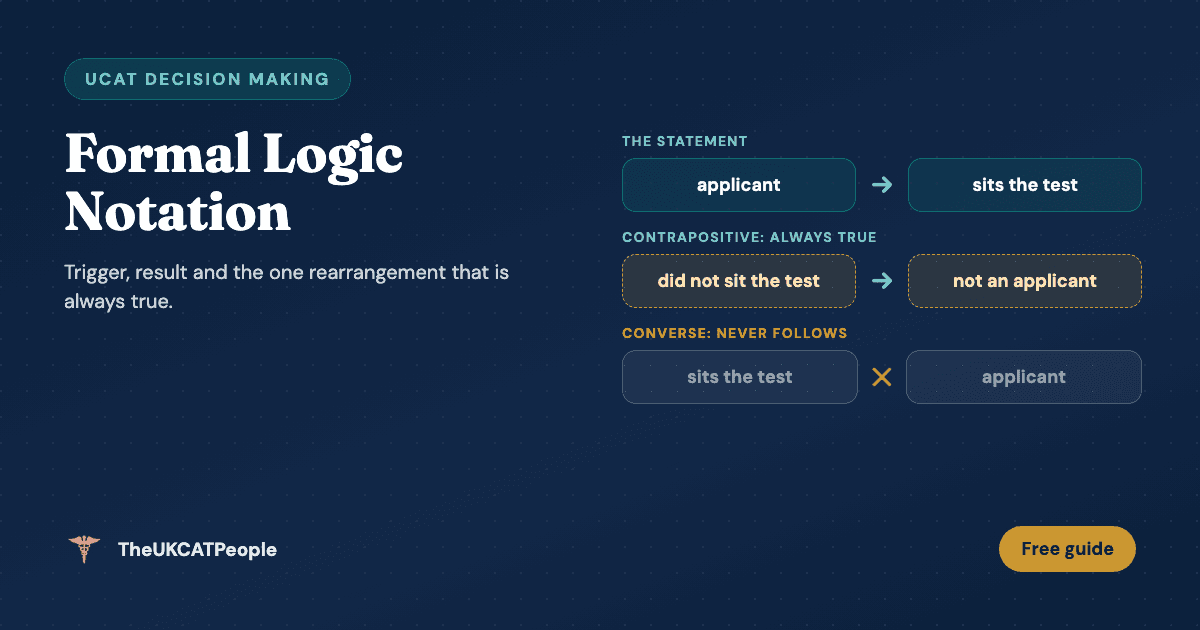
At TheUKCATPeople, I am Dr Akash, and this is the method I teach when a student has learned Venn diagrams properly and is still losing marks on syllogisms. The pattern is always the same: they are fine with statements about groups, and they fall apart on statements about conditions. "All surgeons are doctors" is a picture. "You can only book a theatre slot if you are on the rota" is not a picture, it is a rule, and drawing circles for it is slow and error prone.
Formal logic notation is the second gear. You turn a conditional statement into two terms and an arrow, then read off the one rearrangement that is guaranteed to be true and the two that are guaranteed to be traps. It takes about ten seconds to set up and it turns several of the hardest Decision Making statements into a glance.
In the 2026 UCAT, Decision Making is 35 questions in 37 minutes, just over a minute per question, with a simple on-screen calculator and no negative marking (UCAT Consortium).
You do not need formal logic to score well in the UCAT. Nothing in the test requires it, and no marks are awarded for writing anything down. It is a tool for a specific job: conditional statements, negatives, and the words only and unless. Use it there, and use Venn diagrams everywhere else.
This guide sits under the Decision Making complete guide and is the companion to our syllogisms guide, which teaches the Venn method and the five premise types. If the logical words themselves are what trip you up, start with the Decision Making definitions first, then come back here.
Most preparation treats formal logic as a general-purpose upgrade. It is not. It is precise about a narrow class of statement and useless outside it, and knowing the boundary is most of the value. The dividing line is whether the statement is categorical, meaning it holds every time with no exceptions, or relative, meaning it is about a proportion.
If the statement uses... | Shape | Best method |
|---|---|---|
all, every, each, any, always | Categorical conditional | Notation, or a Venn diagram. Both work |
no, none, never, nothing | Categorical, negative | Notation. Faster than drawing separated circles |
only, the only, only if, unless | Categorical, reversed or negated in English | Notation. A Venn diagram will usually be drawn the wrong way round |
if, provided that, requires, must | Categorical conditional | Notation |
some, many, several, most, majority, few, not all | Relative | Venn diagram. Notation does not apply and will produce a wrong answer |
A mix of categorical and relative premises | Mixed | Venn diagram for the whole chain, notation to check any conditional link inside it |
The single most damaging mistake with formal logic is applying it to a relative statement. "Some students are graduates" cannot be written as an arrow, so it has no contrapositive, and any rearrangement you produce from it is invented. Arrows are only ever for statements that hold in every case without exception.
The Venn method, including how to draw the five premise types and chain them, is in the syllogisms guide, with a dedicated walk-through of two-set and three-set diagrams in the Venn diagrams guide.
Every conditional statement has a part that sets something off and a part that must follow. Call them the trigger and the result. The trigger is the condition that, if present, forces the result every single time. The result is the thing you are guaranteed once the trigger is there.
In logic textbooks these are the sufficient condition and the necessary condition. You do not need those names and I would not spend exam time recalling them, but the idea behind them is the whole method: the trigger is enough on its own to give you the result, and the result is required by the trigger but does not by itself prove it.
The basic shape. "All UK medical students study anatomy". Notated: if UK medical student, then studies anatomy. Contrapositive, also always true: if does not study anatomy, then not a UK medical student. The arrow reads "guarantees". Reverse the two terms and flip both negatives and you get the contrapositive, which is always true whenever the original is.
Notice what the notation does not claim. It does not say that everybody who studies anatomy is a UK medical student. Physiotherapists, dentists and vets study anatomy too. The arrow points one way, and the whole discipline of this method is refusing to walk back up it.
Reading the arrow out loud
Words that behave exactly like "if" and set the trigger: all, every, each, any, whenever, provided that. Words that behave exactly like "then" and set the result: must, has to, is required to, and the whole phrase "only if". The word "only" on its own is the exception that catches most people, and it has a section of its own below.
Before you can notate anything you have to notice that a conditional is there. The UCAT rarely writes "if, then". It writes English, and the trigger and the result are buried in ordinary phrasing. This table is the one I get students to learn first, because a correct notation of the wrong shape is worse than no notation at all.
The stimulus says | Trigger | Result |
|---|---|---|
All A are B | A | B |
Every A is a B | A | B |
A requires B | A | B |
B is required for A | A | B |
B is necessary for A | A | B |
A is enough to guarantee B | A | B |
A is sufficient for B | A | B |
There is no A without B | A | B |
You cannot have A unless you have B | A | B |
A is a prerequisite for B | B | A |
Only A are B | B | A |
B only if A | B | A |
No A are B | A | not B |
A rules out B | A | not B |
A and B are mutually exclusive | A | not B |
Read the last three rows together. "Rules out" and "mutually exclusive" are the two phrasings students most often fail to recognise as conditionals at all, and both produce a clean negative arrow that reverses safely.
Watch the two rows that swap. "A requires B" puts A first, because needing B is triggered by wanting A. "A is a prerequisite for B" puts B first, because A is the thing that must already be in place. The words look similar and the arrows point opposite ways, so read the sentence rather than pattern matching on the word.
The necessary and sufficient test, in plain words
If you are unsure which way the arrow points, take the two terms one at a time and ask a single question of each: does having this term guarantee the other? The term that guarantees the other is the trigger, and it goes on the left. The term that is merely required, so that you cannot have the first without it, is the result, and it goes on the right.
In an ordinary conditional exactly one term passes that test. If both seem to pass, look again: either you have misread one of them, or the statement really does run both ways, which in Decision Making happens with "either" and is dealt with below.
There is exactly one rearrangement of a conditional statement that is guaranteed to be true. It is called the contrapositive, and forming it is two steps that must both happen.
Do both and the new statement carries exactly the same information as the original. Do only one and you have written something that is not merely different, it is one of the standard wrong answers, planted deliberately.
The one that is true, and the two that are traps. "Every applicant to this course sits an admissions test". Notated: if applicant to this course, then sits an admissions test. Contrapositive, also always true: if did not sit the test, then not an applicant. Does not follow: if sits an admissions test, then applicant to this course. Plenty of people sit admissions tests for other courses. Reversing alone proves nothing. Does not follow: if not an applicant, then did not sit the test. Not applying here does not stop you sitting a test. Negating alone proves nothing. Both invalid rows do half the job. The contrapositive is the only rearrangement that does both, and it is the only one that is always true.
Why the contrapositive has to be true
It is worth understanding rather than memorising, because understanding survives exam stress. If every applicant sits the test, then finding somebody who did not sit the test tells you something certain: they cannot be an applicant, because if they were, they would have sat it. That is the contrapositive, and you have just derived it from ordinary reasoning rather than a rule.
Form | Statement | Verdict |
|---|---|---|
Original | If applicant, then sits the test | Given |
Contrapositive | If did not sit the test, then not an applicant | Always true. Same information |
Converse | If sits the test, then applicant | Does not follow. Reversed only |
Inverse | If not an applicant, then did not sit the test | Does not follow. Negated only |
A useful check at the desk: the converse and the inverse are contrapositives of each other, so they stand or fall together. If a question offers you both, either both are unsupported, which is the usual case, or the stimulus contains a second premise you have missed.
When a student and I go through a set of wrong syllogism answers, almost every conditional-logic mistake is one of three things. Naming them matters, because a mistake with a name is one you can look for next time, and a mistake described as "I got confused" is one you will make again.
You read "all A are B" and accepted "all B are A". This is the commonest error in Decision Making and it feels reasonable because in everyday speech we often do mean both directions. "Everyone in the meeting is on the project" usually implies, socially, that the project team is who is in the room. Logically it does not.
You read "all A are B" and accepted "all non-A are non-B". This one hides better than the converse because it is stated in negative language, which sounds cautious and therefore sounds safe. It is exactly as wrong.
You read "most A are B" or "some A are B" and wrote an arrow anyway, then formed a contrapositive from it. Everything downstream of that is invented. This error is specific to students who have learned notation and then over-applied it, so it appears at exactly the point where the method starts helping, and it is the reason the boundary section above comes before this one.
Symptom in the mark scheme | What you probably did | The fix |
|---|---|---|
You marked Yes on a statement that swaps the two terms | Converse error | Ask: does a second premise give me the reverse? If not, it is No |
You marked Yes on a statement full of "not" that mirrors the original | Inverse error | Check both steps happened: reversed AND negated |
You marked Yes on a rearrangement of a "some" or "most" premise | Illicit notation | Relative premises have no contrapositive. Draw a Venn diagram instead |
You marked No on a correct contrapositive because it "sounded different" | Under-confidence, not an error of logic | Trust the two steps. Reversed and negated is the same statement in different words |
Aiming for a top-decile UCAT score?
Two statements that look almost identical on the page mean completely different things depending on which side the negative is on. Getting this wrong is not a small slip, it inverts your answer.
A negative result, and its contrapositive. "No candidate on the reserve list has been made an offer". Notated: if on the reserve list, then has not been made an offer. Contrapositive, also always true: if made an offer, then not on the reserve list. Negating a term that is already negative removes the negative. "Not, not offered" is simply "offered", which is why the contrapositive of a "no" statement comes out clean and positive on the left.
That is the practical value of the rule on negative statements: every "no A are B" premise gives you a free, tidy second statement in the other direction. "No A are B" and "no B are A" are the same claim, which is why this is the one premise type where reversing feels safe. It is safe because the negation is doing the work, not because reversing is allowed.
Double negatives
Flip a negative twice and you are back where you started, exactly as multiplying by minus one twice returns the original number. "Not unqualified" is qualified. "It is not the case that no students passed" means at least one student passed. Read these slowly, because the UCAT writes them precisely to cost you the seconds you would otherwise save.
Negative prefixes and antonyms, with one caution
You can often negate a term by stripping or adding a prefix: qualified and unqualified, clinical and non-clinical, complete and incomplete. This is genuinely useful and it is how the test writes many of the answer statements.
The caution most guides skip: this only works when the pair is a true two-way split with nothing in between. Qualified and unqualified is a real binary, so negating one gives the other. Hot and cold is not, because "not hot" includes warm and tepid, and "not tall" is not "short". If a third possibility exists, the antonym is not the negation, and treating it as one manufactures a conclusion the stimulus never gave you.
Most multi-premise syllogisms are a chain. Two arrows join if, and only if, they meet head to tail: the result of one is the trigger of the next. When they do, you can read straight through the middle and treat the chain as a single arrow.
A two-link chain, read end to end. "Every foundation doctor is on the deanery register, and everyone on the deanery register has an NHS smartcard". Notated: if foundation doctor, then has an NHS smartcard. Contrapositive, also always true: if has no NHS smartcard, then not a foundation doctor. The middle term, being on the deanery register, disappears once the arrows are joined. The contrapositive of the joined chain is as reliable as the contrapositive of a single link.
The three ways a chain fails to connect
Reason 3 is the most common broken chain at the top of the score range, because it looks so nearly valid. A shared word is not a link. The link has to be a guarantee, and "most" is never a guarantee.
These four are where notation earns its place, because in each case the English word order does not match the logical order. Students who reason intuitively get them wrong at a rate that has nothing to do with how clever they are. Students with notation get them right mechanically.
English | Notation | Reads as | Contrapositive |
|---|---|---|---|
Only A are B | If B, then A | Everything that is B is A. Nothing about whether A are B | If not A, then not B |
The only A are B | If A, then B | Behaves like "all". Normal order | If not B, then not A |
A only if B | If A, then B | The phrase "only if" is the arrow itself. What follows it is the result | If not B, then not A |
No A unless B | If A, then B | Unless introduces the result. The part before it is the trigger | If not B, then not A |
A unless B | If not A, then B | Negate the part before "unless" | If not B, then A |
Three of the five rows collapse to the same arrow, if A then B, which is the reassuring part. It is the first row, plain "only", that reverses the English order, and plain "only" is by far the most common of the five in official practice material.
Plain "only" reverses the English order. "Only registered prescribers can sign the chart". Notated: if signs the chart, then registered prescriber. Contrapositive, also always true: if not a registered prescriber, then does not sign the chart. Does not follow: if registered prescriber, then signs the chart. Being allowed to sign is not the same as signing. Most registered prescribers will never touch this chart. Plain "only" marks the result, not the trigger, so the term that appears second in the English sentence is the one that goes first in the notation.
The same statement as a picture. Picture people who sign the chart as a circle drawn entirely inside a larger circle for registered prescribers. This proves: Everyone who signs the chart is a registered prescriber. This does not follow: Every registered prescriber signs the chart. The inner circle can be much smaller than the outer one, and it can even be empty. That is why "only" never tells you the reverse.
Unless, in one line
The part immediately after "unless" is the result. The part before it is the trigger, and you negate it as you write it down. Test any notation you produce against a plain reading of the sentence before you use it: "I will not attend unless the tutorial is recorded" becomes if I attend, then it was recorded, and its contrapositive is if it was not recorded, then I did not attend. Both match what the sentence obviously means, so the notation is right.
Either, which behaves unusually
In Decision Making, "either A or B" means exactly one of them, not both and not neither. That gives you two arrows rather than one: if A, then not B, and if not A, then B. To disprove an "either" statement you need only find a case that is both, or a case that is neither.
"Either" gives you an arrow in each direction. "Each placement is either community based or hospital based". Notated: if community based, then not hospital based. Contrapositive, also always true: if hospital based, then not community based. Because the two options are exclusive and exhaustive, the contrapositive here is genuinely useful: knowing a placement is hospital based settles that it is not community based.
These are full five-statement sets in the exam format, so you can practise the whole decision rather than one statement at a time. Notate the stimulus first, then work down the statements.
Every student who passes the practical assessment is entered for the final examination.
For each statement, decide whether it follows from the information given:
1. A student who is not entered for the final examination did not pass the practical assessment.
Answer: Yes. This is the contrapositive: reversed and negated on both sides. It carries the same information as the premise.
2. A student who is entered for the final examination passed the practical assessment.
Answer: No. This is the converse. Students could be entered by another route, and nothing rules that out.
3. A student who did not pass the practical assessment is not entered for the final examination.
Answer: No. This is the inverse. It is the converse in disguise and fails for the same reason.
Choose your 1-1 UCAT package
Rated 5.0 from 640+ reviews. 1-1 sessions with top-scoring tutors, weekly or more often, built around your weakest subtests.
10 hours
1-1 UCAT tutoring
20 hours
1-1 UCAT tutoring
30 hours
1-1 UCAT tutoring
4. A student who passed the practical assessment is entered for the final examination.
Answer: Yes. This is the premise read forwards, in the direction the arrow already points. Restatements are worth marking quickly and moving on.
5. Some students who passed the practical assessment are not entered for the final examination.
Answer: No. This directly contradicts the premise, which says every one of them is entered.
Statements 2 and 3 are the converse and the inverse of one another, so they always share a verdict. Spotting that pairing is worth a few seconds on test day.
Only staff who have completed the safeguarding module may supervise a clinic.
For each statement, decide whether it follows from the information given:
1. Anyone supervising a clinic has completed the safeguarding module.
Answer: Yes. This is the premise stated in the correct direction. Only marks the result, so supervising guarantees completion.
2. Every member of staff who has completed the safeguarding module supervises a clinic.
Answer: No. The direction trap. Completing the module permits supervision, it does not require it.
3. A member of staff who has not completed the safeguarding module may not supervise a clinic.
Answer: Yes. The contrapositive of the premise: not completed, therefore not permitted to supervise.
4. Some staff who have completed the safeguarding module do not supervise a clinic.
Answer: No. Possible, and probably true in real life, but the premise does not establish it. Nothing tells us any such member of staff exists.
5. Staff who supervise a clinic are the only staff who have completed the safeguarding module.
Answer: No. This makes the module exclusive to supervisors, which reverses the premise and adds a claim it never made.
Statement 4 is the trap that catches careful students: it is cautiously worded and plausible, but "does not follow" and "is probably true" are different verdicts, and only the first earns the mark.
No applicant without a predicted grade of AAA is invited to interview. Every applicant invited to interview is sent a timetable.
For each statement, decide whether it follows from the information given:
1. An applicant who is sent a timetable has a predicted grade of AAA.
Answer: No. The chain runs from AAA-less to not invited to, separately, invited to timetabled. Being sent a timetable does not prove an invitation, because nothing says timetables go only to those invited.
2. An applicant who is not sent a timetable was not invited to interview.
Answer: Yes. The contrapositive of the second premise: invited guarantees timetabled, so not timetabled guarantees not invited.
3. An applicant without a predicted grade of AAA is not sent a timetable.
Answer: No. The first premise stops the chain at "not invited". Whether such an applicant is sent a timetable anyway is not settled.
4. An applicant invited to interview has a predicted grade of AAA.
Answer: Yes. The contrapositive of the first premise. No AAA means no invitation, so an invitation means AAA.
5. Every applicant with a predicted grade of AAA is invited to interview.
Answer: No. The converse of the first premise. AAA is required for an invitation, not sufficient for one.
Statement 1 is the one that separates strong candidates. A chain only runs in the direction its arrows point, and a shared word in two premises is not a link unless the arrows meet head to tail.
The rota is not published unless the department head has approved it. The department head has not approved this week's rota.
For each statement, decide whether it follows from the information given:
1. This week's rota has not been published.
Answer: Yes. Notate the first premise as: if published, then approved. The contrapositive is: if not approved, then not published. The second premise supplies "not approved".
2. If the department head approves the rota, it will be published.
Answer: No. The converse. Approval is required for publication, not sufficient for it. Something else could still hold it up.
3. A published rota has been approved by the department head.
Answer: Yes. This is the first premise read in the correct direction.
4. The department head approves every rota that is not published.
Answer: No. This reverses and misreads the premise. Non-publication tells you nothing at all about approval.
5. It is not the case that this week's rota has been published.
Answer: Yes. A double negative wrapped around statement 1. Strip the wrapper and it says the rota was not published, which follows.
Statement 5 is a wording test rather than a logic test, and the UCAT uses these to spend your seconds. Read the sentence, strip the negatives in pairs, then compare.
Most members of the research group have a doctorate. All members of the research group attend the weekly seminar.
For each statement, decide whether it follows from the information given:
1. Someone who attends the weekly seminar has a doctorate.
Answer: No. The seminar is attended by all members, but it may also be attended by non-members, and "most" does not guarantee that any particular attendee is one of the doctorate holders.
2. Someone who does not attend the weekly seminar is not a member of the research group.
Answer: Yes. The contrapositive of the second premise, which is categorical and therefore can be notated.
3. Most people who attend the weekly seminar have a doctorate.
Answer: No. The proportion applies to the research group, not to the seminar audience, and the audience may be much larger.
4. Not all members of the research group have a doctorate.
Answer: Yes. Most means a majority but not all, so at least one member does not have a doctorate, which is exactly what not all claims. Note that the stronger statement "some members do not have a doctorate" would be No here, because some needs more than one and most only guarantees one.
5. A member of the research group without a doctorate does not attend the weekly seminar.
Answer: No. All members attend, doctorate or not. This contradicts the second premise.
One premise here is categorical and one is relative. Notate the first, draw or reason about the second, and never let an arrow touch the word "most".
Every trainee on the rotation attends the induction. No one who attends the induction is exempt from the safety test. Everyone exempt from the safety test holds a prior certificate.
For each statement, decide whether it follows from the information given:
From diagnostic to test day: a structured plan with 1-1 expert support at every stage.
1. No trainee on the rotation is exempt from the safety test.
Answer: Yes. The first two premises join head to tail: on the rotation gives attends induction, and attends induction gives not exempt. The chain reads straight through.
2. A trainee on the rotation does not hold a prior certificate.
Answer: No. The third premise runs from exempt to certificate. Trainees are not exempt, and knowing someone is outside a group tells you nothing about a consequence of being inside it.
3. Someone who does not attend the induction is not a trainee on the rotation.
Answer: Yes. The contrapositive of the first premise.
4. Someone who holds a prior certificate is exempt from the safety test.
Answer: No. The converse of the third premise. Certificates may be held for other reasons.
5. Someone exempt from the safety test did not attend the induction.
Answer: Yes. The contrapositive of the second premise: attending rules out exemption, so being exempt rules out attending.
Statement 2 is the chain trap. Two of the three premises connect and the third hangs off the far end pointing away, which is exactly how the UCAT builds a hard set.
No applicant who has not submitted references is shortlisted. Every shortlisted applicant is contacted by email.
For each statement, decide whether it follows from the information given:
1. A shortlisted applicant has submitted references.
Answer: Yes. The first premise notates as: if not submitted references, then not shortlisted. Its contrapositive flips both negatives: if shortlisted, then submitted references.
2. An applicant who has submitted references is shortlisted.
Answer: No. The converse. References are required for shortlisting, not sufficient for it.
3. An applicant not contacted by email has not been shortlisted.
Answer: Yes. The contrapositive of the second premise.
4. An applicant not contacted by email has not submitted references.
Answer: No. Not contacted gives not shortlisted, and the chain stops there. Nothing runs from "not shortlisted" back to references.
5. An applicant contacted by email has submitted references.
Answer: No. Being contacted does not prove shortlisting, because the premise only says shortlisted applicants are contacted, not that only they are.
A premise phrased with a negative on both sides, as the first one is here, produces a clean positive contrapositive. Writing that contrapositive out immediately is usually the fastest move available.
This is what the method looks like at the desk rather than on the page. The stimulus: "Only clinicians with an up-to-date appraisal may lead a ward round. No locum is given an up-to-date appraisal on their first week."
Twenty seconds of setup and forty seconds of answering. That is the whole case for the method, and it is also the whole case against using it on a stimulus with one simple premise, where the setup buys you nothing.
This is the question nobody answers, and it decides whether the method helps you or costs you. Decision Making gives you about 63 seconds a question. A five-statement syllogism is worth two marks and can carry partial credit, so it deserves more than average time, but not unlimited time.
Writing out a notation costs roughly eight to twelve seconds once you are fluent: two terms, an arrow, and the contrapositive underneath. That investment pays back only if you then use it more than twice, which is exactly why the decision is per question rather than per section.
Stimulus | Notate? | Why |
|---|---|---|
One simple "all" statement, no negatives | No | You can hold it in your head. Writing it down is pure cost |
Any statement using only, the only, only if or unless | Yes, always | The English order misleads, and this is where the method pays most |
Two or more conditional premises to chain | Yes | The arrows show instantly whether the chain connects head to tail |
Any statement with a negative in it | Yes | Where the "not" sits decides the answer, and notation makes it visible |
Relative premises only (some, most, few) | No | Notation does not apply. Draw a Venn diagram |
You have already flagged the question and are short of time | No | Answer all five statements on instinct, flag, move on. Partial credit means a blank set is the worst outcome |
Section-by-section pacing, including how much time a two-mark set can safely borrow, is in the UCAT timings guide. If time pressure rather than logic is your limiting factor, read UCAT time pressure alongside it.
Practise notating away from the clock first. Speed on this method comes from the notation becoming automatic, and if you drill it under time before it is automatic you will simply abandon it in the exam and waste the preparation.
If you have read a formal logic textbook or done a philosophy module, be careful. In standard logic, "some" means at least one and is perfectly compatible with all. In Decision Making, "some" is defined more tightly as more than one but less than all, which means it positively excludes the possibility that all of them qualify.
That difference changes real answers. A statement concluding "some A are B" from a premise that "all A are B" is correct under textbook logic and wrong under the UCAT definitions. Where the two systems disagree, the UCAT definitions win, because they are what the mark scheme uses.
Every definition, with the numbers each one allows and the traps built on it, is in the Decision Making definitions guide.
Work these before you read the answers below the list. Retrieval beats rereading: if you can produce the contrapositive from memory under mild time pressure, you own the method.
1. Notate: "All bursary applicants must submit a household income form."
2. Notate: "Only final-year students may apply for the elective fund."
3. Notate: "You will not be admitted unless you show photographic identification."
4. True or false: from "no locum shifts are paid weekly", it follows that no weekly-paid shifts are locum shifts.
5. Which error is this? From "every bursary applicant submits a form", concluding "everyone who submits a form is a bursary applicant".
6. Can you form the contrapositive of "most tutors have taught for over five years"?
Answers
1. If bursary applicant, then submits a household income form. Contrapositive: if did not submit the form, then not a bursary applicant.
2. If applies for the elective fund, then final-year student. Contrapositive: if not a final-year student, then does not apply for the elective fund. Note the reversal: plain "only" marks the result.
3. If admitted, then showed photographic identification. Contrapositive: if did not show photographic identification, then not admitted.
4. True. Notated, the premise is: if locum shift, then not paid weekly. The contrapositive is: if paid weekly, then not a locum shift. A "no" statement is the one type that safely reverses, because the negative does the work.
5. A converse error: reversed without negating. Forms may be submitted for other reasons entirely.
6. No. It is a relative statement, not a conditional one, so it has no arrow and no contrapositive. Any rearrangement of it is invented. Reason about it with a Venn diagram instead.
Drill the notation itself against the clock on our free syllogism foundations trainer, then bring the questions you got wrong to a session. Most students need about a fortnight of short daily sets before the contrapositive comes automatically, and our 1-to-1 UCAT tutoring works through your own error log rather than a generic syllabus.
Key Takeaway: Turn a conditional statement into a trigger and a result, then form the contrapositive by doing both steps: reverse the two terms and flip both negatives. That rearrangement is always true. Reversing alone is the converse error and negating alone is the inverse error, and both are always No. Plain "only" marks the result, so it alone reverses the English order, while "the only" and "only if" keep the normal order as written. "Unless" also keeps the normal order, but the part before it is negated as you write it down. Never put an arrow on some, many, most or few: those are relative statements, they have no contrapositive, and they belong on a Venn diagram.
The contrapositive is the one rearrangement of a conditional statement that is guaranteed to be true. Form it in two steps: reverse the trigger and the result, then flip the negative on both. So "if A, then B" gives "if not B, then not A". It carries exactly the same information as the original statement, which is why a UCAT statement that is a correct contrapositive of a premise is always Yes.
No. Nothing in the UCAT requires formal logic and no marks are given for working. It is a tool for one specific job: conditional statements, statements with negatives in them, and the words only, the only, only if and unless. Many students find it makes those questions mechanical. For premises using some, most or few, a Venn diagram is the right method instead.
The converse reverses the two terms only: "if A, then B" becomes "if B, then A". That does not follow and is a standard wrong answer. The contrapositive reverses the terms and also flips both negatives, giving "if not B, then not A". Only the contrapositive is guaranteed to be true.
Plain "only" marks the result, not the trigger, so it reverses the order of the English sentence. "Only A are B" becomes if B, then A. For example, "only registered prescribers can sign the chart" means if someone signs the chart, then they are a registered prescriber. It does not mean every registered prescriber signs the chart. Note that "the only A are B" and "A only if B" behave differently and keep the normal order, giving if A, then B.
The part immediately after "unless" is the result, and the part before it is the trigger, which you negate as you write it. "A unless B" becomes if not A, then B, and "no A unless B" becomes if A, then B. Check any notation against a plain reading of the sentence before you rely on it.
No. Some, many, several, most, majority, few and not all are relative statements about a proportion, not conditional rules that hold in every case. They have no arrow and therefore no contrapositive, and any rearrangement you produce from one is invented. Use a Venn diagram for those premises.
For conditional statements, yes. Writing a notation costs roughly eight to twelve seconds once fluent and pays back if you use it more than twice, which is why it suits stimuli with two or more conditional premises, any negative, or the words only and unless. For relative premises, a Venn diagram is both faster and the only correct method.
No, and this catches students who have studied logic elsewhere. In standard logic "some" means at least one and is compatible with all. In UCAT Decision Making, "some" is defined as more than one but less than all, so it excludes the possibility that all of them qualify. Where the two disagree, the UCAT definition is the one the mark scheme uses.

Want expert UCAT tutoring?
From 1-1 UCAT tutoring to our intensive UCAT courses, we can take your prep further than free guides alone. Tell us your test date and where you are and we will recommend the right option.
Ultimate Package students from our 2025/26 cycle, with their UCAT scores and offers, who trained with us for the UCAT, personal statements and interviews.
“Harry got my UCAT up to 2,590, working through the sections I kept dropping marks on week by week. Gemma then ran my interview practice so the MMI stations didn't catch me out, and Dr Akash mentored me the whole way through. I'm off to King's for Medicine.”
“The interview prep was the part that actually moved the needle. Proper mock MMIs, not just lists of questions, and feedback that was honest about what I was getting wrong. I ended up with four offers and firmed UCL.”
“The Ultimate Package kept me organised from UCAT through to interviews. They knew what dental schools actually ask and tightened up my personal statement. Four offers in the end, and I'm going to Birmingham.”
“Vet applications come down to the written SAQs as much as the interview. Dr Rebecca went through my SAQs line by line, sharpened my answers and prepped me for the panels. I came away with four offers and chose the RVC.”
Book your FREE consultation today
Click to book your free consultation