10 hours
1-1 UCAT tutoring
Reviewed by Dr Shaneil Tanna
At TheUKCATPeople, I am Dr Akash, and this is the shortest route to a higher Decision Making score that I know of. The logical words used in Decision Making have fixed meanings, those meanings are narrower than everyday English, and a large share of wrong answers are not reasoning failures at all. They are vocabulary failures. A student who treats "few" as though it means "some" will get a run of questions wrong while reasoning perfectly.
This page is the reference sheet: every logical word, what it allows in numbers, and the specific trap built on each one. It is worth learning to the point of recall, because unlike almost everything else in the UCAT, this part is finite and it is entirely within your control.
In the 2026 UCAT, Decision Making is 35 questions in 37 minutes, just over a minute per question, with a simple on-screen calculator and no negative marking (UCAT Consortium).
These definitions are used most heavily in syllogisms, and they interact with the notation method in the formal logic guide. For the section as a whole, start at the Decision Making complete guide.
Read down the third column before the second. The number range is what actually decides answers, and it is the part students never quite pin down.
Word | Meaning in Decision Making | In numbers | The trap |
|---|---|---|---|
All | The whole of it, every member, no exceptions | 100% | Accepting the reverse. All A are B never gives all B are A |
None / No | Not even one | 0% | Reading "no A are B" as a claim about some other group |
Nothing | Not a single thing, of no value | 0% | Rare in practice material. Behaves as none |
Always | On every occasion, without fail | 100% of occasions | Applies to actions and occasions rather than group membership |
Never | On no occasion, without fail | 0% of occasions | Not on the official list, but used in practice material as the opposite of always |
Most | An undetermined but majority number, the largest part | 51% to 99% | Upgrading it to all, or downgrading many to it |
Majority | More than half of the whole but not all | 51% to 99% | Treating it as a precise figure. It is a range |
Few | A small number, less than half | 1% to 49% | Treating few as interchangeable with some. Few claims a minority |
Some | More than one but less than all | 2 members up to 99% | Assuming some tells you about the rest of the group. It never does |
Many | An undetermined number similar to some | 2 members up to 99% | Upgrading many to most. Many makes no claim about a majority |
Several | Used in official practice as a synonym for some or many | 2 members up to 99% | Not on the official definitions list, but it appears in questions |
Not all | At least one does not, at least one does | 1% to 99% | Reading it as none. Not all is much weaker than none |
Only | Introduces a necessary condition, or indicates there is nothing else | Direction, not a proportion | Reversing it. Only A are B means every B is an A |
Unless | Introduces the only circumstance that makes the statement untrue | Direction, not a proportion | Missing that the part before "unless" is negated |
Either | Exclusively A or B, not both | Exactly one of two | Allowing both, or allowing neither. Both are disproofs |
Both | The two of them together | Two of two | Confusing it with either, which excludes the pair |
Neither | Not the one and not the other | Zero of two | Reading it as "not both", which still allows one |
At least | That number or more | n to 100% | Reading "at least two" as "exactly two" |
At most | That number or fewer, including zero | 0 to n | Forgetting that at most includes none at all |
A note on sourcing, because it matters when you are learning these to the letter. The Consortium sets out the logical terms used in Decision Making through its question tutorials and practice material rather than as a single downloadable glossary. Words such as never and several are not on that list but do appear in official questions, so they are flagged as observed usage above rather than presented as official definitions.
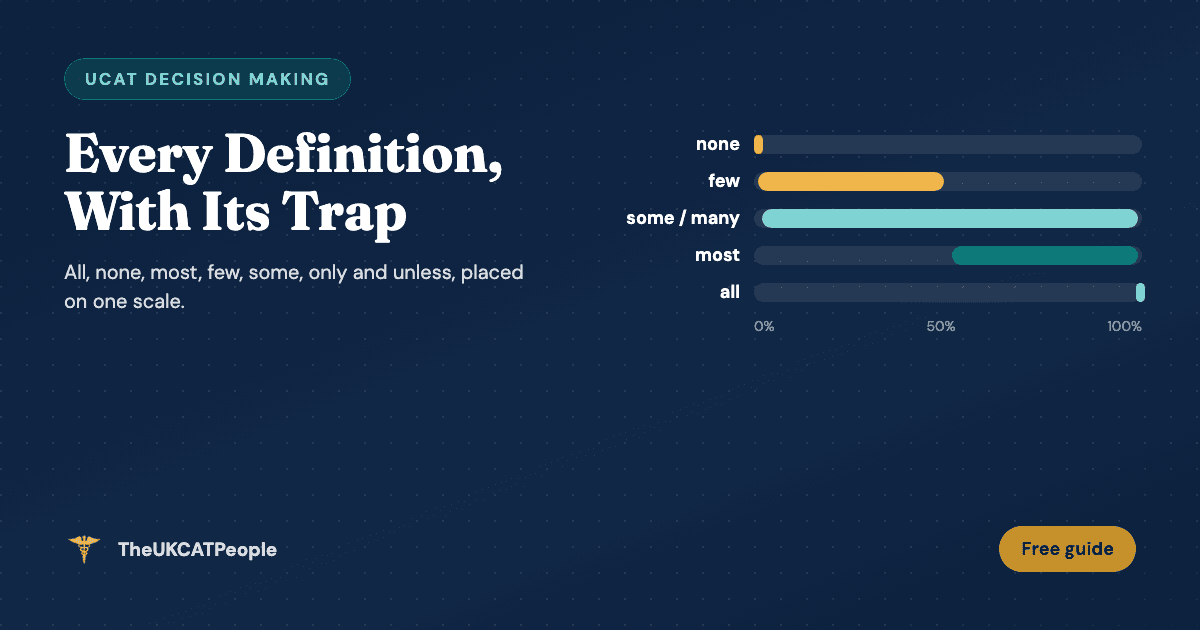
Almost every definition error is a student placing a word in the wrong part of the same 0 to 100 per cent scale. Rather than learning the words in groups, learn where each one sits on one line, and the overlaps that cause the confusion become visible instead of abstract.
Where every UCAT quantifier sits on one scale: none / no exactly 0% (exactly zero); few 1% to 49% (a minority); some / many more than one member, up to 99% (at least two, not all); not all 1% to 99% (as little as one); most / majority 51% to 99% (more than half); all exactly 100% (every one). Read the overlaps. Few and some share the whole lower half, so a "few" premise supports a "some" conclusion wherever more than one member qualifies, but never the reverse. Not all and few both reach further left than some, because a single member satisfies them and some needs more than one.
Three things the picture tells you that a list does not
These are categorical, meaning they hold in every case with no exceptions. They are the strongest claims available and, usefully, the only ones you can safely rearrange, provided you rearrange them correctly.
All A are B. Picture A as a circle drawn entirely inside a larger circle for B. This proves: Every A is a B. This does not follow: Every B is an A. A sits entirely inside B. B may be very much larger, so nothing at all follows about B in general.
No A are B. Picture A and B as two separate circles with no overlap. This proves: No A is a B, and no B is an A. This is the one premise type where the reverse comes free, because complete separation is symmetrical.
The reversal trap is the single most expensive error in Decision Making. "All surgeons are doctors" tells you nothing whatsoever about whether all doctors are surgeons, and most of them are not. Every time a statement swaps the two terms of an "all" premise, your default should be No unless a second premise supplies the reverse.
These three are relative: they compare a subgroup to half. They are useful precisely because they are bounded, and they are dangerous because students round them to the nearest absolute word under time pressure.
Premise says | Conclusion says | Verdict | Why |
|---|---|---|---|
Most A are B | Some A are B | Yes | A majority is more than one and less than all, which satisfies some |
Most A are B | All A are B | No | Most explicitly excludes all |
Most A are B | Few A are B | No | The ranges do not overlap |
Few A are B | Some A are B | Yes, where more than one A is a B | Few can be satisfied by a single A, and some needs more than one |
Few A are B | Most A are B | No | Few caps the group below half |
Most A are B | Not all A are B | Yes | Most excludes all, so at least one A is not a B |
This group makes the weakest claims, and weak claims are usually easier to support. From a mid-scale premise a conclusion using some is more often Yes than one using most, simply because there is less to prove. The exception is an "all" premise, which supports neither, because some and many both require at least one member outside the group.
A boundary worth getting exactly right. "Some tutors are examiners" does guarantee that at least one tutor is not an examiner, because the UCAT definition of some means less than all. What it does NOT guarantee is the statement "some tutors are not examiners", because that needs more than one tutor outside the group and the premise only guarantees one. There may well be more, but "may" is not "must". At least one: Yes. Some: No.
Aiming for a top-decile UCAT score?
These do not describe proportions. They describe structure: which condition depends on which. They are the hardest of the definitions and, conveniently, the ones that formal logic notation handles best.
Word | What it does | Worked reading |
|---|---|---|
Only A are B | Marks A as the necessary condition, reversing the English order | "Only prescribers sign the chart" means everyone who signs is a prescriber, not that every prescriber signs |
The only A are B | Behaves like all, in normal order | "The only staff on site are cleaners" means every member of staff on site is a cleaner |
A only if B | The whole phrase is the arrow. What follows it is required | "You may sit only if you have a ticket" means sitting requires a ticket |
A unless B | B is the only circumstance that makes A untrue. Negate the part before "unless" | "The clinic runs unless the lead is absent" means if the clinic did not run, the lead was absent |
Either A or B | Exactly one of the two, never both and never neither | Disprove it by finding a case that is both, or a case that is neither |
Both A and B | The two together | Disprove it by finding a case missing either one |
Neither A nor B | Not the one and not the other | Stronger than "not both", which still allows one of them |
At least n | n or more | "At least two" is satisfied by two, by five, or by all of them |
At most n | n or fewer, including none | "At most two" is satisfied by two, by one, and by zero |
The notation for only, the only, only if and unless, with the contrapositive of each and worked five-statement sets, is in the formal logic notation guide.
This is the skill the definitions exist to support, and it is the fastest single check I teach. Put the premise band and the conclusion band on the scale above, then ask one question: does the whole of the premise band sit inside the conclusion band? If it does, the conclusion is supported. If any part of the premise band falls outside, it is not.
That test is more reliable than the usual advice about "weakening" a claim, because it gets the top of the scale right, and the top of the scale is where most students go wrong.
The rule almost everybody has backwards: an "all" premise does not support a "some" or a "most" conclusion. Most means more than half BUT NOT ALL, and some means more than one BUT LESS THAN ALL. Both definitions positively exclude 100%. So if every A is a B, a conclusion that most A are B, or that some A are B, is No. This is one of the places where the UCAT definitions depart from ordinary English and from textbook logic, and it is worth reading twice.
Premise | Conclusion | Verdict | Why |
|---|---|---|---|
All A are B | Some A are B | No | Some requires at least one A outside B, and an "all" premise leaves none |
All A are B | Most A are B | No | Most excludes 100% by definition |
All A are B | At least one A is a B | Yes | "At least one" has no upper bound, so 100% sits inside it |
Most A are B | Some A are B | Yes | 51 to 99% sits inside "more than one, less than all" |
Most A are B | Not all A are B | Yes | Most excludes all, so at least one A is outside B |
Most A are B | All A are B | No | An upgrade. Most caps the group below 100% |
Some A are B | Most A are B | No | An upgrade. Some makes no claim about proportion |
Many A are B | Most A are B | No | Many carries no majority claim |
Few A are B | Not all A are B | Yes | Few caps the group below half, so at least one A is outside B |
Few A are B | Some A are B | Yes, where more than one A is a B | Few allows as few as one, and some needs more than one |
Not all A are B | Some A are not B | Yes, where more than one A is outside B | A single exception satisfies not all but not some |
Most A are B | Most B are A | No | A direction error rather than a strength error, and it is checked separately |
The definitions hold across the whole of Decision Making, but they bite differently depending on what the question is asking you to do. Knowing which job the word is doing saves you from checking the wrong thing.
Question type | What the definitions are used for | The usual failure |
|---|---|---|
Syllogisms | Judging whether a conclusion is guaranteed by abstract premises | Upgrading a quantifier, or reversing an "all" or "only" premise |
Interpreting information | Checking that a conclusion about text or data matches the strength of the evidence | Reading "most" off a chart where the data supports only "some" |
Logical puzzles | Turning constraints such as "at least two" and "neither" into placements | Treating "at most" as an exact figure and over-constraining the grid |
Strongest argument | Weighing how much an option actually claims | Preferring a sweeping option because it sounds decisive, when its strength is unsupported |
Each of those has its own method guide: syllogisms, interpreting information, logical puzzles and strongest argument questions.
This list is short enough to know cold, and knowing it cold is worth more than another week of untimed practice. The protocol below is what I set for students who are losing marks on definitions rather than on reasoning.
The third sitting is the one students skip and it is the one that matters. The point of memorising definitions is not to know them, it is to stop them costing marks, and only a marked, timed set tells you whether that has happened.
Eleven rapid statements, each built on a single misread word. Decide what is wrong before you read the verdict. These take about ten seconds each and they are the fastest diagnostic on this page.
Choose your 1-1 UCAT package
Rated 5.0 from 640+ reviews. 1-1 sessions with top-scoring tutors, weekly or more often, built around your weakest subtests.
10 hours
1-1 UCAT tutoring
20 hours
1-1 UCAT tutoring
30 hours
1-1 UCAT tutoring
Five sets in the exam format, each built to test the definitions rather than the reasoning. If you know the words, these are quick.
Most of the tutors at a centre have taught for over five years. Few of the tutors hold a teaching qualification. All of the tutors have an enhanced DBS check.
For each statement, decide whether it follows from the information given:
1. Some tutors have taught for over five years.
Answer: Yes. Most means a majority, which is more than one and less than all, so it supports some. This is a safe downgrade.
2. Most tutors hold a teaching qualification.
Answer: No. Few caps that group below half, and most requires more than half. The ranges do not overlap.
3. Not all tutors have taught for over five years.
Answer: Yes. Most excludes all, so at least one tutor has not, which is exactly what not all claims.
4. Some tutors do not have an enhanced DBS check.
Answer: No. All of them do, so this directly contradicts the premise.
5. At least one tutor holds a teaching qualification.
Answer: Yes. Few means a small number under half, but it is a positive claim, so at least one does.
Statements 1 and 3 are both downgrades of the same premise and both Yes. Getting comfortable with how many valid conclusions a single "most" premise supports is worth real marks.
Only members may borrow from the library. A book is not renewed unless it is returned on time. Each returned book is either shelved or repaired.
For each statement, decide whether it follows from the information given:
1. Everyone who borrows from the library is a member.
Answer: Yes. Only marks the necessary condition, so borrowing guarantees membership. This is the premise read in the correct direction.
2. Every member borrows from the library.
Answer: No. The reversal trap on only. Membership permits borrowing, it does not require it.
3. A book that was not returned on time has not been renewed.
Answer: Yes. Unless makes on-time return the requirement for renewal, so failing it rules renewal out.
4. A returned book that has been repaired has not been shelved.
Answer: Yes. Either in Decision Making means exactly one of the two, so repaired excludes shelved.
5. A book returned on time is renewed.
Answer: No. On-time return is required for renewal, not sufficient for it. This reverses the condition.
Statements 3 and 5 are the two directions of the same premise, and only one of them follows. If you find yourself accepting both, you have read "unless" as though it worked both ways.
A committee has ten members. Exactly one member abstained from the vote. At least two members voted in favour. Neither of the two co-chairs voted against.
For each statement, decide whether it follows from the information given:
1. Not all members voted.
Answer: Yes. One member abstained, and a single exception is enough to satisfy not all.
2. Some members did not vote.
Answer: No. Some requires more than one, and exactly one member abstained. This is the boundary where not all holds and some does not.
3. At least one member voted in favour.
Answer: Yes. At least two voted in favour, and at least two entails at least one.
4. Exactly two members voted in favour.
Answer: No. At least two means two or more, so the figure is not fixed at two.
5. Both co-chairs voted in favour.
From diagnostic to test day: a structured plan with 1-1 expert support at every stage.
Answer: No. Neither voted against, and only one member abstained in total, so at least one co-chair did vote in favour. The other could be the single abstainer, so both voting in favour does not follow.
This set is deliberately pedantic, because so is the mark scheme. Statement 2 in particular separates students who know the definitions from students who know roughly what the words mean.
All of the ward clerks have completed fire training. None of the ward clerks holds a clinical qualification. Every member of staff who holds a clinical qualification has completed fire training.
For each statement, decide whether it follows from the information given:
1. Everyone who has completed fire training is a ward clerk.
Answer: No. The reversal trap. Clinically qualified staff have completed it too, and the premise never limits fire training to clerks.
2. No one who holds a clinical qualification is a ward clerk.
Answer: Yes. A "no" premise reverses safely, because complete separation works in both directions.
3. Some ward clerks have not completed fire training.
Answer: No. All of them have, so this contradicts the premise directly.
4. Every member of staff has completed fire training.
Answer: No. Two groups are covered, ward clerks and the clinically qualified. Nothing is said about anyone else on the staff.
5. Someone who has not completed fire training does not hold a clinical qualification.
Answer: Yes. The contrapositive of the third premise: qualification guarantees training, so no training guarantees no qualification.
Statement 4 is the scope trap rather than a definition trap. Two "all" premises about two groups never combine into a claim about everybody.
Most of the practices in the region offer evening appointments. Few of the practices offer weekend appointments. Not all of the practices have on-site parking.
For each statement, decide whether it follows from the information given:
1. Some practices in the region offer evening appointments.
Answer: Yes. Most is a majority, which is more than one and less than all, so the downgrade to some is safe.
2. Most practices offer weekend appointments.
Answer: No. Few caps that group below half. Most requires more than half, and the two ranges cannot both hold.
3. At least one practice has on-site parking.
Answer: Yes. Not all means at least one does not and at least one does. Students who read not all as none mark this No, which is the trap the wording is built on.
4. All practices that offer weekend appointments also offer evening appointments.
Answer: No. Two separate proportions of the same population tell you nothing about the overlap between them.
5. Not all practices offer evening appointments.
Answer: Yes. Most excludes all, so at least one practice does not, which is exactly the not all claim.
Statement 4 is the overlap trap and it is worth dwelling on. Knowing what proportion of a group has property X and what proportion has property Y never tells you how the two properties are distributed across the same members.
Work these before you read the answers below the list. Retrieval beats rereading: if you can state each definition and its number range from memory, the words will stop costing you marks.
1. A premise states that few of the delegates are consultants. Does it follow that some of the delegates are consultants?
2. A premise states that many of the applicants hold a degree. Does it follow that most of them do?
3. What is the difference between "not all patients were seen" and "no patients were seen"?
4. "Only postgraduate students may use the study room." Does every postgraduate student use the study room?
5. A statement says each sample is either frozen or refrigerated. How would you disprove it?
6. What does "at most three" allow?
Answers
1. Yes in any realistic stimulus, with one caveat worth knowing. Few is a positive claim about a minority, so at least one delegate is a consultant. Strictly, some also needs more than one, and few can be satisfied by a single delegate, so the conclusion follows wherever more than one qualifies.
2. No. Many is defined as similar to some and carries no claim about a majority. This is an upgrade and is always No.
3. Not all means at least one was not seen and at least one was, anywhere from 1% to 99%. None means zero were seen. Not all is far weaker, and treating the two as equivalent is one of the commonest definition errors.
4. No. Plain only marks the necessary condition and reverses the English order: everyone using the room is a postgraduate, but postgraduates need not use it.
5. Find a sample that is both frozen and refrigerated, or one that is neither. In Decision Making, either means exactly one of the two, so both and neither are each enough to disprove it.
6. Three, two, one or none. The commonest slip is forgetting that at most includes zero.
Once the definitions are secure, the next gain is in how you apply them under time. Work through the syllogisms guide for the Venn method, the formal logic guide for conditional statements, and the 17 Decision Making tips for the section-level tactics. You can drill the words themselves on our free syllogism foundations trainer.
Key Takeaway: Learn where each word sits on one 0 to 100 per cent scale rather than as a list. None is zero and all is 100. Few is under half, most and majority are over half, and some and many sit anywhere between more than one and less than all while claiming nothing about proportion. Not all needs only a single exception, which is why it is weaker than some. Upgrading a claim is never safe, and downgrading is safe only in the middle of the scale: most supports some, but all supports neither most nor some, because both of those exclude 100%. Only, unless and either describe structure rather than proportion, so they are checked for direction instead.
They are the fixed meanings the UCAT gives to the logical words used in Decision Making, mainly in syllogisms. The core list is all, none, nothing, always, most, majority, few, some, many, not all, only, unless and either. Each has a narrower meaning than in everyday English: for example some means more than one but less than all, and few specifically means less than half.
Some means an undetermined number that is more than one but less than all. Both halves matter: at least two members of the group qualify, and at least one does not. It makes no claim about proportion, so it never supports a conclusion using most or majority. It does support many, because many is defined the same way. It is also stricter than some in standard formal logic, where some means at least one and can include all.
Few is a claim about proportion: a small number, less than half of the group. Some is not, and only tells you that more than one qualifies and at least one does not. A premise using few supports a conclusion using some wherever more than one member qualifies, because few can be satisfied by a single member and some cannot. A premise using some never supports a conclusion using few, because some is compatible with a majority.
Most means an undetermined but majority number, so more than half and less than all. Many is defined as similar to some and carries no majority claim at all. Upgrading many to most is one of the commonest wrong answers in Decision Making.
Not all means between 1% and 99%: at least one member of the group does not qualify, and at least one does. It is much weaker than none, which means zero. It is also weaker than some, because a single exception satisfies not all whereas some requires more than one.
Only introduces a necessary condition and indicates there is nothing else. "Only A are B" means everything that is B is an A, so it reverses the order of the English sentence. It does not mean that every A is a B. Note that "the only A are B" is different and behaves like all, keeping the normal order.
Either means exclusively one of two options, so A or B but not both. This is stricter than everyday speech, where either often leaves both open. To disprove a statement using either, find a case that is both or a case that is neither.
No, and this catches almost everybody. The UCAT defines some as more than one but less than all, so it positively excludes 100%. If every A is a B, there is no A left outside B, and a conclusion that some A are B is therefore No. The same applies to most, which means more than half but not all. From an "all" premise the only safe downgrade is "at least one".
Yes, and it is the highest-return memorisation in the whole test because the list is short and finite. A large proportion of Decision Making errors are vocabulary errors rather than reasoning errors, which means a student can reason perfectly and still lose marks by treating few as some or many as most.

Want expert UCAT tutoring?
From 1-1 UCAT tutoring to our intensive UCAT courses, we can take your prep further than free guides alone. Tell us your test date and where you are and we will recommend the right option.
Ultimate Package students from our 2025/26 cycle, with their UCAT scores and offers, who trained with us for the UCAT, personal statements and interviews.
“Harry got my UCAT up to 2,590, working through the sections I kept dropping marks on week by week. Gemma then ran my interview practice so the MMI stations didn't catch me out, and Dr Akash mentored me the whole way through. I'm off to King's for Medicine.”
“The interview prep was the part that actually moved the needle. Proper mock MMIs, not just lists of questions, and feedback that was honest about what I was getting wrong. I ended up with four offers and firmed UCL.”
“The Ultimate Package kept me organised from UCAT through to interviews. They knew what dental schools actually ask and tightened up my personal statement. Four offers in the end, and I'm going to Birmingham.”
“Vet applications come down to the written SAQs as much as the interview. Dr Rebecca went through my SAQs line by line, sharpened my answers and prepped me for the panels. I came away with four offers and chose the RVC.”
Book your FREE consultation today
Click to book your free consultation