“Harry got my UCAT up to 2,590, working through the sections I kept dropping marks on week by week. Gemma then ran my interview practice so the MMI stations didn't catch me out, and Dr Akash mentored me the whole way through. I'm off to King's for Medicine.”

Free work experience your students can do from school
A ready-made hand-out for your medicine, dentistry and veterinary applicants: the free, virtual work experience and online courses they can do from school, plus a printable reflection log. No placements, connections or budget required, and everything links to our existing free directories.
Written by Dr Akash Gandhi, NHS GP and founder of TheUKCATPeople. Updated 28 September 2026.
- 100% free for your cohort
- No placements or connections needed
- Virtual options schools respect
- Reflection log included
What is inside
- What counts as work experience now
- Free virtual programmes and the finder
- Free online courses (MOOCs) by subject
- Wider reading your cohort can follow
- A term-by-term enrichment plan
- A printable reflection log template
What your cohort gets, at a glance
- Observe GP from the Royal College of GPs and the Brighton and Sussex Medical School Virtual Work Experience are free, structured virtual programmes that students can complete from a classroom.
- The free Work Experience Finder searches any UK postcode for GP surgeries, hospitals, dental practices, care homes and hospices, with contact details and a ready-made request email.
- Three free MOOC directories cover medicine, dentistry and veterinary. Every listed course is free to access and no student needs to buy a certificate.
- Nothing on this page costs the school or the student anything. There is no account to create, no card to enter and no school licence.
- The printable reflection log has five columns: date, activity and setting, what the student did or saw, what they learned, and how it links to the course they are applying for.
- The enrichment plan runs in three phases, from Year 12 autumn through Year 12 spring and summer to Year 13 autumn, with no single large placement to organise.
For your school
Bring a doctor-led course into your school
One-day UCAT and interview courses for a whole cohort, in person at your school or live online, and priced per cohort.
UCAT course for schools
One intensive day covering every UCAT section, taught live by a doctor, with the strategy and timing each subtest needs.
Suits the summer term of Year 12, before students sit the test.
Interview course for schools
A live MMI circuit with real station rotation, panel practice, ethics and NHS hot topics, run by doctors and dentists, with feedback on the day and a debrief for you afterwards.
Suits the autumn of Year 13, before interview season.
What counts as work experience now
In-person placements are hard to get, but a strong profile does not depend on them alone. A few points you might share with your cohort before they start.
No placements or connections needed
Three kinds of experience, each with a free route
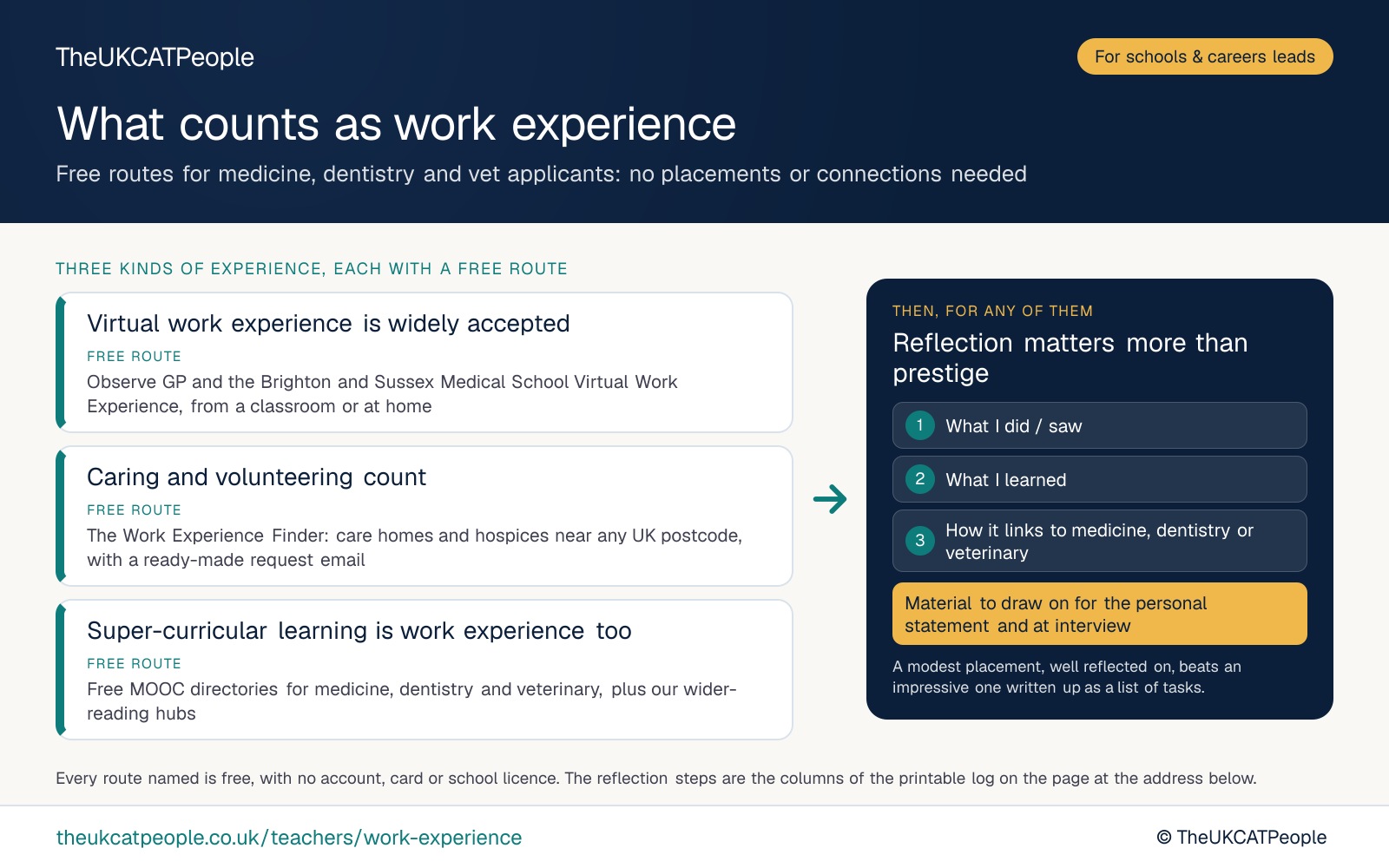
- Virtual work experience is widely acceptedFree route: Observe GP and the Brighton and Sussex Medical School Virtual Work Experience, from a classroom or at home
- Caring and volunteering countFree route: The Work Experience Finder: care homes and hospices near any UK postcode, with a ready-made request email
- Super-curricular learning is work experience tooFree route: Free MOOC directories for medicine, dentistry and veterinary, plus our wider-reading hubs
Then, for any of them
Reflection matters more than prestige
- 1What I did / saw
- 2What I learned
- 3How it links to medicine, dentistry or veterinary
Material to draw on for the personal statement and at interview
A modest placement, well reflected on, beats an impressive one written up as a list of tasks.

Use this chart
Free to use on school websites, in newsletters and in presentations, with a credit link to the page it comes from. The image carries our name and this page's address, so it stays credited wherever it goes.
Show the embed code
<a href="https://www.theukcatpeople.co.uk/teachers/work-experience"><img src="https://www.theukcatpeople.co.uk/teachers/work-experience/what-counts-as-work-experience.png" alt="Diagram by TheUKCATPeople: what counts as work experience for medicine, dentistry and veterinary applicants, with no placements or connections needed. Three kinds of experience each have a free route: virtual work experience (Observe GP and the Brighton and Sussex Medical School Virtual Work Experience, from a classroom or at home); caring and volunteering (The Work Experience Finder: care homes and hospices near any UK postcode, with a ready-made request email); and super-curricular learning (Free MOOC directories for medicine, dentistry and veterinary, plus our wider-reading hubs). Reflection matters more than prestige: whichever route a student takes, a reflection log of what they did or saw, what they learned and how it links to medicine, dentistry or veterinary gives them material to draw on for the personal statement and at interview." width="1600" height="1000" style="max-width:100%;height:auto" loading="lazy"></a> <p>Source: <a href="https://www.theukcatpeople.co.uk/teachers/work-experience">Free work experience your students can do from school</a>, TheUKCATPeople</p>
Virtual work experience is widely accepted
Structured online programmes made for aspiring medics, such as Observe GP from the Royal College of GPs and the Brighton and Sussex Medical School Virtual Work Experience, are widely accepted when in-person placements are hard to find. They are free and can be done from a classroom or at home.
Caring and volunteering count
A longer, regular commitment in a care home, hospice or community setting often teaches more about patient-facing work than a short shadowing day. It is also easier for students to arrange themselves.
Super-curricular learning is work experience too
Free online courses (MOOCs), wider reading and following current healthcare topics all show sustained interest. They give students something to reflect on, whatever placements they manage to get.
Reflection matters more than prestige
Selectors care more about what a student understood and how it changed their thinking than about where they went. A modest placement, well reflected on, beats an impressive one written up as a list of tasks.
Source for the access points above: our own free Work Experience Finder, which sets out the same guidance for students in detail.
Work experience students can do from a classroom
The well-regarded virtual programmes, and a free tool to find real placements. Some schools share these with the whole cohort so nobody is left with nothing to write about.
Free Work Experience Finder & map
Students search any UK postcode for GP surgeries, hospitals, dental practices, care homes and hospices to approach, with contact details and a ready-made request email. The page also points them to the free virtual programmes for when in-person shadowing is not possible.
Free MOOCs by subject
Filterable directories of free-to-access online courses, ready to set as super-curricular reading. Every course is free: students never need to pay for a certificate.
Free Medicine MOOCs directory
A filterable directory of free online courses for medicine applicants, from Harvard, Yale, the NHS and top UK universities. Filter by topic and length, with tips on how to reflect on a course instead of just listing it.
Free Dentistry MOOCs directory
The same idea for dentistry applicants: free, wider-reading online courses to build super-curricular depth around oral health, science and the profession.
Free Veterinary MOOCs directory
Free online courses for aspiring vets, covering animal health, biology and the realities of veterinary practice, ready to use as super-curricular reading.
Topics your cohort can follow between activities
Our free guide hubs give students something current to read, think and write about between activities, if you would like to share them.
UCAS & Applications
Free, regularly updated guides your students can read and reflect on.
NHS Hot Topics 2026
Free, regularly updated guides your students can read and reflect on.
UCAT & Universities
Free, regularly updated guides your students can read and reflect on.
Ethics for MMI Medicine Interviews
Free, regularly updated guides your students can read and reflect on.
A term-by-term enrichment plan
A simple outline to adapt for your own enrichment or super-curricular programme. It runs over two years, with no single big placement to organise.
Year 12, autumn
Start early and build the habit
- Introduce the reflection log and ask for one short entry a fortnight
- Point the cohort at one free virtual programme to complete together
- Set a first MOOC from the medicine, dentistry or veterinary directory
Year 12, spring and summer
Add real caring experience
- Use the Work Experience Finder to line up volunteering or a placement
- Encourage a regular caring commitment over a one-off shadowing day
- Keep one wider-reading or NHS hot-topic item going each month
Year 13, autumn
Turn experience into an application
- Review reflection logs before personal statements are drafted
- Map each activity to what it taught, ready to discuss at interview
- Signpost the free UCAT resources alongside admissions-test planning
Printable reflection log
One page a student fills in after each activity. Print it or copy it into a shared document; by Year 13 it is a ready list of things to write and talk about.
Work experience reflection log
Name:
| Date | Activity (and where) | What I did / saw | What I learned | How it links to medicine, dentistry or veterinary |
|---|---|---|---|---|
| Date for entry 1 | Activity (and where) for entry 1 | What I did / saw for entry 1 | What I learned for entry 1 | How it links to medicine, dentistry or veterinary for entry 1 |
| Date for entry 2 | Activity (and where) for entry 2 | What I did / saw for entry 2 | What I learned for entry 2 | How it links to medicine, dentistry or veterinary for entry 2 |
| Date for entry 3 | Activity (and where) for entry 3 | What I did / saw for entry 3 | What I learned for entry 3 | How it links to medicine, dentistry or veterinary for entry 3 |
| Date for entry 4 | Activity (and where) for entry 4 | What I did / saw for entry 4 | What I learned for entry 4 | How it links to medicine, dentistry or veterinary for entry 4 |
| Date for entry 5 | Activity (and where) for entry 5 | What I did / saw for entry 5 | What I learned for entry 5 | How it links to medicine, dentistry or veterinary for entry 5 |
| Date for entry 6 | Activity (and where) for entry 6 | What I did / saw for entry 6 | What I learned for entry 6 | How it links to medicine, dentistry or veterinary for entry 6 |
Tip for students: write your entry within a day or two of the activity, while it is fresh. Focus on what you learned and how it changed your thinking, not just what you did.
Careers-lead FAQs
Is virtual work experience good enough for a medicine application?
Yes. Structured virtual programmes made for aspiring medics, such as Observe GP from the Royal College of GPs and the Brighton and Sussex Medical School Virtual Work Experience, are well regarded and free. Medical schools know in-person placements are hard to get, and they look at what a student learned and how they reflected on it, whatever the format.
Where a student can arrange some real caring experience too, virtual work sits well alongside it. Either way, one reflection-log entry per activity.
How do we find placements for students without connections?
Our free Work Experience Finder lets a student search any UK postcode for GP surgeries, hospitals, dental practices, care homes and hospices near them, with contact details and a ready-made request email. No connections or paid placement are needed.
Suggest students contact several places, follow up politely after a couple of weeks, and start care-home volunteering or a virtual programme while they wait.
What can a whole cohort do together for free?
One approach is to set one free virtual programme and one free MOOC as a shared starting point, with a reflection-log entry from each student afterwards. The group then has something in common to discuss, and you have something to look at before personal statements.
The MOOC directories are filterable by topic and length, so you can pick a course that fits a single lesson or a half-term project.
How should students record and reflect on what they do?
A simple reflection log works well, and there is a printable one on this page. For each activity a student notes the date, what they did or saw, what they learned, and how it links to medicine, dentistry or veterinary study. Kept up, it gives them material to draw on for the personal statement and at interview.
A few lines written the day after an activity are usually more useful than a long description written months later.
Does this cost the school anything?
No. Everything linked from this page is free for your students to use, with no account, card or school licence required, so you can hand it to a whole cohort at once.
Everything here is free to hand to your students
Share this page with your medicine, dentistry and veterinary applicants, or bookmark it for your enrichment programme. Our team of NHS doctors, dentists and vets has supported 2,700+ students through their applications.
Reviewed by Dr Akash Gandhi · Last updated 28 September 2026