Interview Tutoring 10h
1-1 sessions
Reviewed by Dr Rebecca Massie, BVetMed MRCVS, Royal Veterinary College
Trusted UK veterinary medicine admissions specialists since 2012 · 2,700+ students taught
At a glance
Liverpool veterinary medicine interviews for 2027 entry are listed by the university as November 2026 to January 2027 (exact dates to be confirmed). The interview format is online, six pre-recorded questions.
Source: University of Liverpool official page, checked 18 September 2026. Universities can change interview dates, so confirm before you book travel.
The University of Liverpool is a public university based in the city of Liverpool, England. Founded as a college in 1881, it gained its Royal Charter in 1903 with the ability to award degrees and is also known to be one of the six original 'red brick' civic universities.
Liverpool is a great city to live in, with fantastic surrounding countryside and national parks, an internationally recognised institute with a fantastic range of on-campus facilities and the opportunity to take full advantage of all the student experience has to offer.
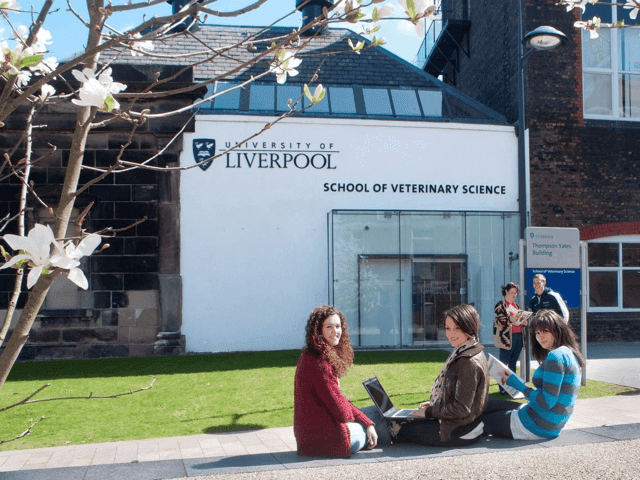
Years 1-3 are based at the Liverpool Campus in the city centre, and years 4-5 are at liverpool vet school leahurst campus on the Wirral Peninsula.
The year group size at Liverpool Vet School is approximately 165 students.
The equine department is particularly strong at Liverpool Vet School, so may have a certain appeal to those wishing to become an equine vet. Liverpool has been referred to as ‘the friendliest city in the UK’, and there are a huge number of student societies under the umbrella of the Guild of Students - from drum and bass to quidditch, astronomy to potholing, there is something for everyone! At Liverpool vet school leahurst you will have access to a wide range of facilities for you to enjoy.
We would highly recommend going to the Liverpool University Veterinary Medicine School open day to get a feel for how welcoming the city and university can be. There are also the Liverpool University Veterinary Society, Veterinary Zoological Society and others for those interested in different clinical areas.
Liverpool veterinary college's course is designed to create practical, compassionate and resilient veterinary surgeons and to equip graduates with the skills and qualities required to practice in the 21st century. The integrated spiral curriculum offers an innovative approach to teaching and learning, where subjects are revisited year on year with an increasing focus on clinical application as the course progresses, with some clinical work at liverpool veterinary hospital.
Professional and clinical skills are introduced from day one, encouraging students to engage with all aspects of veterinary science from the moment they begin the course. The curriculum provides opportunities to get involved with veterinary research, and to intercalate or study abroad. Completion of the university of liverpool school of veterinary science course enables registration as a Member of the Royal College of Veterinary Surgeons upon graduation. Students often spend time at liverpool veterinary hospital, where they undertake their clinical rotations.
Intercalation
Liverpool offer intercalation, and run a particularly innovative Veterinary Conservation Medicine BSc.
Liverpool Vet School employs an integrated, spiral curriculum that introduces clinical and professional skills from day one and revisits core subjects throughout the five-year program to deepen clinical application. Students develop practical abilities early on using state-of-the-art clinical skills labs and guided self-directed learning, building competence through feedback and reflection. In later years, the focus shifts to immersive clinical rotations at the Leahurst campus across small and large animals, including exotics, alongside opportunities for research projects, electives, and international exchanges.
Expert 1-1 support for your application
1-1 support from our admissions experts across every stage of your vet school application.
Interview Tutoring 10h
1-1 sessions
Interview Tutoring 20h
1-1 sessions
Vet Ultimate Package
Full application support
Universities revise entry requirements between cycles, usually in August and September. Always confirm with the university before you apply.
AAA including Biology (or Human Biology) and Chemistry. If Chemistry is not taken at A Level it must be taken at AS Level (grade B or above) and the second A Level must be another academic science-related subject. Where a science is taken at A Level (Chemistry, Biology, Geology or Physics) a pass in the science practical is required. The third A Level cannot be General Studies or Critical Thinking.
At least five GCSEs at grade 7 (A) including two science GCSEs (either as separate subjects or, e.g., dual award science), with at least a grade 6 (B) in English (Literature or Language) and Mathematics.
Still sitting your GCSEs? Protect the grades this course screens for with 1-1 GCSE Maths, Biology and Chemistry tutoring from medics.
36 Points to include grade 6 in higher level Biology, Chemistry and one other subject.
Grades BB in Biology and Chemistry Advanced Highers, in addition to five Highers at AAAAB grades including grades AA in Biology and Chemistry. AAABBB required in National 5 to include a minimum of grade B in English, Mathematics and two science subjects.
Upper second class (2.1) degree, and A levels in Biology and Chemistry (grades BB for BSc graduates; AA for BA graduates). W
(IELTS) test - an overall score of 7.0 or above with a minimum of 7.0 in each component.
Most useful
Unlike medicine and dentistry, Liverpool does not use the UCAT or any other written admissions test. Veterinary admissions instead turn on your hands-on animal and clinical work experience, your UCAS application and personal statement, and your interview.
Prepare for the interview with 1-1 vet school interview coaching, and compare entry requirements, fees and competition across every UK vet school in our UK vet schools guide.
A minimum of three weeks (15 days; 105 hours) of work experience within the last five years, across categories A, B and C: (A) veterinary practice; (B) the commercial animal industry with core species (cattle, sheep, horses, pigs, poultry, dogs, cats, rabbits); and (C) non-core species (e.g. zoo or wildlife placements) or a customer-facing role. At least one week must be from A or B. Applicants unable to secure a week in veterinary practice (category A) must also complete a virtual veterinary placement, such as the free Virtual Work Experience and Exploring the Veterinary Profession MOOC, in addition to the 15 days.
Liverpool do not use personal statements as part of their application process.
The University of Liverpool, in collaboration with local FE partners, has developed a Year Zero foundation programme for Home/EU students that leads to access onto a variety of vocational Health Studies programmes, including Veterinary Medicine.
Liverpool Vet School Gateway Course
The University of Liverpool BVSc interview is conducted online as an asynchronous, pre-recorded format rather than a live face-to-face event. Applicants answer six questions, each lasting four minutes, recording their responses as they would in a face-to-face interview.
Candidates are given a seven-day window in which to sit the interview at a convenient time, but once started it must be completed in one sitting (total time under an hour). Interviews take place between November and January (dates confirmed annually).
The interview assesses non-academic attributes, and post-interview selection is based on interview performance. Note: this online pre-recorded model replaced Liverpool's earlier live multiple mini interview (historically reported as around 9 stations of ~5 minutes); older third-party sources describing that live station format are out of date.
University of Liverpool Veterinary Science interviews for 2027 entry take place online between November 2026 and January 2027, with exact dates to be confirmed. Shortlisting is on the academic requirements and evidenced work experience, due by 23.59 on 29 October 2026.
The interview lasts no longer than an hour and consists of six pre-recorded questions of four minutes each, answered as if in a face to face interview. Applicants have a seven day window to sit it at a convenient time, but once started it must be finished in one sitting.
To be shortlisted for a liverpool vet school interview, applicants must meet Liverpool’s academic criteria and have declared their work experience on the online questionnaire.
Prepare with 1-1 vet school interview coaching and practise with our vet school interview questions guide.
Practise under timed conditions with our free generator. It builds a randomised circuit from real Liverpool interview themes, with follow-up questions and a notes summary you can keep. It opens preset to Liverpool's own interview format, and you can record your answers to watch them back.
Boost your vet school application
AAA including Biology (or Human Biology) and Chemistry. If Chemistry is not taken at A Level it must be taken at AS Level (grade B or above) and the second A Level must be another academic science-related subject. Where a science is taken at A Level (Chemistry, Biology, Geology or Physics) a pass in the science practical is required. The third A Level cannot be General Studies or Critical Thinking.
At least five GCSEs at grade 7 (A) including two science GCSEs (either as separate subjects or, e.g., dual award science), with at least a grade 6 (B) in English (Literature or Language) and Mathematics.
No, Liverpool does not require the UCAT for entry to Veterinary Medicine.
Yes, Liverpool interviews applicants for Veterinary Medicine.
The interview format is recorded as: Online recorded (six questions).
Liverpool uses a Online recorded (six questions) interview format for Veterinary Medicine interviews.
Yes. Our 1-1 veterinary medicine interview tutoring is online and your tutor is matched to Liverpool, so every mock runs in the interview format Liverpool uses (recorded as Online recorded (six questions)), with written feedback after each one.
We cover every UK vet school and last year our students were offered places at every one, including Liverpool.
Ten hours is £749 (£75 an hour) and includes the £349 Ultimate Q&A Guide free (300+ questions with model answers written by vets), plus WhatsApp support between sessions.
Book on the vet school interview coaching page at www.theukcatpeople.co.uk/vet-school-interview-coaching, or start with a single £125 mock: upgrade within 7 days of your feedback and the full £125 comes off any package.
The Veterinary Medicine interview at Liverpool covers motivation and insight into the profession, work experience and reflection, ethics and animal welfare, communication and professional skills and problem-solving and data interpretation.
University of Liverpool Veterinary Science interviews for 2027 entry take place online between November 2026 and January 2027, with exact dates to be confirmed. Shortlisting is on the academic requirements and evidenced work experience, due by 23.59 on 29 October 2026.
No, Liverpool does not formally score the personal statement for Veterinary Medicine applicants.
Liverpool do not use personal statements as part of their application process.
Yes, you need to be 18 to study Veterinary Medicine at Liverpool.
International students pay £44,850 per year for Veterinary Medicine at Liverpool.

Want expert help getting into Liverpool?
From admissions test prep and personal statement editing to interview coaching and our all-in-one Ultimate Package, we help applicants at every stage. Tell us where you are and we will recommend the right option.
Ultimate Package students from our 2025/26 cycle, with their UCAT scores and offers, who trained with us for the UCAT, personal statements and interviews.
“Harry got my UCAT up to 2,590, working through the sections I kept dropping marks on week by week. Gemma then ran my interview practice so the MMI stations didn't catch me out, and Dr Akash mentored me the whole way through. I'm off to King's for Medicine.”
“The interview prep was the part that actually moved the needle. Proper mock MMIs, not just lists of questions, and feedback that was honest about what I was getting wrong. I ended up with four offers and firmed UCL.”
“The Ultimate Package kept me organised from UCAT through to interviews. They knew what dental schools actually ask and tightened up my personal statement. Four offers in the end, and I'm going to Birmingham.”
“Vet applications come down to the written SAQs as much as the interview. Dr Rebecca went through my SAQs line by line, sharpened my answers and prepped me for the panels. I came away with four offers and chose the RVC.”
Book your FREE consultation today
Click to book your free consultation